

CVT Transmission in UAE Traffic: Care and Failure Signs

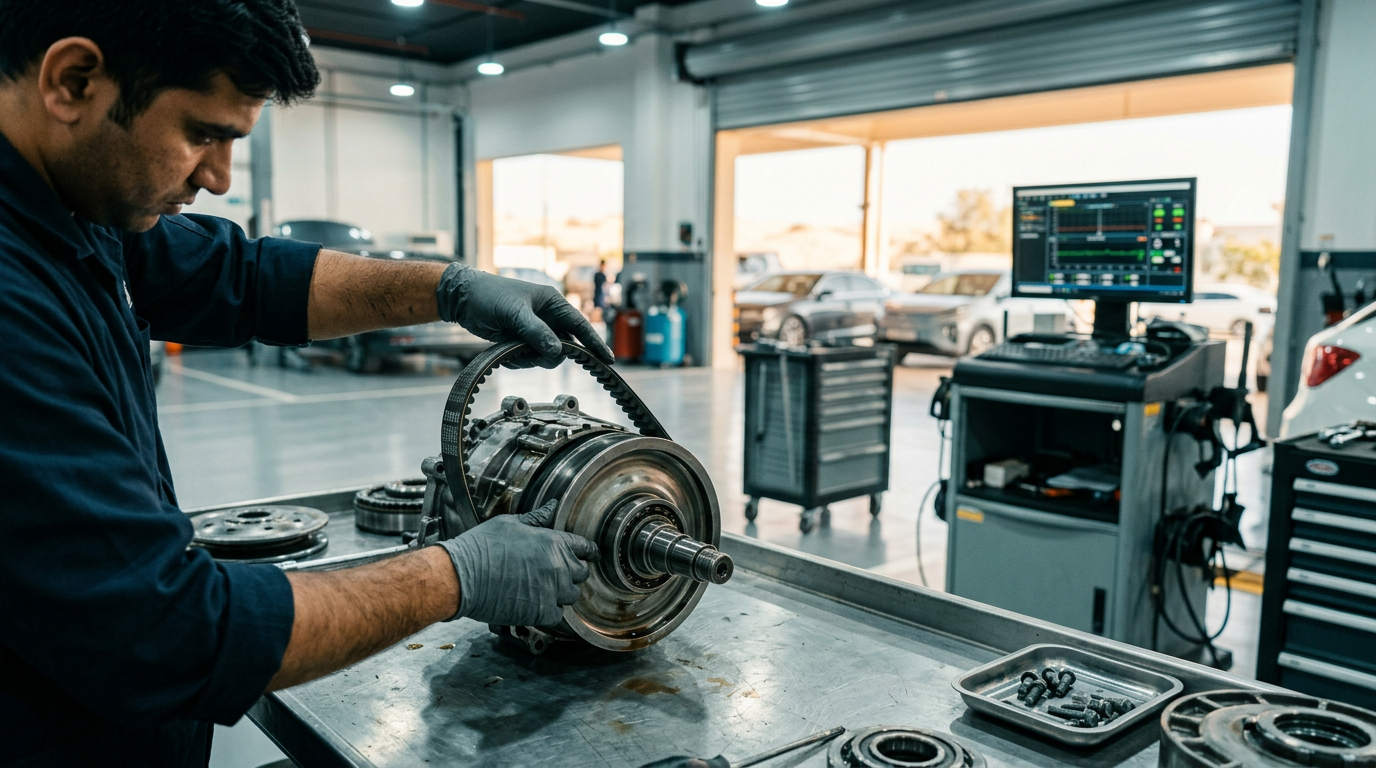
A continuously variable transmission (CVT) uses a belt or chain between two variable-diameter pulleys to deliver an infinite number of gear ratios, eliminating fixed gears for smoother acceleration and improved fuel efficiency. In UAE traffic, CVTs face unique stress from extreme heat, prolonged idling, and constant speed changes, making fluid condition and heat management critical to avoid judder, slipping, and premature belt or chain wear.
How a CVT Transmission Works
Unlike a traditional automatic transmission with fixed gears, a continuously variable transmission cvt changes the effective gear ratio seamlessly. Two cone-shaped pulleys—one connected to the engine, the other to the drive wheels—are linked by a steel belt or chain. As the pulleys change diameter, the belt moves up or down, altering the ratio continuously without discrete gear shifts.
This design delivers several advantages. Engine power stays in the optimal RPM range for efficiency, acceleration feels linear without shift shock, and fewer moving parts mean a simpler mechanical layout compared to planetary gearsets in conventional automatic transmissions. Nissan's Xtronic CVT, Audi's Multitronic (in older models), and systems in many hybrid vehicles all follow this basic principle, though belt construction and control software vary.
The variable ratio allows the engine to operate at the most efficient speed for any given vehicle speed. When you accelerate, the CVT holds engine RPM steady while the ratio changes, creating a characteristic sound some drivers find unusual—engine noise rises and stays constant rather than cycling through gears.
CVT vs Traditional Automatic Transmission
A conventional automatic transmission uses a torque converter and fixed gears—typically six to ten forward speeds in modern units. The transmission shifts between these gears, and you feel a slight jolt with each change. A CVT automatic transmission has no fixed gears, so there are no shifts to feel. The result is smoother power delivery and often better fuel economy, especially in city driving.
However, CVTs have limitations. They typically handle less torque than a robust planetary automatic, which is why high-performance and heavy-duty vehicles rarely use them. The belt or chain and pulley surfaces must withstand enormous clamping force, and heat buildup can degrade transmission fluid faster. In Dubai's stop-start traffic and summer temperatures reaching 50°C, this heat stress is amplified.
Traditional automatics also allow engine braking on downhill grades by locking a lower gear. CVTs simulate this through software, but the feel is less direct. For towing or spirited driving, a conventional automatic or dual-clutch transmission often provides more control and durability.
Common CVT Applications and Technologies
Nissan has been a major adopter of CVT technology, fitting Xtronic CVT units across the Altima, Maxima, Pathfinder, X-Trail, and many other models sold in the United States and globally. Early generations faced reliability concerns, but later Xtronic units improved fluid formulation and belt design.
Audi used the Multitronic CVT in front-wheel-drive models until the mid-2010s, when the company shifted to dual-clutch transmissions for performance reasons. Subaru employs a chain-type CVT in most of its lineup, including the Outback and Forester. Honda, Toyota (in non-hybrid models), and several other manufacturers also offer continuously variable transmissions in compact and mid-size vehicles.
Hybrid vehicles often pair a CVT-like system with electric motors. Toyota's Hybrid Synergy Drive uses a planetary gearset that functions as an electronic CVT, blending engine and motor power without a traditional belt or chain.
Failure Signs in UAE Driving Conditions
Dubai's climate and traffic patterns accelerate CVT wear. Prolonged idling in traffic heats transmission fluid without the cooling benefit of airflow. Short trips prevent the fluid from reaching optimal operating temperature, allowing moisture and contaminants to accumulate. Fine sand ingress through breather vents can contaminate fluid and score pulley surfaces.
Watch for these symptoms:
- Judder or shudder during acceleration: Felt as a vibration or hesitation when pulling away from a stop, often caused by worn belt or degraded fluid losing friction properties.
- Slipping or flare: Engine RPM rises without a corresponding increase in vehicle speed, indicating the belt is slipping on the pulley cones.
- Delayed engagement: A noticeable pause between selecting Drive and the transmission engaging, pointing to low fluid pressure or worn clutch packs (CVTs still use clutches for forward/reverse).
- Whining or grinding noise: High-pitched whine suggests belt wear or bearing failure; grinding indicates metal-to-metal contact inside the transmission.
- Overheating warning: Dashboard light or message indicating transmission temperature is too high, common in heavy traffic or towing beyond the CVT's design limit.
- Erratic ratio changes: The transmission hunts for the correct ratio or feels sluggish, often a sign of failing sensors or contaminated fluid affecting hydraulic control.
| Symptom | Most Likely Cause | Secondary Cause |
|---|---|---|
| Judder on take-off | Degraded CVT fluid | Worn belt surface |
| Slipping / RPM flare | Worn belt or chain | Low fluid level |
| Delayed engagement | Low fluid pressure | Worn forward clutch |
| Whining noise | Belt wear | Bearing failure |
| Overheating warning | Clogged cooler / heavy traffic | Failed temperature sensor |
| Erratic ratio control | Contaminated fluid | Faulty stepper motor / sensor |
Workshop Diagnosis and Testing
A qualified independent workshop uses manufacturer-grade diagnostic equipment to interrogate the transmission control module. Stored fault codes reveal sensor failures, pressure faults, and overheating events. Live data monitoring shows pulley position, line pressure, fluid temperature, and ratio command versus actual ratio—discrepancies indicate mechanical wear or hydraulic issues.
The technician will check transmission fluid condition: CVT fluid must meet exact specifications (Nissan NS-2, NS-3, or the vehicle's required grade). Fluid that smells burnt, appears dark, or contains metallic particles signals internal damage. A fluid level check is performed with the engine running and the transmission at operating temperature; even slightly low fluid causes slipping and overheating.
A road test under controlled conditions confirms symptoms. The technician monitors for judder during gentle acceleration, listens for abnormal noise, and checks how the CVT responds to throttle input. A scan tool logs data during the test drive, capturing transient faults that may not set a permanent code.
If internal damage is suspected, the workshop may perform a pressure test using a gauge connected to test ports on the transmission body. Low pressure points to a failing pump or internal leaks. In some cases, an inspection camera can be inserted through the drain or fill port to view belt condition without full disassembly, though this is less common for CVTs than for conventional automatics.
Typical Repair Procedures
Fluid and filter service: For judder or minor slipping caused by degraded fluid, a complete drain and refill with OEM-specification CVT fluid often restores smooth operation. Many CVTs do not have a traditional spin-on filter; instead, a mesh screen inside the pan is cleaned or replaced. The procedure includes torque-checking the pan bolts and resetting adaptation values via the scan tool so the transmission control module relearns the new fluid's characteristics.
Belt or chain replacement: When the belt shows wear or the transmission slips persistently, the unit must be removed from the vehicle and disassembled. The belt (or chain in Subaru and some Audi units) is replaced along with any worn pulleys or bearings. Pulley surfaces are inspected for scoring; if damaged, the entire pulley assembly is renewed. Reassembly requires precise shimming and calibration to ensure correct belt tension and pulley alignment. The transmission is then refilled with fresh fluid and bench-tested before reinstallation.
Valve body and solenoid replacement: Erratic ratio control or delayed engagement often traces to a faulty valve body or stepper motor. The transmission pan is removed, and the valve body—a complex assembly of passages, solenoids, and springs—is unbolted. Faulty solenoids are replaced individually if available, or the entire valve body is renewed. The mating surface is cleaned, a new gasket fitted, and torque specifications followed precisely to avoid leaks or warping.
Overhaul or replacement: Severe internal damage—worn pulleys, damaged bearings, or a broken belt—typically requires a full overhaul or replacement with a remanufactured unit. Overhaul involves complete disassembly, cleaning, measurement of all components, and replacement of any part outside specification. Given the precision required and the cost of parts, replacement with a factory-remanufactured CVT is often more economical and comes with a warranty on the unit itself.
Preventive Maintenance for UAE Conditions
CVT longevity in Dubai depends on regular fluid changes and avoiding behaviours that generate excess heat. Manufacturers often list CVT fluid as "lifetime," but in the UAE's extreme environment, changing fluid every 60,000 to 80,000 kilometres is prudent. Fresh fluid maintains the friction properties essential for belt grip and cools more effectively than degraded fluid.
Avoid aggressive driving and heavy towing. CVTs are designed for efficiency, not high torque loads. If you must tow, stay well below the vehicle's rated capacity and monitor transmission temperature. In stop-start traffic, shift to neutral at long red lights to reduce heat buildup, though modern CVTs manage this automatically to some extent.
Ensure the transmission cooler and radiator are clean. Fine sand and dust can clog cooling fins, reducing heat dissipation. During routine general maintenance, the workshop should inspect and clean the cooler. If your vehicle has a separate transmission cooler, consider an auxiliary unit for added protection in summer.
Address any engine issues promptly. A misfiring engine or faulty throttle sensor can confuse the CVT control module, causing erratic ratio changes and unnecessary wear. Similarly, worn engine mounts transmit vibration into the transmission, accelerating bearing and pulley wear.
Use diagnostic services to monitor transmission health. A scan every 20,000 kilometres or annually captures early fault codes and allows the technician to review adaptation values and fluid temperature trends. Catching a failing sensor or minor pressure issue early prevents a cascade failure that destroys the belt or pulleys.
CVT Reliability and Real-World Performance
Continuously variable transmissions have improved significantly over the past decade. Early Nissan Xtronic CVT units in the 2007–2012 generation suffered from premature failure, prompting extended warranties and software updates. Later models use stronger belts, better fluid, and refined control algorithms that reduce heat and wear.
In city driving, a well-maintained CVT delivers excellent fuel economy and a relaxed driving experience. The seamless power delivery suits commuting and light highway use. However, enthusiasts often prefer the tactile feedback of a conventional automatic or manual transmission, and CVTs can feel unresponsive during hard acceleration because engine RPM stays constant.
For Nissan owners in the UAE, the Xtronic CVT in the X-Trail and Altima has proven reliable when fluid is changed regularly and the vehicle is not subjected to heavy loads. Audi moved away from the Multitronic CVT in favour of dual-clutch units, reflecting a market preference for sportier transmission behaviour in premium vehicles.
Hybrid models from Toyota and Honda use CVT-type systems that benefit from electric motor assistance, reducing the load on the belt and extending service life. If you're considering a hybrid, hybrid car servicing in Dubai covers maintenance specifics and cost comparisons.
When to Seek Specialist Support
CVT diagnosis and repair require specific training and equipment. Generic scan tools may not access all transmission control module functions, and incorrect fluid or improper filling procedures can cause immediate damage. If you notice any of the symptoms listed above, schedule an inspection promptly. Continuing to drive with a slipping or overheating CVT risks catastrophic failure and a much higher repair bill.
Independent workshops with manufacturer-grade diagnostic tools can perform the same tests as a main dealer, often with shorter wait times and more transparent communication. Look for a facility experienced in transmission services and equipped to handle European and Japanese vehicles, as CVT designs vary by manufacturer.
Before committing to a major repair, request a detailed diagnosis report including fault codes, fluid condition, and live data logs. A reputable workshop will explain what each test revealed and provide options—fluid service, component replacement, or full overhaul—with realistic cost estimates for each. If you're purchasing a used vehicle with a CVT, a pre-purchase inspection should include a transmission health check to avoid inheriting an expensive problem.
For drivers of Volkswagen, Audi, or Nissan models fitted with CVTs, understanding how the system works and recognising early warning signs keeps your vehicle reliable and avoids the inconvenience of a breakdown in Dubai traffic. Regular fluid changes, gentle driving habits, and timely diagnostics are the pillars of CVT longevity in the UAE's demanding environment.
CVT Diagnosis and Repair in Al Quoz
If your vehicle shows judder, slipping, or overheating warnings, JAD Garage in Al Quoz 4 offers manufacturer-grade CVT diagnostics and transparent repair options. Call +971 56 355 6113 or visit Warehouse No.1, Street 8 to schedule an inspection.
Frequently asked questions