
Mercedes AIRMATIC Suspension Problems and Repair Options

Mercedes AIRMATIC suspension repair typically addresses compressor failure, air spring leaks, valve block malfunctions, or ride-height sensor faults. Symptoms include sagging corners, "AIRMATIC Visit Workshop" warnings, compressor noise, or uneven ride height. Repair costs in Dubai range from AED 1,500–3,000 for a single air spring to AED 8,000–15,000 for a complete compressor and strut overhaul, depending on the model and parts specification.
What Is Mercedes-Benz AIRMATIC Suspension?
AIRMATIC is Mercedes-Benz's adaptive air suspension system, introduced in 1999 and fitted to S-Class, E-Class, CLS, GL, GLE, GLS, and many AMG models. Instead of conventional coil springs, the system uses air springs at each corner, fed by an electric compressor and controlled by a valve block. An electronic control unit monitors ride height sensors, speed, steering angle, and body acceleration to adjust damping and ride height in real time.
The system offers multiple benefits: self-levelling under load, adjustable ride height for easier entry or off-road clearance, and adaptive damping that firms up during spirited driving or softens for motorway comfort. In Dubai's mix of smooth highways and speed-bump-heavy residential streets, AIRMATIC delivers a noticeably more compliant ride than steel springs—when it works correctly.
Common AIRMATIC Suspension Problems
Heat, age, and mileage all accelerate wear on AIRMATIC components. Dubai's ambient temperatures—regularly hitting 50°C in summer—cook rubber seals and stress electrical relays. Here are the failures most frequently seen on Mercedes-Benz models in the UAE:
Air Spring (Strut) Leaks
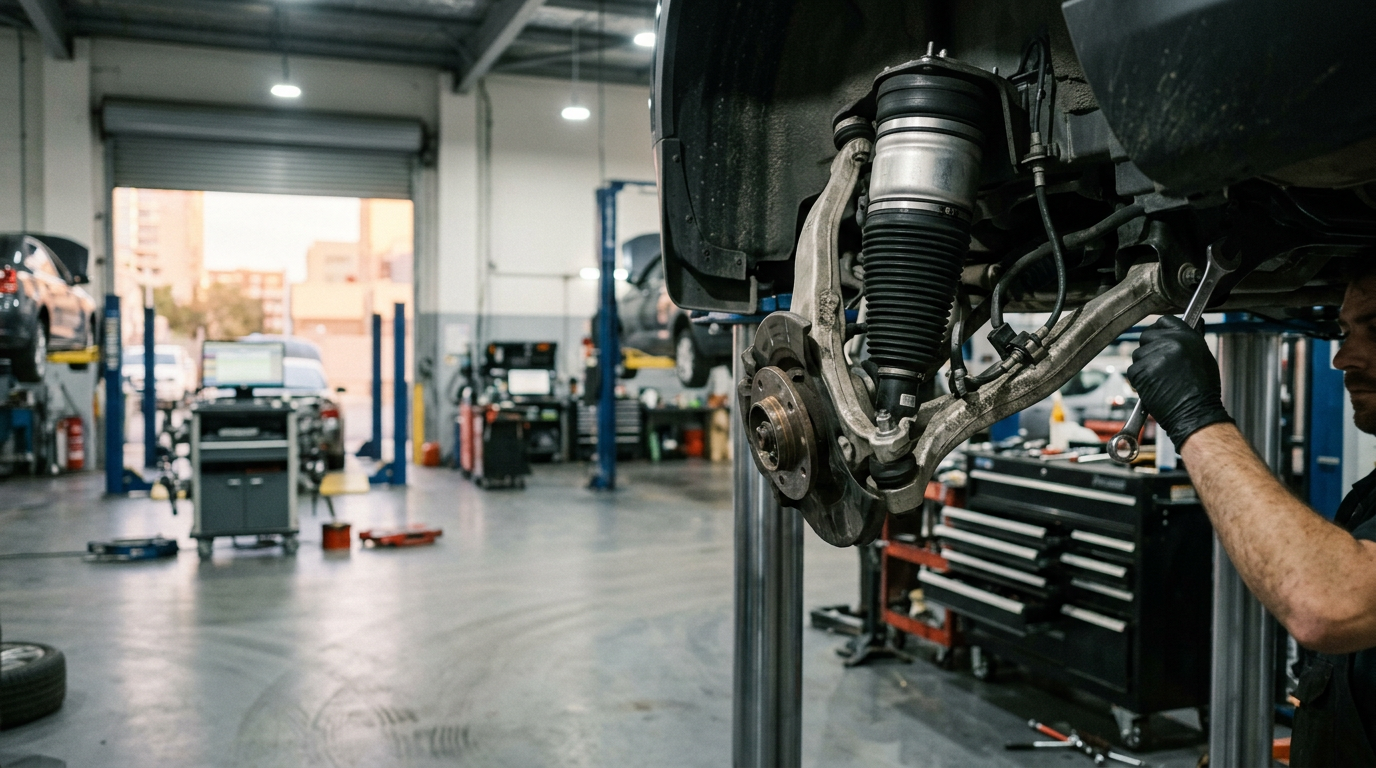
The rubber bellows inside each air spring perish over time, especially when exposed to fine sand and ozone. A small crack allows pressurised air to escape. You'll notice one corner sitting lower than the others after the car has been parked overnight. The compressor may run more frequently to compensate, and eventually the system will throw a fault code and drop into limp mode with a fixed, harsh ride.
Compressor Wear and Overheating
The air pump works hardest in stop-start city traffic and when compensating for a slow leak elsewhere in the system. Continuous cycling wears the piston seals and carbon brushes. An ageing compressor becomes noisy—often described as a loud humming or grinding from under the boot floor—and may overheat and shut down, leaving the car stuck at minimum ride height. In Dubai's heat, thermal cut-out is common if the compressor has been running excessively.
Valve Block Faults
The valve block distributes compressed air to each corner and vents air when lowering. Internal solenoid valves can stick or leak, causing one corner to sag independently or preventing the system from raising. Valve-block faults often trigger multiple fault codes and erratic ride-height behaviour that doesn't follow a simple "one corner low" pattern.
Ride-Height Sensors
Each corner has a linkage-mounted sensor that reports suspension travel to the control module. Plastic bushings crack, corroded connectors give intermittent signals, and the module misinterprets the car's posture. You may see the dashboard warning even when the suspension visually looks level, or the system may command maximum height and refuse to lower.
Relay and Wiring Issues
The compressor relay, usually located in the rear fuse box, is a known weak point on W221 S-Class and W164 ML/GL models. Repeated high current through a marginal contact causes the relay to fail closed or open, cutting power to the pump. Wiring to the valve block can also chafe where it passes through the chassis, especially on cars that have covered high mileage on rough roads.
Symptoms That Your AIRMATIC System Needs Attention
Recognising early warning signs can prevent a roadside breakdown and limit repair costs. Watch for these symptoms:
- "AIRMATIC Visit Workshop" or "Air Suspension Failure" message on the instrument cluster.
- One or more corners sagging noticeably lower, especially after the vehicle has been parked for several hours.
- Continuous or frequent compressor noise from the rear of the car, even when stationary.
- Harsh, jarring ride quality—the system has dropped into failsafe mode with no air pressure.
- Inability to raise or lower ride height using the dashboard control button.
- Uneven stance: front sits higher than rear, or one side leans visibly.
If you see any of these signs, a diagnostic scan will pinpoint which component has failed and whether multiple faults are present.
Diagnosing AIRMATIC Faults
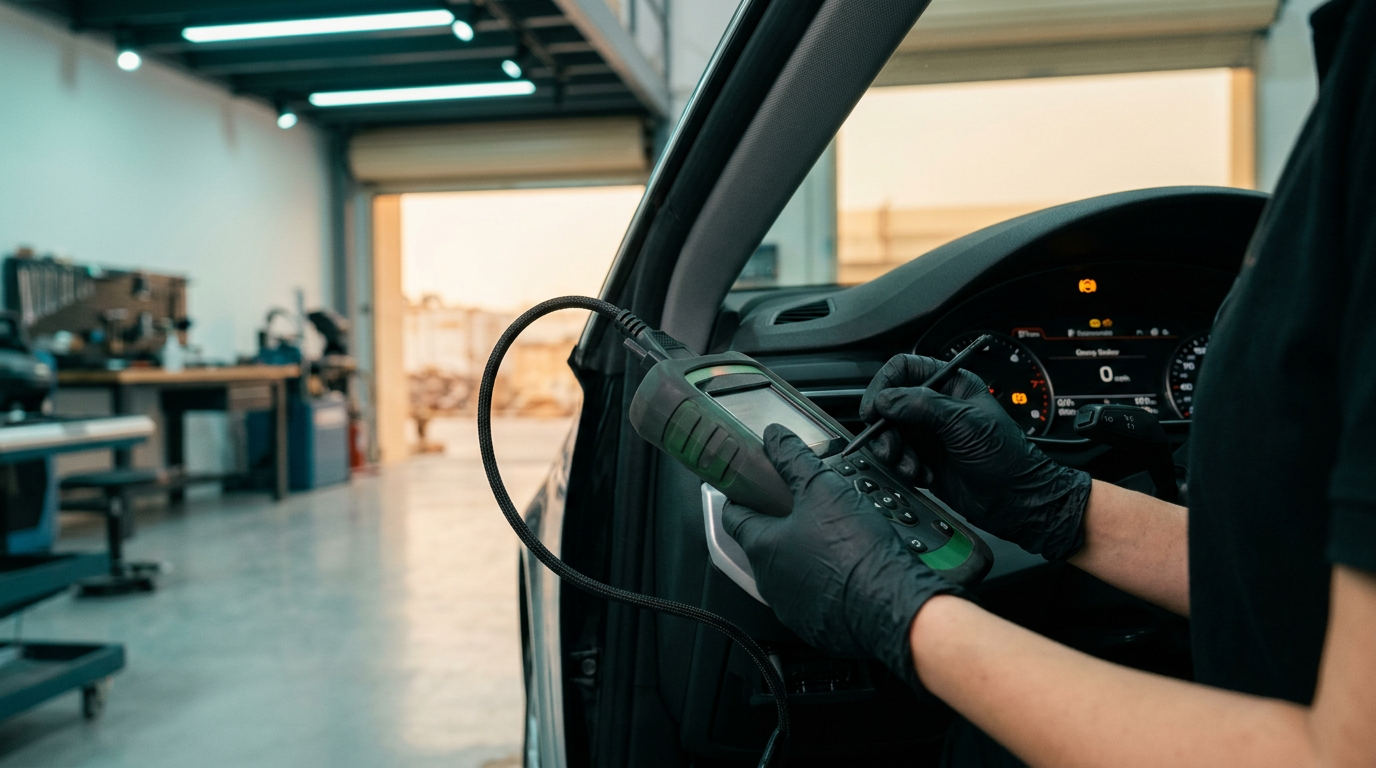
Accurate diagnosis requires manufacturer-grade scan tools—generic OBD readers typically cannot access the air-suspension control module or command individual corner tests. A proper AIRMATIC diagnostic session includes:
- Reading stored and pending fault codes from the suspension ECU.
- Live-data monitoring of each corner's pressure and ride-height sensor voltage.
- Actuating individual air springs and exhaust valves to isolate valve-block or strut faults.
- Compressor current draw and run-time analysis to assess pump health.
- Visual inspection of air lines, connectors, and strut bellows for cracks or corrosion.
In Dubai, fine sand can obscure small cracks in air lines, so a soapy-water leak test—spraying suspect joints and watching for bubbles—is often part of the process. Thermal imaging can also reveal a compressor that's running too hot.
Repair and Replacement Options
Single Component Replacement
If only one air spring has failed and the compressor is healthy, replacing that strut is the most economical approach. OEM Mercedes-Benz air springs are built by suppliers like Continental or Arnott and typically include a two-year warranty. Premium aftermarket alternatives from Arnott or Bilstein offer similar quality at a lower price point and are widely used in independent workshops.
Compressor replacement is straightforward on most models—the pump lives in a tray under the boot floor or behind the rear bumper. A new OEM compressor costs significantly more than a remanufactured unit, which replaces wear parts (seals, brushes, piston rings) and carries a one-year warranty.
Full System Overhaul
On higher-mileage S-Class, GL, or GLE models—especially those over eight years old or beyond 150,000 km—it often makes financial sense to replace all four air springs, the compressor, and the relay in one session. This prevents the frustration of fixing one corner only to have another fail three months later. A complete overhaul resets the system's service life and is particularly worthwhile if you plan to keep the car for several more years.
Coil-Spring Conversion Kits
Some owners, particularly of older W220 S-Class or W211 E-Class models, opt to remove AIRMATIC entirely and fit conventional coil springs and passive dampers. Conversion kits are available from Arnott and others. You lose ride-height adjustment and adaptive damping, but gain simplicity and eliminate recurring air-suspension costs. This route makes sense for high-mileage cars of modest value, but it's irreversible without significant expense and not recommended for AMG or newer models where AIRMATIC is deeply integrated into the vehicle's dynamic systems.
Typical Repair Costs in Dubai
Market prices for AIRMATIC suspension repair vary by model generation, parts specification, and workshop. Typical ranges across independent service centres in Dubai are:
| Component | Typical Range (AED) |
|---|---|
| Single air spring (OEM or premium aftermarket) | 1,500 – 3,000 |
| Air compressor (remanufactured or new) | 3,500 – 7,000 |
| Valve block | 2,500 – 5,000 |
| Ride-height sensor | 400 – 800 |
| Compressor relay | 150 – 300 |
| Complete four-corner overhaul (struts + compressor) | 8,000 – 15,000 |
Labour is usually included in these figures. Prices climb for AMG models with adaptive damping (ADS or ABC) or for cars requiring additional suspension and steering work such as control-arm bushings or alignment.
Can You DIY AIRMATIC Repairs?
Replacing an air spring is mechanically straightforward—remove the wheel, disconnect the air line and electrical connector, unbolt the top mount, and swap the strut. However, the system must be depressurised safely before you start, and you'll need a scan tool to clear fault codes and run a calibration routine once the new part is fitted. Without proper diagnostics, you risk misdiagnosing a valve-block fault as a strut leak and wasting money on the wrong part.
Compressor replacement requires accessing the boot floor or rear subframe, and on some models (W222 S-Class, X166 GL) that means removing trim panels and the spare-wheel well. The job is within the scope of an experienced home mechanic, but you'll still need a scan tool to verify the repair and ensure the system holds pressure.
For valve-block work or complex electrical faults, professional diagnostic services and electrical and electronics expertise are essential. Misdiagnosis is common, and AIRMATIC parts are too expensive to replace on guesswork.
Choosing a Specialist for AIRMATIC Suspension Repair in Dubai
Look for an independent workshop with manufacturer-grade diagnostic equipment—specifically Star Diagnosis (Xentry) for Mercedes-Benz, which can command individual valves and log live suspension data. The workshop should offer both OEM and quality aftermarket parts so you can choose the specification that fits your budget and ownership plans.
Ask whether the workshop has experience with your specific model generation—AIRMATIC architecture varies significantly between W220, W221, and W222 S-Class, for example, and between older hydraulic ABC systems and newer air-only setups. A pre-purchase inspection that includes an AIRMATIC health check is also worthwhile if you're considering a used Mercedes with air suspension, as latent faults can be expensive to rectify.
Finally, verify that the workshop provides a proper warranty on parts and labour. Reputable suppliers of remanufactured compressors and aftermarket air springs back their products with at least a one-year guarantee, and a professional installer will honour that coverage.
Preventive Care to Extend AIRMATIC Life
While AIRMATIC components do have finite service lives, you can maximise longevity with a few simple habits:
- Wash the underside of the car periodically to remove fine sand and salt, which accelerate rubber and metal corrosion.
- Avoid leaving the car parked for extended periods in direct sun at maximum ride height—lower it to normal or access mode to reduce stress on the air springs.
- Address any suspension warning lights promptly; a small air leak forces the compressor to overwork, shortening its life.
- During routine general maintenance, ask the technician to inspect air-line connections and strut bellows for early signs of cracking.
- Keep the rear load within the vehicle's rated capacity; chronic overloading strains the system and can damage the valve block.
Regular servicing at an independent specialist familiar with European marques—Audi, BMW, and Mercedes-Benz all use similar air-suspension architectures—ensures small issues are caught before they cascade into expensive failures.
AIRMATIC Suspension Repair in Al Quoz
JAD Garage in Al Quoz 4 uses manufacturer-grade diagnostics to pinpoint AIRMATIC faults and offers both OEM and premium aftermarket repair solutions for all Mercedes-Benz models. Call +971 56 355 6113 or visit us Monday to Saturday, 09:00–19:00.
Frequently asked questions