
Range Rover Air Suspension Failure: Symptoms, Repair and Cost

Range Rover air suspension failure typically shows as uneven ride height, warning lights, compressor noise, or a sagging corner. Repair involves diagnosing whether the fault lies in air springs, compressor, valve block, or sensors, then replacing failed components. Dubai market costs range from AED 1,500–3,000 per air spring, AED 2,500–4,500 for a compressor, and AED 800–1,500 for height sensors.
How Range Rover Air Suspension Works
Land Rover Range Rover models from the L322 series (2002–2012) through to the current L405 and Range Rover Sport L494 use electronically controlled air suspension. Four air springs replace traditional coil springs, inflated or deflated by an electric compressor to adjust ride height. A valve block directs air to each corner, while height sensors at each wheel feed data to the suspension ECU.
The system offers multiple ride heights: access mode for entry, normal for everyday driving, off-road for clearance, and extended for motorway cruising. In Dubai's stop-start traffic and summer heat—often exceeding 50°C—the compressor works harder and rubber seals age faster, accelerating wear on air springs and valve seals.
Common Symptoms of Air Suspension Failure
Early recognition saves both money and secondary damage. Watch for these signs:
- Uneven stance: One or two corners sit lower than the others, especially after the car has been parked overnight.
- Suspension fault warning: Amber or red suspension message on the dashboard, sometimes accompanied by a restricted ride-height message.
- Compressor running constantly: You hear the pump cycling frequently or continuously, trying to maintain pressure.
- Harsh or bouncy ride: Loss of the characteristic Range Rover cushioned feel, indicating a deflated air spring or failed damper.
- Inability to raise or lower: The system won't switch between access, normal, and off-road heights.
- Hissing sound: Air leaking from a perished spring or valve seal, most noticeable when parked.
Dubai's fine dust can clog air-spring dust boots and accelerate seal wear, while prolonged exposure to heat degrades the rubber bladders inside the air springs faster than in temperate climates.
Which Components Fail and Why
Air Springs (Struts)
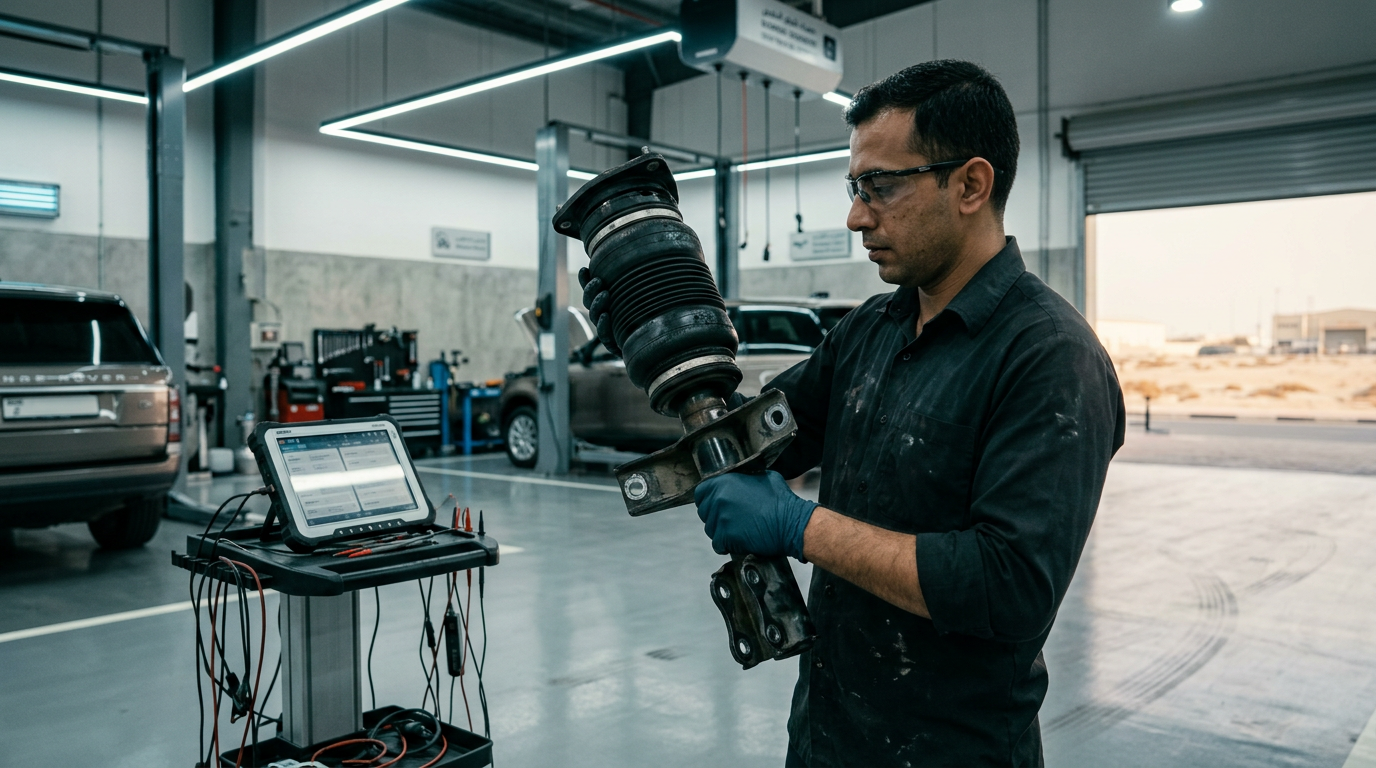
The air spring itself is a reinforced rubber bellows that flexes thousands of times. Heat and ozone cause the rubber to crack, typically at the folds. On the Range Rover Sport and full-size Range Rover, rear air springs often fail first due to higher load and dust ingress around the axle. Lifespan in Dubai is typically 60,000–100,000 km, shorter than the 120,000–150,000 km seen in cooler climates.
Compressor and Relay
The compressor pumps air into a reservoir tank. Continuous cycling to compensate for a leak overheats the motor and burns out the piston seals. The compressor relay can also fail, leaving the pump inoperative. Expect compressor life of 80,000–120,000 km under normal conditions, less if the system has been leaking unnoticed.
Valve Block
The valve block sits under the car and routes air to each spring. Internal solenoid valves can stick or leak, causing one corner to drop or preventing height changes. Corrosion from humidity and road salt (used occasionally on UAE mountain roads) can seep into connectors.
Height Sensors
Each corner has a ride-height sensor—a small linkage connecting the suspension arm to the body. Plastic bushings wear, connections corrode, or the sensor itself drifts out of calibration. A faulty sensor sends incorrect data, triggering fault codes and disabling automatic leveling.
Air Lines and Fittings
Plastic air lines can crack at fittings, especially where they pass through the chassis and flex with suspension travel. Less common than spring or compressor failure, but a source of slow leaks.
Diagnosing the Fault
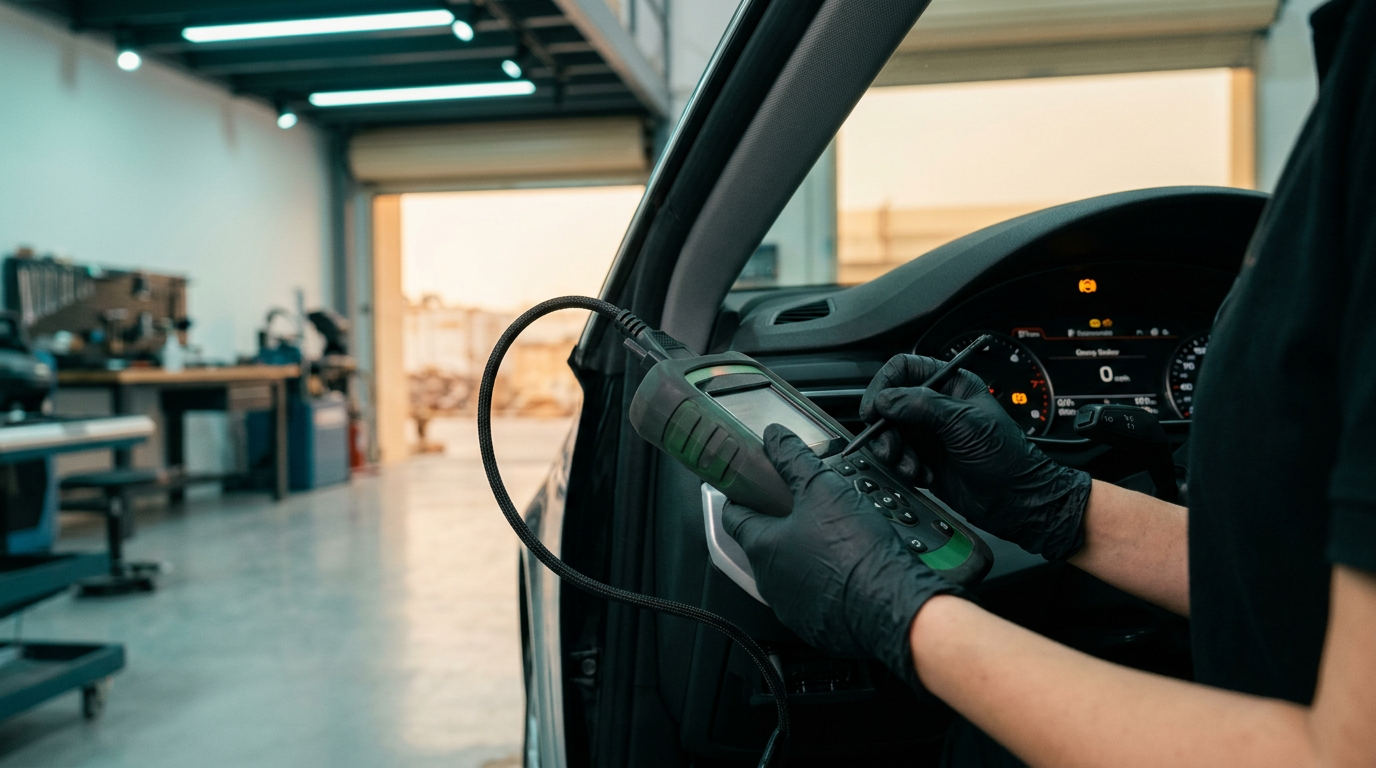
Proper diagnosis requires manufacturer-grade scan tools that read live suspension data: individual corner heights, compressor duty cycle, valve commands, and stored fault codes. Visual inspection reveals cracked air springs, oil leaking from dampers, or corroded connectors. A soapy-water spray test can pinpoint air leaks at springs and valve-block fittings.
Specialists experienced with Land Rover and Range Rover systems will also check the compressor intake filter, reservoir tank pressure, and calibrate height sensors after any component replacement. Skipping calibration leaves the system hunting for the correct ride height and triggers nuisance warnings.
Repair Options: OEM vs Aftermarket Parts
Original Land Rover air springs and compressors offer guaranteed fit and durability but command a premium. Aftermarket brands—Arnott, Dunlop (OEM supplier for some models), Bilstein, and others—provide quality alternatives at 30–50% lower cost. For older L322 and early L405 models, aftermarket parts have a proven track record.
Some owners consider converting to traditional coil springs, eliminating the air system entirely. Conversion kits exist for most Range Rover and Range Rover Sport generations. While this removes the risk of future air-suspension failures, you lose adjustable ride height, load leveling, and off-road capability. Resale value may also suffer, as buyers expect the original air suspension on luxury SUVs.
For specialist suspension and steering work, experienced technicians will discuss both repair and conversion options based on your budget and how you use the vehicle.
Step-by-Step Repair Process
- Diagnostic scan: Read fault codes and live data to isolate the failed component.
- Lift and secure: Raise the vehicle on a lift, ensuring the suspension is at normal height or manually deflated via the scan tool.
- Remove wheel and arch liner: Access the top mount (inside the wheel arch or engine bay) and lower air-line connection.
- Disconnect air line: Release the push-fit connector and electrical plug (if the strut includes an integrated damper sensor).
- Unbolt the strut: Remove top mount nuts and lower mounting bolt, then withdraw the air spring/damper assembly.
- Fit new component: Install the replacement air spring, torque bolts to specification, reconnect air line and electrics.
- Calibrate and test: Use the scan tool to calibrate ride-height sensors, cycle through all height modes, and clear fault codes.
- Road test: Verify smooth operation, correct ride height at all settings, and no warning lights.
Compressor replacement involves accessing the unit (often under the driver's side or in the rear quarter panel), disconnecting air lines and electrical connectors, and bolting in the new pump. Valve-block replacement is more involved, requiring the vehicle to be raised and multiple air lines disconnected.
Typical Repair Costs in Dubai
Market prices for Range Rover air suspension parts and labor in Dubai typically fall into these ranges:
- Single air spring (front or rear): AED 1,500–3,000 including labor, depending on model year and part brand.
- Compressor: AED 2,500–4,500 including fitting and calibration.
- Valve block: AED 2,000–3,500 including labor.
- Height sensor: AED 800–1,500 per corner, including calibration.
- Full four-corner air-spring replacement: AED 5,000–9,000, often recommended if one or two have already failed and the car has over 80,000 km.
Costs vary by model: the Range Rover Sport shares many components with the full-size Range Rover, but the older L322 series and the newer L460 (2022+) have different part numbers and labor times. Always request a detailed quote after diagnosis. For context on broader service expenses, see our Range Rover service cost breakdown by model.
Preventing Premature Air Suspension Failure
While air suspension will eventually wear, you can extend its life:
- Avoid extended off-road height on tarmac: Running in off-road mode on the highway over-extends the air springs and stresses seals.
- Clean wheel arches regularly: Fine sand and dust accumulate around the air-spring boots; periodic washing reduces abrasion.
- Address leaks immediately: A small leak forces the compressor to run continuously, shortening its life and masking additional faults.
- Park in shade when possible: Reducing direct sun exposure on rubber components slows degradation in Dubai's intense UV.
- Service the compressor intake filter: A clogged filter starves the pump of air, increasing motor load and heat.
Include air-suspension health checks in your regular service intervals. For comprehensive maintenance guidance, review our article on Range Rover common problems in Dubai and how to prevent them.
DIY vs Professional Repair
Replacing an air spring is mechanically straightforward—unbolt, disconnect, fit new, reconnect—but requires a scan tool to calibrate height sensors and clear fault codes. Without calibration, the system will throw errors or sit at the wrong height. Compressor and valve-block jobs add complexity: air-line routing, electrical connectors with multiple pins, and the need to bleed the system.
DIY kits are available online, often bundled with basic instructions. However, misdiagnosis is common: replacing all four air springs when the real fault is a leaking valve block wastes money and time. Professional diagnostic services with Land Rover–specific scan tools pinpoint the exact failure, saving you from trial-and-error parts swapping.
For owners of high-value or complex models like the Range Rover Sport Supercharged or the latest plug-in hybrid variants, specialist knowledge of integrated systems—active anti-roll bars, adaptive dampers, and hybrid battery placement—is essential. Incorrect procedures can trigger additional faults or even safety issues.
Air Suspension in Other Luxury SUVs
Air suspension isn't unique to Land Rover. The Mercedes-Benz GLE and GLS, Audi Q7 and Q8, Porsche Cayenne, and Jeep Grand Cherokee (in higher trims) all use similar technology. Failure modes and repair costs are comparable, though part numbers and calibration procedures differ. If you're cross-shopping or own multiple luxury SUVs, the maintenance principles and cost structures are similar across brands.
When to Consider Coil Conversion
Coil-spring conversion makes sense if:
- Your Range Rover has already suffered multiple air-suspension failures.
- You rarely use off-road modes or adjustable ride height.
- You plan to keep the car long-term and want to eliminate a known wear item.
- Budget is tight and a second compressor replacement isn't feasible.
Conversion kits typically cost AED 3,000–5,000 fitted and include four coil springs, dampers, and any necessary mounting hardware. Ride quality remains comfortable, though you lose the signature Range Rover ability to raise or lower on demand. For buyers in the used market, a well-executed coil conversion is often preferred over a car with failing or patched air suspension.
Finding a Qualified Repair Specialist in Dubai
Range Rover air suspension repair demands specific diagnostic software, experience with the valve-block and compressor locations (which vary by model year), and access to quality replacement parts. Look for workshops that:
- Carry manufacturer-grade scan tools for Land Rover and Jaguar (often shared platforms).
- Stock or can quickly source both OEM and proven aftermarket air-suspension components.
- Offer transparent diagnostics—itemized fault codes and live data—before quoting repair.
- Provide warranty on parts and labor, typically 6–12 months for suspension components.
Independent specialists focusing on luxury car repair and maintenance often combine deep brand knowledge with more flexible pricing than main-dealer networks. For additional peace of mind, a pre-purchase inspection on any used Range Rover should include a full air-suspension function test and fault-code scan.
Real-World Example: Range Rover Sport L494 (2014–2022)
The Range Rover Sport L494 is popular in Dubai, and rear air springs commonly fail between 70,000 and 90,000 km. Symptoms start with a slightly lower rear end after overnight parking, progressing to a permanent sag and suspension warning. Left unaddressed, the compressor runs continuously, overheats, and fails within weeks. Total repair cost for both rear air springs and a new compressor can reach AED 8,000–10,000 if tackled late. Catching the initial air-spring leak early and replacing just the two rear springs costs AED 3,000–4,500, avoiding compressor damage entirely.
Range Rover Air Suspension Repair in Al Quoz
JAD Garage in Al Quoz 4 specializes in Land Rover and Range Rover air suspension diagnosis and repair, using manufacturer-grade diagnostic tools and OEM or premium aftermarket parts. Call +971 56 355 6113 or visit us Monday to Saturday, 09:00–19:00, for a transparent diagnostic scan and repair quote.
Frequently asked questions