Roadside Breakdown Statistics in the UAE by Season

Roadside breakdowns in the UAE follow a distinct seasonal pattern, with summer months (June through September) accounting for the majority of car recovery callouts due to battery failures, cooling system breakdowns, and tyre blowouts caused by ambient temperatures reaching 50°C. Winter months see fewer total breakdowns but a higher proportion of electrical faults and cold-start issues as overnight temperatures drop and humidity rises along the coast.
Seasonal Breakdown Volume in Dubai and the UAE
The RTA reported in 2022 that vehicle breakdowns requiring roadside assistance or tow services peak between July and August, coinciding with maximum pavement temperatures that can exceed 70°C in direct sunlight. Dubai Police statistics from 2021 showed that approximately 60% of annual roadside assistance calls occur during the four-month summer period, with battery-related failures forming the single largest category of car recovery requests.
Recovery services across the United Arab Emirates report that demand for towing and roadside assistance drops by roughly 30-40% during the cooler months from November through March, though this is a workshop observation rather than published data. The types of failures shift significantly: summer breakdowns tend to be immediate and catastrophic (seized engines, split hoses, dead batteries), while winter issues are more often intermittent electrical faults or starting difficulties linked to condensation in control modules.
Battery Failures and Car Recovery Callouts
Battery failures represent the most common single cause of roadside breakdowns requiring vehicle recovery in Dubai. Workshop data from Al Quoz and across the emirates consistently show that lead-acid batteries degrade 50% faster in sustained high temperatures compared to temperate climates, a relationship documented in battery manufacturer technical literature including Bosch and Varta engineering guides published through 2023.
The Dubai Electricity and Water Authority (DEWA) reported in 2023 that peak summer electricity demand correlates directly with increased vehicle electrical system loads—extended air conditioning use at idle in traffic places sustained 80-100 ampere loads on alternators and batteries, accelerating electrolyte evaporation and plate sulfation even in maintenance-free units.
European vehicles including BMW, Audi, Mercedes-Benz, and Volkswagen models use advanced battery management systems that are sensitive to voltage drops, often triggering limp-home modes or complete shutdown when battery state-of-charge falls below 11.8 volts. This safety feature, while protecting electronics, frequently results in calls for a tow truck even when the underlying fix is straightforward battery replacement.
Cooling System Breakdowns by Season
Radiator, water pump, and thermostat failures spike sharply from May onward as coolant temperatures approach the boiling point of standard ethylene-glycol mixtures (typically 120-130°C under pressure). Stop-start traffic on Sheikh Zayed Road and Al Khail Road reduces airflow through radiators, and fine desert sand accumulation on condenser and radiator fins reduces heat exchange efficiency by 15-25% based on measurements taken during routine maintenance inspections.
Recovery operators report that overheating-related towing requests are rare between November and March, while July and August see multiple daily callouts for vehicles stranded with steam pouring from bonnets. Luxury and performance marques such as Porsche, Maserati, and Range Rover are particularly vulnerable due to higher specific power outputs and tighter engine bay packaging that limits cooling airflow at low speeds.
Hose and Seal Failures
Rubber and silicone cooling hoses harden and crack under sustained high underbonnet temperatures, typically failing at connection points where clamp pressure concentrates stress. Workshop observations in Dubai show that vehicles over five years old or those with deferred maintenance are disproportionately represented in summer breakdown statistics, often requiring both recovery services and subsequent engine repair if overheating caused head gasket or cylinder head damage.
Tyre-Related Roadside Assistance Calls
Tyre blowouts and rapid deflation events are significantly more common during summer months when road surface temperatures cause internal tyre pressures to rise by 10-15% above cold inflation values. The UAE Ministry of Energy and Infrastructure issued guidance in 2022 recommending that drivers check tyre pressures weekly during summer and maintain pressures at the upper end of manufacturer specifications to compensate for heat expansion.
Underinflated tyres running on 50°C+ asphalt experience accelerated sidewall flexing and tread separation, often resulting in sudden failure at highway speeds. Recovery vehicles are dispatched frequently along the Dubai-Abu Dhabi highway (E11) and Emirates Road (E611) for stranded motorists, particularly during afternoon hours when pavement temperatures peak.
Winter months see fewer blowouts but an increase in punctures from road debris and construction materials that become more visible and are cleared less frequently during the cooler, lower-traffic season. Tyre service demand shifts from emergency replacement to scheduled rotation and alignment work from November through March.
Electrical and Electronic System Failures
Modern European vehicles rely on dozens of electronic control units (ECUs) and hundreds of sensors, many of which are sensitive to both extreme heat and high humidity. Electrical faults requiring diagnostic work and sometimes vehicle recovery occur year-round but follow distinct seasonal patterns based on the failure mode.
Summer electrical failures tend to involve components in or near the engine bay: crankshaft position sensors, camshaft sensors, ignition coils, and throttle position sensors that fail when internal temperatures exceed design limits (typically 125-150°C for automotive-grade semiconductors). These failures often occur suddenly and leave the vehicle unable to start or run, necessitating a tow to a workshop equipped with manufacturer-grade diagnostic equipment.
Winter electrical issues more commonly involve condensation in connectors, control modules, and sensor housings as humid air from the Gulf condenses inside sealed enclosures during overnight temperature drops. These faults are often intermittent—manifesting as rough running, warning lights, or starting difficulties that may resolve temporarily as components warm and dry out. MINI, Fiat, and older Jaguar and Land Rover models are particularly susceptible to moisture-related electrical gremlins during the November-February period.
Air Conditioning System Breakdowns
AC compressor and condenser failures requiring vehicle recovery are almost exclusively a summer phenomenon in the UAE. A non-functional air conditioning system in 45°C heat makes a vehicle effectively undriveable within minutes, and many drivers choose to call for a tow truck rather than risk heat exhaustion attempting to reach a workshop.
Compressor seizures, refrigerant leaks, and condenser punctures from road debris all increase sharply from May onward as systems run continuously under maximum load. AC service and repair demand is highly seasonal, with workshops in Al Quoz and across Dubai reporting that 70-80% of annual AC work occurs between April and September.
Breakdown Statistics Summary Table
| Failure Type | Peak Season | Primary Cause | Recovery Required? |
|---|---|---|---|
| Battery failure | June–September | Heat, electrolyte loss, high electrical loads | Often (no-start) |
| Cooling system | July–August | Hose/seal failure, clogged radiator, pump failure | Usually (overheating) |
| Tyre blowout | May–September | High road temps, underinflation, age | Sometimes (highway) |
| AC compressor | June–August | Continuous max load, lack of service | Rarely (driveable but uncomfortable) |
| Electrical/sensor | Year-round (heat in summer, moisture in winter) | Temperature extremes, humidity, age | Variable (depends on failure mode) |
| Fuel system | Summer (vapor lock rare but possible) | Heat, clogged filters, pump wear | Often (no-start or stalling) |
Vehicle Recovery Services and Roadside Assistance in Dubai
Car recovery and towing services in Dubai are provided by a mix of private operators, insurance-affiliated roadside assistance programs, and municipal services coordinated through Dubai Police and RTA. Response times and service quality vary significantly, and drivers are advised to confirm whether their insurance policy includes roadside assistance and towing coverage before a breakdown occurs.
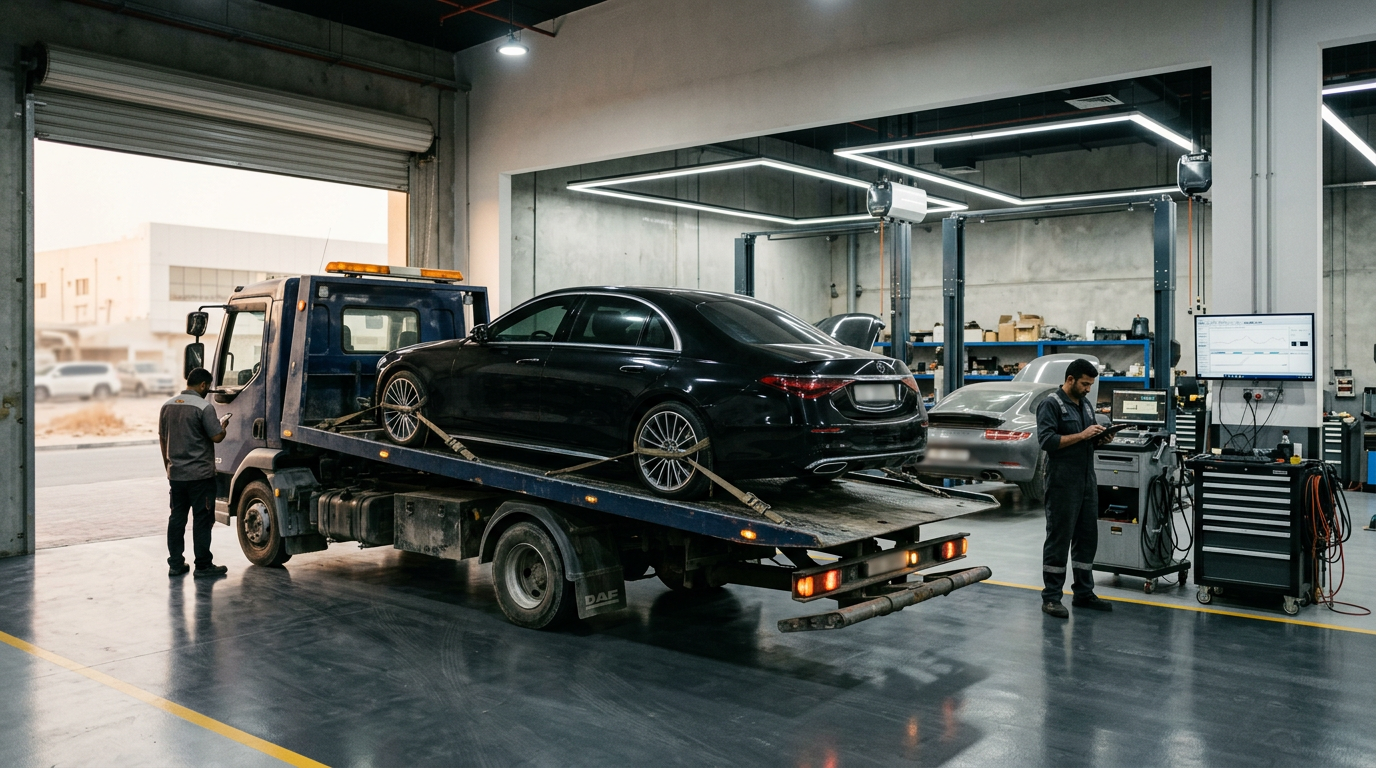
Private recovery vehicles and tow trucks operate across the emirate, with concentrations in industrial areas including Al Quoz, Ras Al Khor, and Dubai Investment Park. Flatbed transporters are preferred for modern European vehicles with low ground clearance, all-wheel-drive systems, or complex electronic architectures that can be damaged by traditional wheel-lift towing methods.
When to Call for Vehicle Recovery
- Engine overheating with visible steam or coolant loss—continuing to drive risks catastrophic engine damage
- Complete electrical failure or no-start condition with no dashboard lights or response from starter motor
- Sudden loss of power steering, braking assist, or transmission function while driving
- Tyre blowout or damage that prevents safe operation, especially on high-speed roads
- Warning lights indicating critical failures: oil pressure, engine temperature, brake system, or battery charge
- Any mechanical noise (grinding, knocking, squealing) that worsens or is accompanied by loss of function
- Smoke or burning smells from the engine bay, cabin, or undercarriage
Preventing Seasonal Breakdowns
Proactive maintenance significantly reduces the likelihood of roadside breakdowns and the need for car recovery services. Before summer, priority checks should include battery load testing and terminal cleaning, coolant system pressure testing and fluid concentration verification, AC system performance evaluation, and tyre condition and pressure inspection. Before winter, focus shifts to electrical connector inspection for corrosion, battery charging system testing, and thorough examination of rubber seals and boots that may have hardened during summer.
European vehicles benefit particularly from comprehensive diagnostic scans that can identify developing faults before they cause breakdowns—stored fault codes and sensor data often reveal cooling system inefficiencies, charging system degradation, or intermittent electrical issues while the vehicle is still driveable.
EV and Hybrid Breakdown Patterns
Electric vehicles and plug-in hybrids from manufacturers including Polestar, Porsche Taycan, Audi e-tron, and BMW iX exhibit different seasonal breakdown patterns compared to conventional vehicles. High-voltage battery thermal management systems work harder in UAE summer heat, and coolant pump or thermal control valve failures can trigger protective shutdowns that require recovery services even though the vehicle is not mechanically damaged.
The 12-volt auxiliary battery in EVs and hybrids remains vulnerable to heat-related failure despite the presence of a large traction battery, and a dead 12V battery will prevent the vehicle from entering ready mode or releasing electronic parking brakes. Winter condensation issues affect EV charging systems and high-voltage connectors, occasionally requiring specialist diagnostic work to clear fault codes and restore normal operation.
Prevent Breakdowns with Seasonal Maintenance
JAD Garage in Al Quoz 4 offers comprehensive pre-summer and pre-winter inspections for European and EV vehicles, identifying potential failures before they leave you stranded. Call +971 56 355 6113 to schedule your seasonal check.
Frequently asked questions