
Steering Wheel Play and Knocking: Rack, Column or Joints

Steering wheel play—where the wheel rotates several degrees before the front wheels respond—and knocking or clunking sounds during turns typically indicate wear in the steering rack bushings, tie rod ends, intermediate shaft joints, or steering column bearings. In Dubai's heat and fine sand environment, rubber bushings age faster and ball joints lose grease, making these symptoms common after 80,000–100,000 km on European and performance vehicles.
Why Play and Knocking Develop in Dubai
The steering system relies on precision-fit components: the rack-and-pinion assembly converts rotational input into linear motion, while tie rods transmit that force to the wheels. Each connection uses bushings, bearings or ball joints to allow controlled movement. When rubber bushings harden in 50°C engine-bay temperatures or ball-joint grease dries out from fine sand ingress, clearances grow. The result is perceptible free-play at the steering wheel and audible knocking as metal surfaces contact under load.
Stop-start traffic in Dubai amplifies wear: constant small steering corrections at low speeds load tie rod ends and rack bushings asymmetrically, accelerating fatigue. Short-trip city driving means components never reach full operating temperature for long enough to expel moisture, so corrosion can develop inside sealed joints on older BMW, Audi and Mercedes-Benz models.
Common Causes Ranked by Probability
Workshops see a predictable pattern of failure modes. The table below ranks causes by frequency across European marques in the UAE:
| Symptom | Most Likely Cause | Second Cause | Less Common |
|---|---|---|---|
| Play at centre (straight ahead) | Steering rack inner bushings worn | Intermediate shaft spline wear | Column bearing play |
| Knocking on lock (full turn) | Outer tie rod end ball joint | Steering rack mounting bushings | Inner tie rod socket |
| Clunk over bumps while turning | Lower control arm ball joint | Steering rack bushings collapsed | Subframe mount deterioration |
| Knocking when reversing out of parking | Intermediate shaft universal joint | Steering column bearing | Rack end-stop contact |
1. Tie Rod Ends (Outer)
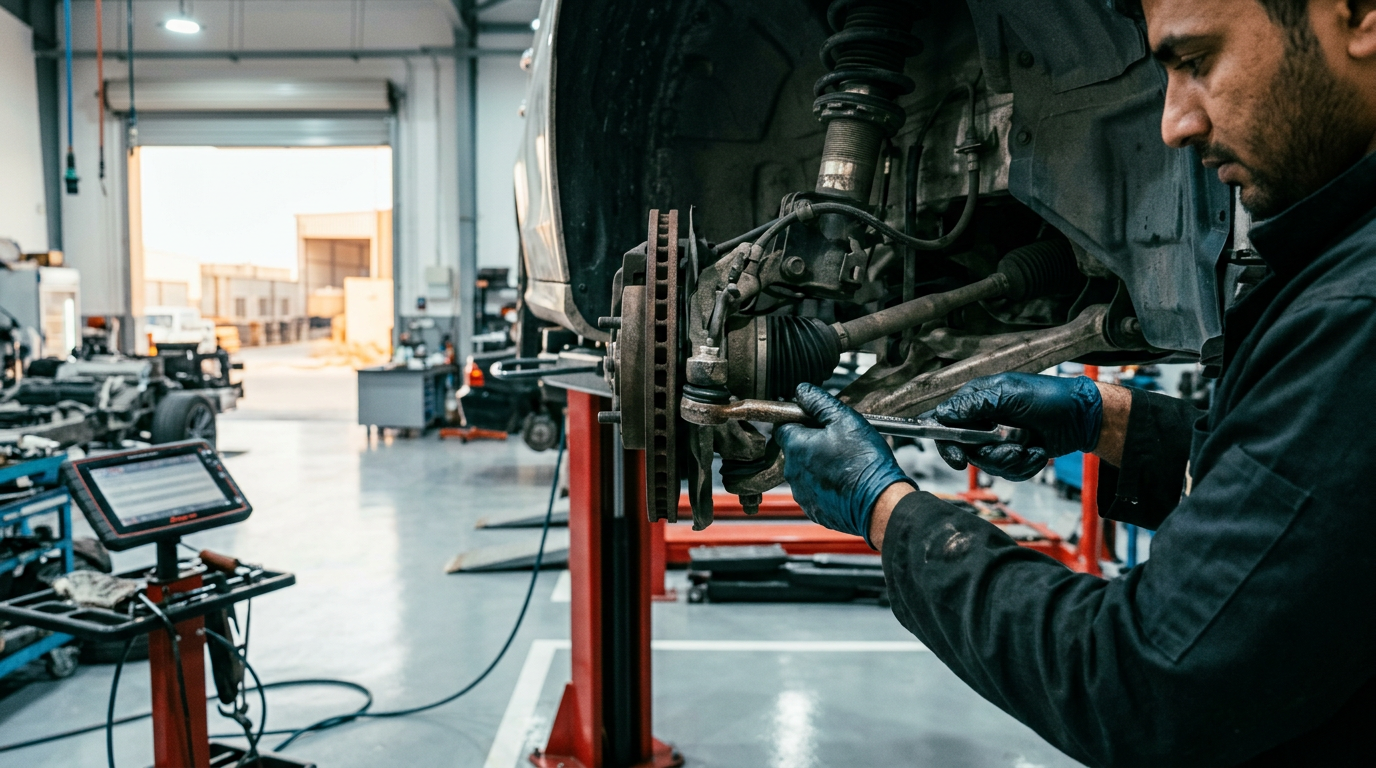
Outer tie rod ends are the most frequent culprit for knocking. Each tie rod terminates in a ball-and-socket joint that allows the wheel to steer and move vertically over bumps. The ball sits in a polymer or metal cup lubricated by sealed grease. When the seal tears—often from stone impacts on Dubai roads—sand enters, the grease leaks, and the ball wears against the socket. You hear a distinct knock at full lock or over speed bumps.
A technician confirms this by lifting the vehicle, gripping the tie rod near the wheel, and attempting to move it vertically and radially. Any perceptible movement or clicking indicates a failed joint. A dial gauge can measure play beyond 1 mm, which exceeds OEM tolerance. Replacement involves unbolting the tie rod end, measuring the old rod length to preserve toe alignment, and torquing the new part to specification—typically 60–80 Nm for European cars. A four-wheel alignment follows to restore factory geometry.
2. Steering Rack Bushings
The steering rack is mounted to the subframe or crossmember via rubber bushings that absorb vibration. Over time, heat and ozone cause these bushings to harden and crack. When they collapse, the entire rack can shift a few millimetres side-to-side, translating to noticeable play at the steering wheel. You may also hear a dull thud when changing direction at low speed, common in Volkswagen and Audi models around 100,000 km.
Diagnosis requires lifting the car and having an assistant rock the steering wheel while the technician observes rack movement. A pry bar applied between the rack body and subframe reveals excess clearance. Some workshops use a dial indicator clamped to the rack to quantify movement; anything over 2 mm indicates bushing failure. Repair involves dropping the subframe or removing the rack to press out old bushings and install OEM or polyurethane replacements. Labour is significant because many European vehicles require partial engine-mount removal for subframe access.
3. Intermediate Shaft and Universal Joint
The intermediate shaft connects the steering column to the rack input shaft, usually via one or two universal joints (U-joints). These joints allow the shaft to articulate as the engine rocks on its mounts. Wear in the splines or U-joint bearings creates a clunking sound when you reverse direction—most noticeable when manoeuvring into parking spaces. BMW E90 and F30 models are known for intermediate-shaft knock around 80,000 km.
A technician checks this by turning the steering wheel a few degrees back and forth with the engine off while watching and feeling the intermediate shaft for lost motion. Any rotational play between the column and rack input confirms the issue. Some workshops disconnect the shaft at the rack and measure spline engagement with a feeler gauge. Replacement is straightforward: unbolt the shaft at both ends, slide it out, and install a new assembly, ensuring the splined connection is aligned to the straight-ahead position to avoid off-centre steering wheel position.
4. Steering Column Bearings
The steering column itself rotates on needle or ball bearings housed in the column tube. These bearings can develop play if the column was over-torqued during airbag or steering wheel removal—common after aftermarket racing steering wheel or quick release hub installations. You'll feel a notchy or gritty sensation when turning, and sometimes a faint clicking audible inside the cabin.
Diagnosis involves removing the lower column trim and manually rotating the column shaft while feeling for roughness or axial play. A dial indicator mounted on the column housing can measure end-float; acceptable clearance is typically under 0.5 mm. If bearings are worn, the column usually requires disassembly on a bench. Some performance and classic car owners opt for aftermarket column assemblies with sealed bearings and quick release hubs for easier wheel removal at track events.
5. Inner Tie Rod Sockets
Inner tie rods connect the steering rack to the outer tie rod ends. They are often sealed with a bellows boot and use a ball-and-socket or threaded joint. Wear here is less common but produces a similar knock to outer tie rod failure. The difference is that inner tie rod play also causes a vague, wandering feel at highway speed because the rack's output is not rigidly coupled to the wheel.
Testing requires removing the bellows boot to access the joint. The technician grips the inner tie rod and attempts to move it perpendicular to its axis; any play indicates a worn socket. Some racks use a crimped or staked joint that cannot be serviced separately, requiring full rack replacement. Others, particularly on Porsche and sports car models, allow inner tie rod replacement by unscrewing the old unit with a special crowfoot wrench and torquing the new one to 100+ Nm.
How a Workshop Confirms the Source
A systematic inspection isolates the fault without replacing parts speculatively. The process typically follows this sequence:
- Visual inspection: Check for torn boots, leaking grease, and corrosion around joints. A split tie rod boot immediately points to a failed seal.
- Dry-park test: With the vehicle stationary and engine off, an assistant turns the steering wheel while the technician watches each joint and bushing for movement. Any visible play or audible click is noted.
- Suspension-loaded test: Lift the vehicle so the wheels hang free, then manually push and pull each tie rod, control arm and rack mount. Dial indicators quantify play in millimetres.
- Road test: Drive over speed bumps and execute full-lock turns while listening for knocks. Note whether the sound occurs on compression, rebound, or direction change.
- Rack centralisation check: With wheels straight, measure the distance from each inner tie rod to a fixed subframe point. Unequal measurements suggest the rack has shifted in its mounts.
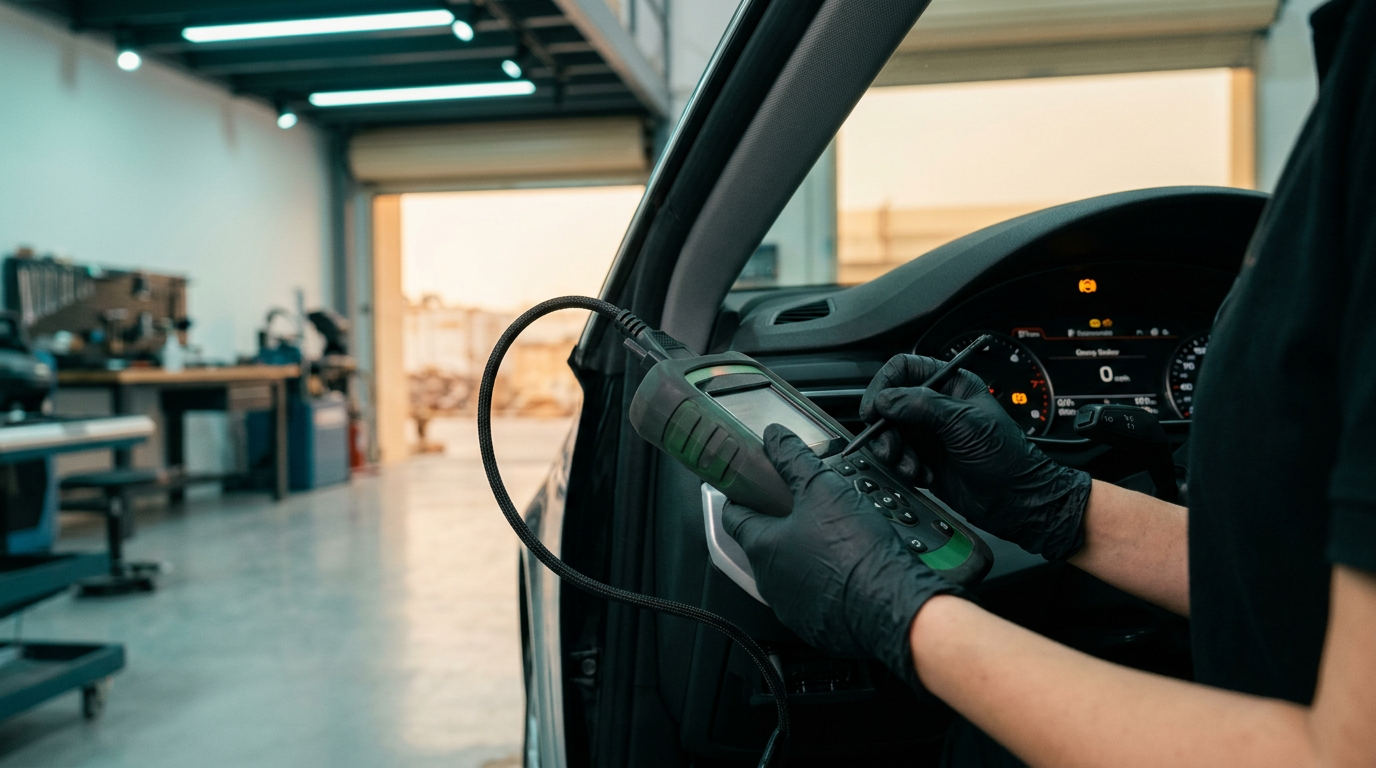
Modern workshops use manufacturer-specific diagnostic software to check electric power-steering (EPS) systems for fault codes. A logged "torque sensor implausible" code can indicate a bent intermediate shaft or misaligned column, while "rack position sensor drift" may point to internal rack wear. For hydraulic systems, a pressure gauge inserted into the pump outlet can reveal whether assist pressure drops under load, suggesting internal rack seal leakage.
What Each Repair Involves
Repair complexity varies by component and vehicle architecture. Front-engine, rear-drive BMW and Mercedes-Benz models often allow easier access to the rack than transverse-engine Audi and Volkswagen platforms, where the engine sits directly above the rack.
Tie rod end replacement is a 1–2 hour job per side. The wheel is removed, the tie rod end nut is loosened, and a ball-joint separator (pickle fork or puller) breaks the taper fit. The old end is unscrewed, the new one threaded on to the same dimension, and the assembly torqued. A four-wheel alignment is mandatory afterward; typical Dubai market rates for alignment range from AED 200 to AED 400 depending on the facility and whether all four wheels are adjustable.
Rack bushing replacement can take 3–5 hours. The subframe is lowered or the rack is removed entirely. Bushings are pressed or drifted out, and new ones installed with a hydraulic press to ensure they seat squarely. Some workshops use polyurethane bushings for sports car and supercar applications; these offer sharper response but transmit more vibration into the cabin—acceptable for a racing setup, less so for a luxury daily driver.
Intermediate shaft replacement is straightforward: 1–1.5 hours. The shaft is unbolted at the column and rack, slid out, and the new unit installed with alignment marks matched. Some technicians apply a light coat of anti-seize to the splines to ease future removal.
Full rack replacement is the most involved repair, often 6–8 hours. The front subframe is dropped, power-steering lines are disconnected (requiring fluid disposal and refill), and tie rods are transferred to the new rack. Hydraulic racks must be bled to remove air; electric racks require initialisation via diagnostic software so the control module learns the new rack's centre position. Market price ranges for a complete rack job—parts and labour—typically fall between AED 3,500 and AED 8,000 in Dubai, depending on whether you choose an OEM rack, a remanufactured unit, or a premium alternative brand.
Preventing Premature Wear
Regular inspection during scheduled general maintenance catches wear early. Technicians should check tie rod boot integrity and rack mount condition at every service interval—typically every 10,000 km or 12 months for European vehicles in the UAE. Replacing torn boots immediately prevents sand and moisture ingress, extending joint life by years.
For enthusiasts who have fitted aftermarket racing steering wheels, quick release hubs, or deep dish designs, ensure the hub is torqued correctly and that the wheel does not contact the column shroud at full lock. Incorrect fitment loads the column bearings unevenly. Sim racing hobbyists sometimes reuse road-car steering wheels on home rigs; if you later reinstall that wheel on the vehicle, verify that the airbag connector and retaining bolt are torqued to specification—typically 40–50 Nm for European marques.
Owners of classic cars should inspect steering components more frequently. Older vehicles often use greaseable tie rod ends with Zerk fittings; periodic greasing—every 5,000 km—keeps joints supple. Many classic steering wheels are trimmed in suede or leather; while aesthetically pleasing, these materials offer less grip than modern carbon fiber or perforated designs, so drivers may apply more force, accelerating wear on the column and rack.
When to Act
Any perceptible play at the steering wheel—more than 10–15 mm of rim movement before the wheels respond—warrants immediate inspection. UAE roads mix high-speed highways with tight urban turns; worn steering components compromise both stability at speed and manoeuvrability in traffic. A vehicle that wanders between lanes or requires constant correction is unsafe and will fail the RTA annual test if the inspector detects excessive play.
Knocking sounds are equally urgent. They indicate metal-on-metal contact, which accelerates wear exponentially. A tie rod end that merely clicks today can separate completely within weeks, causing loss of steering control. Dubai's road network includes long stretches at 120–140 km/h; a steering failure at that speed is catastrophic.
If you notice any of these symptoms, book a diagnostic session with a facility that has manufacturer-grade equipment. Independent workshops in Al Quoz specialising in European and performance marques can perform the same tests as franchised service centres, using OEM diagnostic software and precision measurement tools. For luxury car and supercar owners, a suspension and steering specialist will have experience with complex multi-link front ends and active steering systems.
Steering system repairs are not optional maintenance—they are safety-critical. Addressing play and knocking early prevents collateral damage to tyres (uneven wear from poor alignment), wheel bearings (side loads from loose tie rods), and subframe mounts (stress from a shifting rack). The cost of early intervention is a fraction of the price of compounded failures, and the peace of mind is invaluable when navigating Dubai's busy roads.
Steering Play or Knocking? Get a Precise Diagnosis
JAD Garage in Al Quoz 4 uses manufacturer-grade diagnostic tools to isolate rack, column and joint wear on European and EV vehicles. Call +971 56 355 6113 to book your inspection Monday to Saturday, 09:00–19:00.
Frequently asked questions