Tyre Blowout Statistics in UAE Summer

Summer tyre blowouts spike across the UAE when pavement temperatures exceed 70°C between June and August. Dubai Police reported that tyre-related incidents accounted for approximately 15% of all summer breakdowns attended in 2022, with the majority occurring on highways during afternoon hours when surface heat peaks. A puncture in the tread is often repairable, but sidewall damage, heat-induced delamination, or cuts longer than 6 mm typically require immediate replacement.
Why UAE Summer Conditions Cause Tyre Failures
Ambient air temperatures in Dubai regularly reach 48–50°C in July and August according to Dubai Statistics Center climate data, but asphalt surface temperatures climb far higher—often 70–80°C in direct sun. At these extremes, the air inside a tyre expands: for every 10°C rise, pressure increases by roughly 1–2 psi. An under-inflated tyre that starts the day at 30 psi can climb to 35 psi or more during a midday drive, and if it was already low, the sidewall flexes excessively, generating internal heat that accelerates rubber degradation.
Heat also softens the tyre compound. Tread that is already worn below 3 mm loses its ability to dissipate heat effectively, and any embedded debris—sharp stones, metal fragments, or construction waste common on Dubai roads—can work deeper into the carcass. The combination of high speed on Sheikh Zayed Road or Emirates Road, heavy loads (especially in SUVs and light truck tires popular in the UAE), and sustained heat creates the perfect recipe for a blowout.
Tyre Incident Data from UAE Authorities
Dubai Police's 2022 summer road safety campaign highlighted that tyre defects were a contributing factor in 12–15% of breakdowns and accidents during peak summer months. The RTA's Vehicle Inspection Programme data from 2021 showed that approximately 8% of vehicles failed their initial test due to tyre tread depth below the legal 1.6 mm minimum or visible sidewall damage. While comprehensive public statistics on blowout causes are not published annually, workshop observations in Dubai consistently show three dominant failure modes during summer:
- Under-inflation and heat buildup: Tyres run 10–15% below recommended pressure flex more, heat faster, and fail structurally. Drivers who check pressure only when a warning light appears often discover one or more tyres have been low for weeks.
- Tread separation and delamination: Budget or aged tyres (over five years old) lose the bond between steel belts and rubber layers when exposed to sustained high temperatures, leading to sudden tread detachment at highway speed.
- Impact damage to sidewalls: Potholes, kerb strikes, and speed-hump impacts are year-round hazards, but the weakened rubber in summer means a bulge or cut that might have held in winter can rupture catastrophically in July.
| Failure Type | Typical Cause | Repairable? | Workshop Observation (Dubai Summer) |
|---|---|---|---|
| Tread puncture (nail, screw) | Debris penetration in centre tread area | Yes, if ≤6 mm and not near sidewall | ~60% of flat tyre visits; most repairable with plug-patch |
| Sidewall puncture or cut | Kerb impact, sharp debris, blowout | No | ~20% of cases; replacement mandatory |
| Tread separation / delamination | Age + heat, under-inflation | No | ~10%; more common in tyres >5 years old |
| Slow puncture (valve, bead leak) | Valve stem corrosion, rim corrosion, bead damage | Often yes (valve/seal replacement) | ~10%; humidity accelerates valve stem corrosion |
When Tyre Repair Is Safe and When It Is Not
International tyre-industry standards—reflected in manufacturer technical documentation from Michelin, Continental, Bridgestone, and Pirelli—agree on the boundaries of safe tyre repair. A puncture is repairable if it meets all of the following:
- Located in the central three-quarters of the tread (the "crown" area), not in the shoulder or sidewall.
- Diameter of the hole is 6 mm or smaller.
- No prior repairs overlap or sit within 40 mm of the new puncture.
- The tyre has not been driven flat or severely under-inflated, which causes internal structural damage invisible from outside.
- Tread depth remains above 3 mm (legal minimum in UAE is 1.6 mm, but safe performance, especially in wet conditions, requires more).
The correct repair method is a combination plug-patch applied from the inside of the tyre after the puncture channel is reamed and prepared. Exterior-only plug repairs—common at roadside tyre shops—are considered temporary and can allow moisture and air to reach the steel belts, leading to corrosion and eventual failure, particularly in Dubai's humid coastal climate.
Sidewall punctures, cuts, bulges, or any damage to the tyre shoulder cannot be safely repaired. The sidewall flexes with every rotation and operates under high stress; a patch will not hold, and the risk of sudden failure is unacceptable. Similarly, if a tyre has been driven flat—even for a few hundred metres—the internal structure is compromised, and replacement is the only safe option.
Preventing Summer Tyre Failures in Dubai
Most blowouts are preventable with routine checks and proactive replacement. In UAE summer conditions, the following practices significantly reduce risk:
- Check pressure weekly: Use a digital gauge in the early morning before the tyres heat up. Inflate to the vehicle manufacturer's recommended pressure (found on the driver's door jamb), adding 2–3 psi if carrying heavy loads or planning highway driving. Do not rely solely on the tyre-pressure monitoring system (TPMS) warning light, which typically triggers only when pressure drops 25% below specification.
- Inspect tread and sidewalls monthly: Look for embedded debris, cuts, cracks, bulges, or uneven wear. Any sidewall bulge is a red flag for internal damage and warrants immediate replacement.
- Rotate tyres every 8,000–10,000 km: This equalises wear, especially important for front-wheel-drive hatchbacks and SUVs where front tyres wear faster. General maintenance visits are an ideal time to rotate and inspect.
- Replace tyres at five years regardless of tread: Rubber degrades with heat and UV exposure. A tyre manufactured in 2018 should be replaced by 2023 even if tread depth appears adequate. The manufacturing date is printed on the sidewall as a four-digit code (week and year).
- Avoid overloading: Passenger light truck tires on SUVs and pickups have load ratings; exceeding them generates excess heat and accelerates wear. Check the load index on the tyre sidewall and compare it to your typical cargo and passenger weight.
For vehicles used in fleet services or corporate accounts—delivery vans, ride-hail sedans, or limo fleets—tyre maintenance schedules should be shorter. High daily mileage in stop-start city traffic accelerates wear, and the cost of a roadside breakdown far exceeds the cost of proactive replacement.
What to Do After a Puncture or Blowout
If a tyre loses pressure suddenly on the highway, do not brake hard or swerve. Ease off the accelerator, grip the wheel firmly, and steer gently to the hard shoulder. Activate hazard lights and, if safe, move well away from the traffic lane. Dubai Police recommend calling 999 if the breakdown is on a major highway and you cannot reach the shoulder safely.
If you have a spare tyre, replace the flat and drive cautiously to the nearest workshop for a permanent repair or replacement. Many modern vehicles, particularly European brands like BMW, Mercedes-Benz, and Audi, are fitted with run-flat tyres or a tyre repair kit instead of a spare. Run-flats allow driving up to 80 km at reduced speed (typically 80 km/h maximum) after a puncture, but they must be inspected immediately—internal damage from running flat usually means replacement, even if the puncture itself is in the repairable zone.
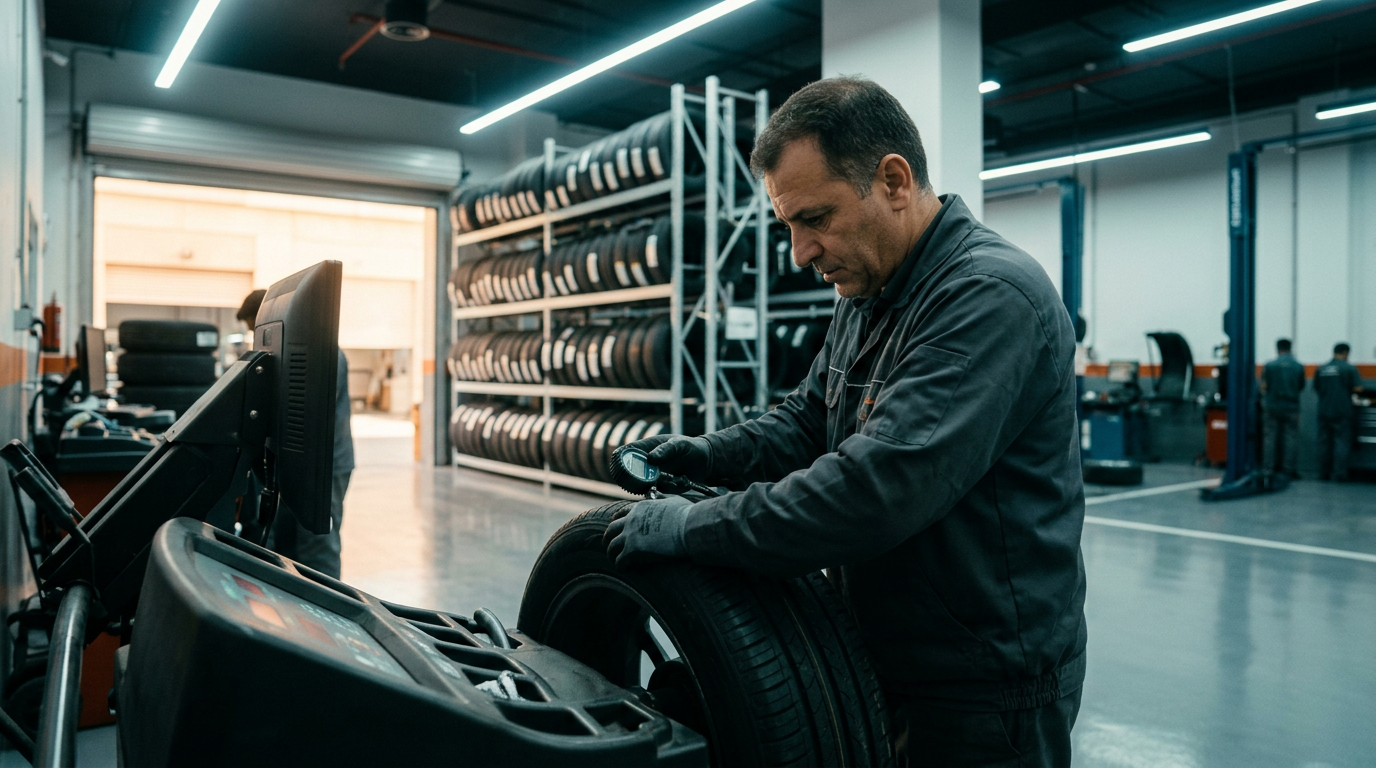
For punctured tyres, bring the vehicle to a workshop equipped with a tyre changer and wheel balancer. A proper inside-out inspection is essential: the technician will dismount the tyre, examine the inner liner for damage, and determine whether a plug-patch repair is safe or whether replacement is necessary. If you drive a performance or sports car, luxury car, or supercar, always replace tyres in pairs on the same axle to maintain balanced handling, especially if tread depth differs by more than 2 mm.
Tyre Replacement and Repair Costs in the Dubai Market
Typical market prices in Dubai for passenger-car tyres range from AED 250–500 per tyre for mid-range brands (Hankook, Kumho, Nexen) to AED 600–1,200 for premium brands (Michelin, Continental, Pirelli, Bridgestone) in common sizes (205/55R16 to 225/45R18). Light truck tires for SUVs and pickups in larger sizes (265/65R17, 275/55R20) range from AED 500–900 for mid-tier brands and AED 1,000–1,800 for premium options. High-performance and run-flat tyres for Porsche, Maserati, or Ferrari can exceed AED 2,000 per tyre in sizes above 20 inches.
A professional plug-patch puncture repair typically costs AED 50–100 per tyre in the Dubai market, including dismount, inspection, repair, and remount with balancing. Valve stem replacement adds AED 20–40. If you encounter a quote significantly below AED 50, confirm that the repair includes an internal patch—not just an external plug—and that the wheel will be balanced afterward.
Always verify that replacement tyres carry the correct speed and load ratings for your vehicle. Installing a lower-rated tyre to save cost is a false economy and a safety risk, particularly in summer heat and high-speed highway driving common in the UAE.
Linking Tyre Health to Broader Vehicle Safety
Tyre condition affects more than just blowout risk. Under-inflated or worn tyres increase braking distance, reduce cornering stability, and stress the suspension and steering components. Uneven tyre wear can indicate alignment issues, worn bushings, or failing shock absorbers—problems that also compromise safety and accelerate wear on other parts.
When a vehicle comes in for brake services, diagnostic services, or an oil change, a thorough technician will inspect tyre condition, tread depth, and pressure as part of the safety check. For buyers considering a used car, a pre-purchase inspection should always include tyre assessment: budget for replacement if tread is below 4 mm or if the tyres are older than four years, regardless of appearance.
For owners of European and electric vehicles—Volvo, Polestar, Volkswagen, Renault, MG, and others—tyre choice matters even more. EVs are heavier due to battery packs and deliver instant torque, both of which accelerate tyre wear. Choosing tyres rated for EV use and maintaining correct pressure extends range and prevents premature failure. Our article on EV servicing in Dubai covers these considerations in detail.
Expert Tyre Repair and Replacement in Al Quoz
If you've had a puncture or need a tyre safety check before summer driving, JAD Garage in Al Quoz 4 offers professional tyre services with manufacturer-grade equipment and genuine or premium alternative parts. Call +971 56 355 6113 or visit us Monday to Saturday, 09:00–19:00.
Frequently asked questions