
Wheel Alignment vs Balancing: What Your Car Actually Needs

Wheel alignment and tire balancing are two separate services that solve different problems. Alignment adjusts the angles of your suspension so your wheels point straight and your car tracks true, preventing uneven tire wear and steering pull. Tire balancing ensures each wheel-and-tire assembly spins without vibration by evening out weight distribution. Both are essential for tire life, handling, and comfort.
What Is Wheel Alignment?
Wheel alignment—sometimes called tracking or four-wheel alignment—is the process of adjusting the angles of your wheels to manufacturer specifications. Technicians adjust three primary angles: camber (the inward or outward tilt of the tire when viewed from the front), caster (the steering axis angle when viewed from the side), and toe (whether the front edges of your tires point inward or outward when viewed from above).
These angles are not adjustments to the wheels themselves but to the suspension and steering components that control wheel position. When alignment is correct, your car drives straight without pulling, the steering wheel sits centred, and your tires wear evenly across the tread. When alignment drifts out of specification—often after hitting a kerb, a deep pothole, or from worn suspension bushings—your tires start scrubbing sideways as they roll, which accelerates wear and costs you money.
When Your Car Needs Alignment
You should have your alignment checked whenever you notice these symptoms:
- The steering wheel is off-centre when driving straight
- The car pulls consistently to one side on a flat, level road
- Uneven tire wear patterns—one edge worn more than the other, or scalloping
- After hitting a significant pothole, speed bump at speed, or kerb
- When fitting new tires (to protect your investment)
- After any suspension or steering component replacement
Dubai's road conditions—expansion joints on the Sheikh Zayed Road, sharp transitions between tarmac and sand on side streets, and the occasional unmarked speed hump—make alignment checks every 10,000 to 15,000 kilometres a sensible precaution. Many European car manufacturers recommend alignment inspection at every major service interval.
What Is Tire Balancing?
Tire balancing corrects weight imbalances in the wheel-and-tire assembly. Even new tires and wheels are never perfectly uniform; a few grams of extra weight in one spot creates centrifugal force as the wheel spins, causing vibration. A balancing machine spins each wheel to detect these heavy spots, and the technician attaches small lead or zinc weights to the rim to counteract them.
Balancing is done with the wheel off the car. The process takes a few minutes per wheel and is entirely separate from alignment, which is performed with all four wheels on the vehicle and the suspension loaded.
When Your Car Needs Balancing
Tire balancing is needed in these situations:
- Vibration felt through the steering wheel at motorway speeds (typically 100–120 km/h)
- Vibration felt through the seat or floor, especially at specific speeds
- Whenever new tires are fitted
- After a puncture repair or tire rotation
- If a balance weight has fallen off
- Every 8,000 to 10,000 kilometres as part of routine tire services
In Dubai's heat, tire rubber becomes softer and more prone to irregular wear, and fine sand can cake inside wheel rims, throwing off balance. If you drive frequently on unpaved roads or construction zones around developments in areas like Al Quoz or Dubai South, balancing may need to be checked more often.
Key Differences Between Alignment and Balancing
| Aspect | Wheel Alignment | Tire Balancing |
|---|---|---|
| What it adjusts | Suspension angles (camber, caster, toe) | Weight distribution of wheel and tire |
| Wheels on or off? | On the vehicle | Off the vehicle |
| Main symptom | Pulling, off-centre steering, uneven tire wear | Vibration at speed |
| Caused by | Impact damage, worn bushings, ride height changes | Manufacturing variance, lost weights, uneven wear |
| Typical interval | Every 10,000–15,000 km or when symptoms appear | Every tire fitment, rotation, or 8,000–10,000 km |
Can You Get Both Services at the Same Time?
Yes, and it often makes sense to do so. If you are fitting new tires, both services should be done: balancing is mandatory for smooth running, and alignment ensures those new tires wear evenly and last their full lifespan. Many workshops in Dubai offer combined packages when you purchase a set of tires.
If you are experiencing both vibration and steering pull, both services are needed to resolve the issues. One does not fix the problem of the other. Balancing will not stop a car from pulling left, and alignment will not eliminate a vibration at 110 km/h.
Consequences of Ignoring Alignment or Balancing
Delaying or skipping these services has real costs. Misalignment shortens tire life dramatically—a set of premium tires that should last 50,000 kilometres may be finished at 25,000 if camber or toe is significantly out. Uneven tire wear is also an MOT failure point during RTA vehicle testing if tread depth varies excessively across the tire face.
Ignoring wheel imbalance leads to vibration that accelerates wear in suspension bushings, wheel bearings, and steering components. On luxury cars and sports cars, even slight imbalance can be felt through the cabin and detracts from ride quality. Persistent vibration also fatigues the driver on long motorway runs to Abu Dhabi or Al Ain.
Both issues affect safety. Uneven tire wear reduces grip, especially in emergency braking or sudden lane changes. A car that pulls under braking is harder to control, and vibration can mask other developing faults in the suspension and steering system.
Typical Service Costs in Dubai
Wheel alignment for a passenger car typically ranges from AED 150 to AED 300 across Dubai workshops, depending on whether it is a two-wheel or four-wheel alignment and the complexity of the suspension. Performance and luxury vehicles with adaptive suspension or air springs may cost more due to additional calibration steps.
Tire balancing usually costs AED 40 to AED 80 per wheel, or AED 160 to AED 320 for a full set of four. Some workshops include balancing free when you purchase tires; others charge separately.
These are general market ranges. Prices vary by vehicle type, wheel size, and whether additional work—such as cleaning caked sand from rims or replacing missing valve caps—is required.
How Often Should You Check Alignment and Balancing?
For most drivers in Dubai, a sensible schedule looks like this:
- Wheel alignment: every 10,000 to 15,000 kilometres, or immediately after any suspension work, kerb strike, or if you notice pulling or uneven tire wear
- Tire balancing: every time you fit or rotate tires, and every 8,000 to 10,000 kilometres as part of routine maintenance
If you drive a Porsche, BMW, Audi, or any other performance-oriented European car, alignment is especially critical because these vehicles are set up with tighter tolerances for handling precision. A few millimetres of toe change can transform steering feel and tire wear. Owners of Mercedes-Benz, Range Rover, and other luxury models should also prioritise regular alignment checks to maintain ride comfort and protect expensive tire investments.
For electric vehicles—Polestar, Audi e-tron, or any EV—tire wear is often faster due to instant torque and heavier kerb weight, making both alignment and balancing even more important for maximising tire life and range efficiency.
What Happens During Each Service
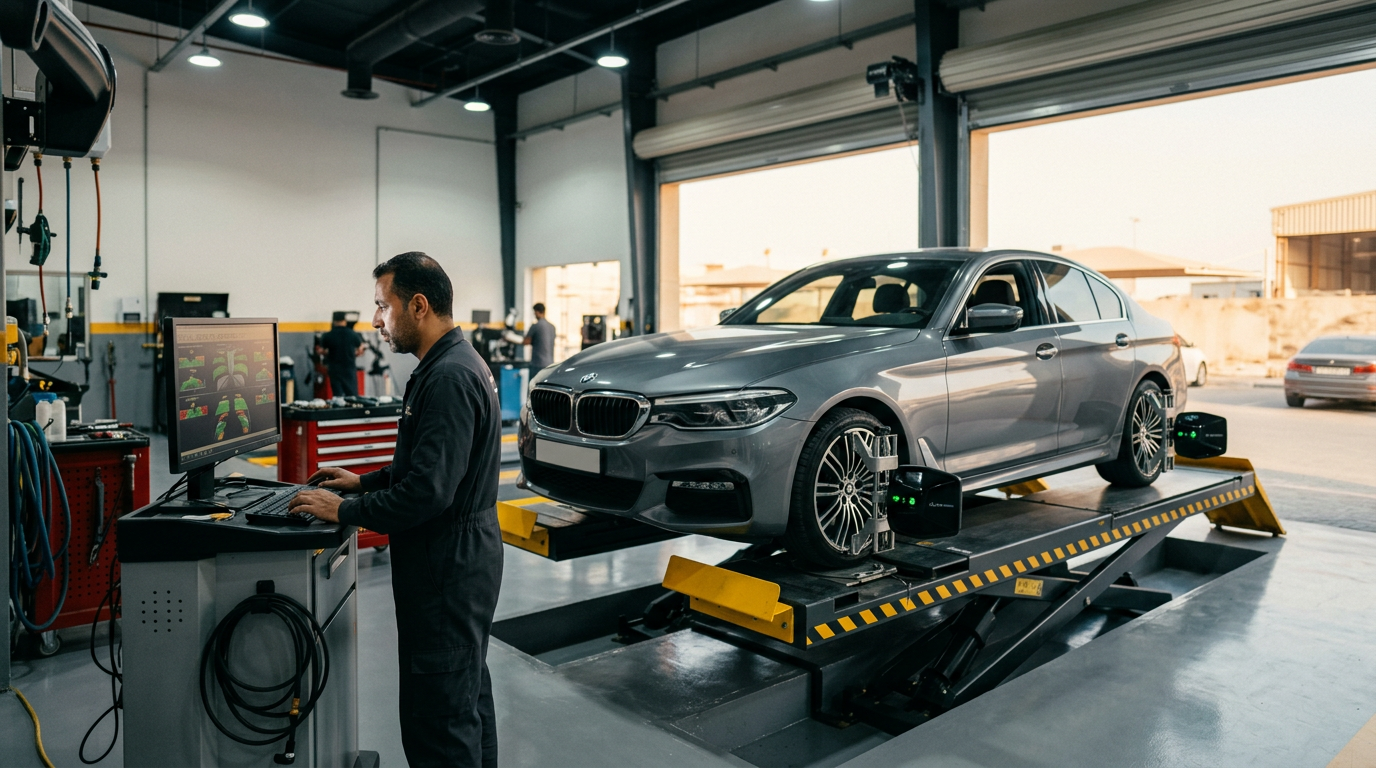
During a wheel alignment, your car is driven onto a lift or alignment rack, and sensors or cameras are attached to each wheel. The system measures the current angles and compares them to manufacturer specifications. The technician then loosens adjustment bolts on suspension components and makes small changes to bring camber, caster, and toe back into range. A printout before and after shows exactly what was adjusted.
During tire balancing, each wheel is removed and mounted on a spin balancer. The machine spins the wheel, detects heavy spots, and indicates where to attach weights. The technician clips or sticks weights to the rim, spins again to verify, and repeats until the assembly is balanced within a few grams. Wheels are then reinstalled and torqued to specification.
Both services require proper equipment. Alignment machines must be calibrated regularly, and balancing machines need to account for the specific rim diameter and width. This is why choosing a workshop with up-to-date diagnostic equipment matters, especially for European and EV models with complex suspension geometry.
Alignment and Balancing Services in Al Quoz
If your car is pulling, vibrating, or showing uneven tire wear, bring it to JAD Garage in Al Quoz 4 for a professional alignment and balancing check. Call +971 56 355 6113 to book your appointment.
Frequently asked questions