AC vs DC Charging: Why Your EV Charges Slower Than Advertised


Your electric vehicle charges slower than advertised because the final charging speed is limited by the smallest bottleneck in the chain: the charging station type (AC or DC), your car's onboard charger capacity, the battery management system, current state of charge, and battery temperature. A 150 kW DC fast charging station will not deliver 150 kW to a car with a 50 kW onboard AC limit or a battery already at 80 percent charge.
AC vs DC Charging: The Fundamental Difference
All electric vehicle batteries store direct current (DC). The difference between AC and DC charging lies in where the conversion from alternating current happens.
When you plug into an AC charging station—whether a 7 kW wall box at home or a 22 kW public charger—the alternating current flows into your car and passes through the onboard charger, a component inside the vehicle that converts AC to DC before feeding the battery. The onboard charger's capacity is the hard limit: if your Audi e-tron has an 11 kW onboard charger, plugging into a 22 kW AC station will still only charge at 11 kW.
With DC fast charging, the charging station itself contains the AC-to-DC converter. The station delivers DC directly to the battery, bypassing the onboard charger entirely. This is why DC stations can deliver 50 kW, 150 kW, or even 350 kW—limited only by what the vehicle's battery management system will accept.
Why Most Home and Office Charging Is AC
AC charging dominates residential and workplace installations because the infrastructure is simpler and cheaper. A 7 kW home charger in Dubai draws roughly 32 amperes on a single-phase supply, well within typical DEWA residential capacity. Installing DC fast-charging equipment at home would require three-phase high-voltage supply, dedicated transformers, and costs that run into tens of thousands of dirhams—impractical for overnight top-ups when a full charge from a 7 kW unit takes 8–10 hours for most mid-size EVs.
The Onboard Charger Bottleneck
Every electric vehicle has an onboard charger rated in kilowatts. This rating is the maximum AC charging speed the car can accept, regardless of the charging station power.
| Model Example | Onboard Charger (kW) | Time 0–100% on 7 kW AC | Time 0–100% on 22 kW AC |
|---|---|---|---|
| BMW i4 eDrive40 | 11 kW | ~7.5 hours | ~7.5 hours (capped at 11 kW) |
| Polestar 2 Long Range | 11 kW | ~9 hours | ~9 hours (capped at 11 kW) |
| Porsche Taycan Turbo S | 11 kW (optional 22 kW) | ~9 hours | ~4.5 hours (with 22 kW option) |
| MG ZS EV | 6.6 kW | ~7 hours | ~7 hours (capped at 6.6 kW) |
Many European EVs sold in the UAE come with 11 kW onboard chargers as standard. Higher-capacity 22 kW onboard chargers are often optional and add significant cost, yet they only help if you have access to a 22 kW three-phase AC charging station—uncommon in Dubai residential areas where single-phase 7 kW is the norm.
DC Fast Charging: Why Speed Tapers
DC fast charging stations advertise peak power—50 kW, 150 kW, 350 kW—but your vehicle will rarely sustain that rate for the entire session. Charging speed follows a curve controlled by the battery management system to protect cell longevity and safety.
The Charging Curve
Lithium-ion batteries charge fastest when the state of charge (SoC) is low and the cells are within an optimal temperature range (typically 20–30°C). As the battery fills, the management system reduces current to prevent overheating and dendrite formation. Most EVs deliver peak DC charging speed between 10 percent and 50 percent SoC, then taper significantly above 80 percent.
For example, a Mercedes-Benz EQE might accept 170 kW at 20 percent charge but drop to 70 kW at 60 percent and just 30 kW at 85 percent. This is why the common advice is to charge only to 80 percent on road trips: the final 20 percent takes disproportionately long.
Heat and Charging Speed in Dubai
Battery temperature has a direct impact on charging speed. In Dubai's summer, when ambient temperatures reach 45–50°C and a parked car's cabin can exceed 70°C, the battery pack often sits well above the optimal range. The thermal management system must cool the cells before and during fast charging, which can delay the session start and reduce peak power by 20–40 percent until the pack cools down.
Conversely, if you drive onto a DEWA EV Green Charger station immediately after a 30-minute highway run in air-conditioned comfort, the battery is warm but not overheated, and you may see closer-to-advertised speeds. Pre-conditioning—when the car heats or cools the battery en route to a charging station using navigation input—helps, but not all models support this feature.
Charging Station Power Sharing and Network Limits
Even a 150 kW DC charging station may not deliver full power if another vehicle is plugged into an adjacent dispenser on the same power cabinet. Many fast-charging stations share a single transformer or power supply across two or more connectors. If the cabinet is rated for 150 kW total and two cars are charging simultaneously, each may receive only 75 kW.
Public charging networks in Dubai—including those operated by DEWA, ADNOC, and private providers—vary in infrastructure. Older 50 kW DC stations are common at malls and petrol stations, while newer 150 kW and 350 kW units are appearing along highways and in premium locations. Always check the station's actual rating, not just the network's marketing materials.
Connector Standards: CCS, CHAdeMO and NACS
The physical connector and communication protocol also matter. In the UAE, most European EVs use the CCS Type 2 (Combined Charging System) connector for both AC and DC fast charging. Japanese models like the Nissan Leaf use CHAdeMO for DC. Tesla vehicles in the region have historically used a proprietary connector but are transitioning to CCS adapters.
In the United States and Canada, Tesla's NACS (North American Charging Standard) connector is gaining adoption, with Ford, GM, and others announcing compatibility. However, NACS is not yet common in the UAE or Middle East public charging infrastructure, so European EV owners should confirm CCS Type 2 availability before relying on a new charging station.
How to Choose the Right Charging Station for Your Needs
Your charging strategy depends on where you park overnight, daily driving distance, and access to fast charging en route.
- Home charging (7–11 kW AC): Ideal for overnight top-ups if you drive less than 200 km per day. A 7 kW wall-mounted unit adds roughly 35–40 km of range per hour, enough to fully charge most EVs in 8–10 hours. Typical market installation cost in Dubai ranges from AED 2,500 to AED 6,000 depending on cable run and electrical upgrades.
- Office or destination charging (11–22 kW AC): Useful for daytime top-ups during work hours or while shopping. A 22 kW three-phase charger can add 100–120 km of range per hour if your car supports it.
- DC fast charging (50–350 kW): Essential for road trips or when you need 200+ km of range in 20–30 minutes. Best used for rapid top-ups between 20 percent and 80 percent SoC. Typical cost per kWh at public DC stations in Dubai ranges from AED 0.70 to AED 1.50.
- Portable or mobile chargers: Usually limited to 3 kW from a standard wall socket, adding only 12–15 km per hour—acceptable for emergencies or very low daily mileage but impractical as a primary solution.
Checklist: Evaluating a Charging Station
- Confirm the station's actual power output (kW) and whether it is shared across multiple connectors.
- Check your vehicle's onboard charger capacity (AC) and maximum DC charging rate in the owner's manual or manufacturer specification sheet.
- Verify connector type: CCS Type 2 is standard for European EVs in the UAE; CHAdeMO for older Japanese models.
- For home installations, ensure your DEWA supply can handle the additional load (a 7 kW charger draws ~32 A; 11 kW draws ~16 A per phase on three-phase).
- Consider cable length and weather protection—Dubai heat and occasional dust storms can degrade exposed connectors over time.
- Review the network's mobile app for real-time availability, pricing per kWh, and session history.
Why Your EV's Charging Time Never Matches the Brochure
Manufacturers quote charging times under ideal laboratory conditions: optimal battery temperature, low initial state of charge, no power sharing, and peak charging curve sustained. Real-world conditions in Dubai introduce multiple variables:
- High ambient temperature requiring active cooling before and during the session.
- Starting charge above 20 percent (most owners top up rather than run to near-empty).
- Older or degraded battery packs with reduced peak acceptance rates.
- Public charging stations with shared power cabinets or lower-than-advertised output.
- Onboard charger limits that cap AC charging well below the station's capacity.
These factors compound. A Volkswagen ID.4 with a 77 kWh battery and 135 kW peak DC charging rate might quote "10–80 percent in 38 minutes" at a 150 kW station. In practice, on a hot afternoon in Dubai with the battery at 30 percent and the station shared with another vehicle, expect 50–60 minutes for the same range gain.
EV Charging and Vehicle Electrical Health
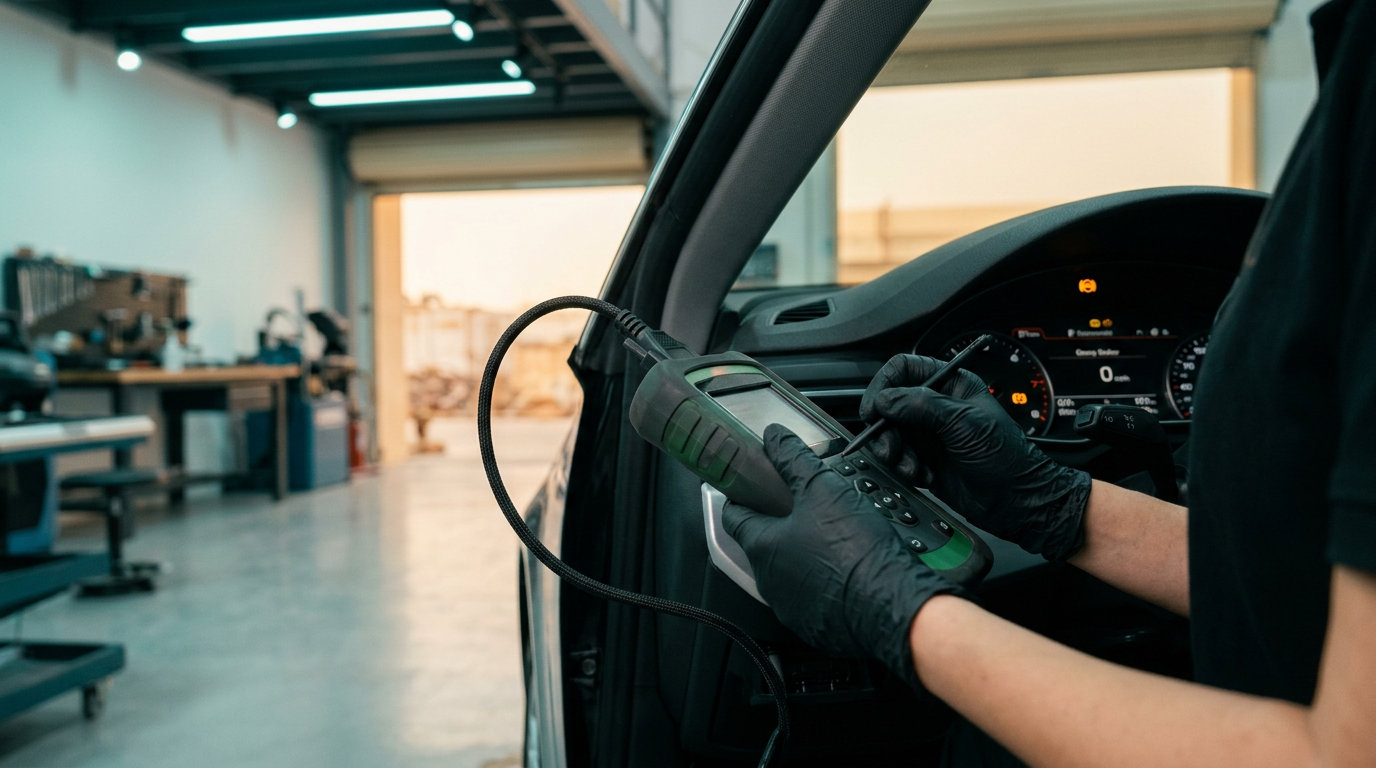
Frequent fast charging generates more heat and stress than slow AC charging, which can accelerate battery degradation over thousands of cycles. If you rely heavily on DC fast charging, periodic diagnostic scans of the battery management system and cooling circuits help catch issues early. European EVs from Audi, BMW, Mercedes-Benz, and Porsche log detailed charge-cycle data accessible via manufacturer-grade diagnostic equipment.
If your EV shows reduced charging speed, longer session times, or frequent thermal warnings, the issue may lie in the cooling pump, thermal sensors, or cell-balancing algorithms rather than the charging station itself. Independent workshops with EV-capable diagnostic tools can retrieve fault codes and compare actual vs expected charging curves, pinpointing whether the problem is vehicle-side or infrastructure-side.
For owners of high-performance EVs—Porsche Taycan, Audi e-tron GT, BMW iX—regular checks of the high-voltage battery cooling system and electrical and electronics are as important as traditional maintenance. Dubai's heat accelerates coolant degradation and places continuous load on thermal management components.
Practical Takeaways for Dubai EV Owners
Understanding the interplay between AC and DC charging, onboard limits, battery temperature, and state of charge helps you plan charging stops more accurately and avoid frustration when a "fast" charging station delivers slower-than-expected results. Always charge to 80 percent on road trips to minimise time, pre-cool your cabin and battery if your EV supports it, and rely on home AC charging for daily use whenever possible to preserve battery health and reduce cost per kilometre.
If you are considering an electric vehicle purchase or already own one, factor in your access to home charging infrastructure and the density of public DC fast-charging stations along your regular routes. The total cost of ownership calculation shifts significantly depending on whether you pay AED 0.29 per kWh at home or AED 1.20 per kWh at a public fast charger.
For fleet operators managing multiple electric vehicles, understanding charging curves and station capacity is critical to route planning and minimising downtime. JAD Garage offers fleet services and corporate accounts tailored to businesses transitioning to electric mobility, including diagnostic support and maintenance scheduling that accounts for high-voltage system health.
EV Diagnostics and Electrical Support in Al Quoz
If your electric vehicle is charging slower than expected or showing thermal warnings, JAD Garage in Al Quoz 4 offers manufacturer-grade diagnostics for European EVs. Call +971 56 355 6113 to book an inspection.
Frequently asked questions