
Cabin and Air Filter Replacement Intervals in Dusty Climates

In Dubai's dusty climate, you should replace your cabin air filter every 10,000–15,000 km or annually, whichever comes first—significantly more often than the typical 20,000–30,000 km factory interval. Fine desert sand, construction dust, and high HVAC usage accelerate clogging, reducing air quality and system performance inside your vehicle.
Why Dubai Conditions Shorten Cabin Filter Life
Most manufacturers base their recommended cabin filter replacement interval on temperate climates with paved roads and moderate air pollution. Volkswagen, Toyota, and Ford owner manuals typically specify 20,000–30,000 km or every two years for cabin air filter changes under normal conditions.
Dubai is not a normal environment. Summer temperatures reach 50°C, forcing your HVAC system to run continuously at maximum capacity. Fine sand particles smaller than 10 microns penetrate engine bays and ventilation intakes. Construction activity across the emirate generates constant dust clouds, and stop-start traffic through areas like Al Quoz and Sheikh Zayed Road means your car inhales more particulate matter per kilometre than highway cruising ever would.
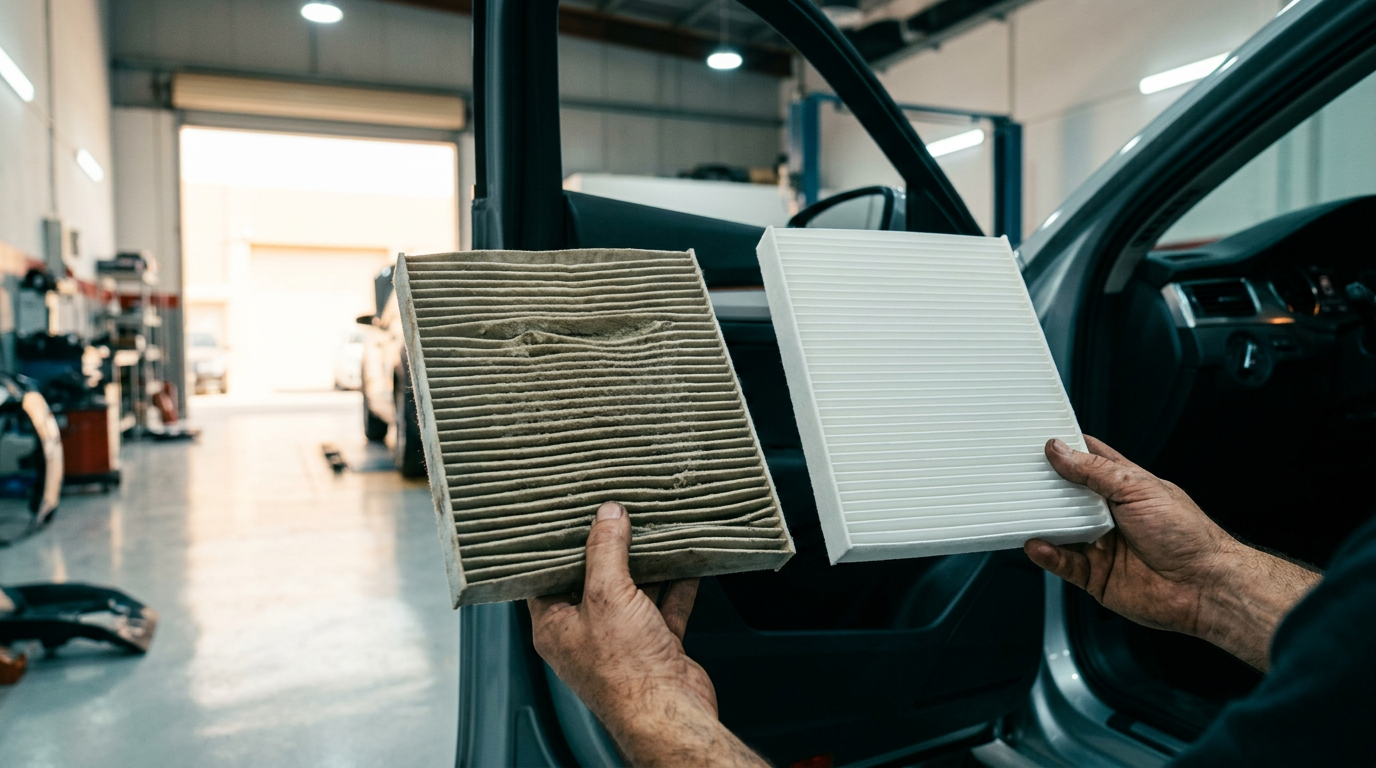
The cabin air filter traps all of this before it reaches your face. Where a filter might last 30,000 km in Germany or the UK, it will often be visibly clogged and restricting airflow at half that distance here. This isn't a theoretical concern—pull out a year-old filter from any Dubai car and you'll see a thick layer of tan dust coating the pleats.
We covered this broader topic in detail in our article on how UAE conditions change service intervals, but the cabin filter deserves special attention because it directly affects your health and comfort every time you drive.
Recommended Cabin Air Filter Replacement Intervals for Dubai
Adjust your replacement schedule based on how and where you drive:
- City driving in Dubai, Sharjah, or Abu Dhabi: every 10,000 km or 12 months
- Frequent desert or off-road driving: every 8,000 km or 6–9 months
- Mostly highway, minimal construction zones: every 15,000 km or 12 months
- Cars parked outdoors in industrial areas (Al Quoz, Jebel Ali): inspect every 6 months, replace as needed
If your car has a premium activated-charcoal cabin filter (common in Mercedes-Benz, BMW, and Audi models), the interval remains the same. Charcoal filters lose their odour-absorbing capacity even faster in heat, so don't assume the higher price means longer life.
For luxury car owners and sports car enthusiasts, many high-end models use larger or dual-stage filters that cost more to replace but still need changing at Dubai-appropriate intervals. A clogged filter in a Porsche or Range Rover will strain the HVAC blower motor just as quickly as in any other vehicle.
Cabin Air Filter vs Engine Air Filter: Different Jobs, Different Intervals
Many drivers confuse the two. The engine air filter cleans air entering the combustion chamber; the cabin air filter cleans air entering the passenger compartment through the HVAC system. Both suffer in Dubai's environment, but they're not on the same replacement schedule.
Engine air filters typically need replacement every 15,000–20,000 km in dusty conditions, but you can visually inspect them easily—most are housed in a plastic box under the bonnet. Cabin air filters sit behind the glove box or under the dashboard, making them less accessible and often forgotten during routine oil changes.
Both filters are part of comprehensive general maintenance, but the cabin filter has a more direct impact on your daily comfort. A dirty engine air filter reduces fuel economy and performance gradually; a clogged cabin filter makes every drive unpleasant immediately.
Signs Your Cabin Air Filter Needs Replacement Now
Don't wait for the service interval if you notice any of these symptoms:
- Weak airflow from vents: the blower motor runs but barely any air comes out, even on maximum setting
- Musty or dusty smell when AC starts: trapped moisture and particles create odours as they decay
- Visible dust on the dashboard after driving: the filter is so clogged that unfiltered air bypasses it
- Windows fog up more easily: restricted airflow prevents the HVAC from dehumidifying effectively
- Increased allergy symptoms in the car: pollen, dust mites, and fine particulates pass through a saturated filter
If your AC system isn't cooling properly, a clogged cabin filter might be part of the problem—though refrigerant levels, compressor health, and condenser blockage are more common culprits in Dubai. We've written a detailed guide on why your car AC might run but not cool that covers the full diagnosis process.
What Happens If You Ignore Cabin Filter Replacement
You can drive indefinitely with a dirty cabin air filter—it won't damage your engine or cause a breakdown. But the consequences accumulate:
First, your HVAC blower motor works harder to push air through the clogged media, drawing more current and generating more heat. Over time, this shortens the motor's lifespan. Blower motor replacement typically costs AED 800–2,000 depending on the vehicle, far more than a AED 80–250 filter.
Second, air quality inside the cabin deteriorates. You're breathing unfiltered dust, diesel particulates from trucks, and allergens. For families with young children or passengers with respiratory conditions, this isn't trivial.
Third, moisture that would normally evaporate gets trapped in the saturated filter, creating a breeding ground for mould and bacteria. That musty smell isn't just unpleasant—it's a sign of biological growth in your ventilation system. Cleaning or replacing the evaporator to remove mould is an expensive fix that a timely filter change would have prevented.
Finally, reduced airflow makes your AC work harder to cool the cabin, increasing fuel consumption slightly and putting extra load on the compressor. In Dubai's summer, your AC already runs at maximum capacity; don't make it struggle further.
How to Check Your Owner Manual for the Baseline Interval
Even though you'll shorten the interval for Dubai, start by finding your manufacturer's recommendation. Open your owner manual (or download the PDF from the manufacturer's website) and look for the maintenance schedule section. Cabin air filter replacement is usually listed under "periodic maintenance" or "service intervals."
Most manuals distinguish between "normal" and "severe" driving conditions. Severe conditions typically include:
- Dusty or sandy environments
- High ambient temperatures
- Stop-and-go city traffic
- Short trips under 10 km
Dubai driving ticks every box. If your manual specifies 30,000 km for normal conditions and 15,000 km for severe, use the severe interval as your starting point, then consider shortening it further based on actual filter condition at each service.
For European brands like Volvo, Peugeot, and Citroën, service schedules are often conservative because they're designed for European conditions. Our article on Peugeot, Citroën and Renault servicing in Dubai discusses how to adapt French car maintenance for the UAE.
Replacement Process: Quick and Inexpensive
Cabin air filter replacement is one of the simplest maintenance tasks. On most vehicles, the filter sits behind the glove box and can be accessed by releasing a few clips—no tools required. Some German and Italian cars position it under the dashboard or behind the engine firewall, requiring more disassembly.
The filter itself is a rectangular pleated panel, sometimes with an activated-charcoal layer that looks darker. Premium OEM filters from manufacturers cost AED 150–350, while quality aftermarket alternatives range from AED 80–180. Both do the same job; the difference is usually brand markup rather than filtration performance.
Labour time is typically 10–20 minutes, so this is often done during routine servicing alongside oil changes or brake inspections. If you're comfortable with basic car maintenance, many owners choose to replace cabin filters themselves—just make sure you install the new filter with the airflow arrow pointing in the correct direction.
Special Considerations for EVs and Hybrids
Electric vehicles like the Polestar 2 or Tesla Model 3 still need cabin air filter changes on the same schedule as petrol cars. In fact, because EVs are silent, you'll notice reduced airflow and odours more readily without engine noise masking the symptoms.
Some EVs use HEPA-grade cabin filters with much finer filtration, marketed as "bioweapon defence mode" or similar. These still clog with Dubai dust and need replacement every 10,000–15,000 km, despite the premium branding. Our guide to Polestar and Volvo EV maintenance covers the full service schedule for Scandinavian electric cars in UAE conditions.
Hybrid vehicles run their petrol engines intermittently, but the HVAC system and cabin filter operate identically to conventional cars. Follow the same Dubai-adjusted intervals.
When to Inspect Between Replacements
If you're stretching toward the 15,000 km mark or driving through unusually dusty periods (sandstorms, construction detours, desert trips), ask your workshop to pull and inspect the cabin filter during any service visit. A visual check takes two minutes and costs nothing.
A clean filter is white or light grey with visible pleats. A filter ready for replacement is tan or brown, with dust caked between the folds and reduced space between pleats. If you can't see light through it when held up to a lamp, it's done.
For fleet managers or corporate account holders maintaining multiple vehicles, standardising cabin filter replacement at every 10,000 km service simplifies scheduling and ensures consistent air quality across your fleet.
Choosing the Right Replacement Filter
Three types are commonly available:
Particulate filters: standard white pleated paper that traps dust, pollen, and larger particles. Adequate for most drivers and the most affordable option.
Activated charcoal filters: add a layer of carbon media to absorb odours, exhaust fumes, and VOCs. Worth the extra AED 50–100 if you're sensitive to smells or spend a lot of time in traffic.
HEPA or electrostatic filters: premium options that claim 99% filtration of particles down to 0.3 microns. Useful for allergy sufferers but no more durable in Dubai dust—they still need changing at the same interval.
Stick with OEM filters or reputable aftermarket brands like Mann, Bosch, or Mahle. Cheap unbranded filters from dubious suppliers may use lower-grade media that collapses or sheds fibres into your ventilation system.
Cabin Filter Replacement in Al Quoz
Breathing clean air in your car starts with a fresh cabin filter. Visit JAD Garage at Warehouse No.1, Street 8, Al Quoz 4, or call +971 56 355 6113 to book your filter replacement and full HVAC system check.
Frequently asked questions