Electric Vehicle Servicing: The Real Annual Checklist


Electric vehicle servicing requires fewer tasks than a gas powered car, but the jobs you do perform are critical. EVs skip oil changes, spark plugs, and exhaust work, yet battery cooling systems, brake fluid, tire pressure, software updates, and high-voltage safety checks demand strict annual attention—especially in Dubai's heat and stop-start traffic.
Why Electric Vehicles Require Less—But Different—Maintenance
Electric cars eliminate hundreds of moving parts found in conventional combustion engines. No oil filter, no transmission fluid changes (in single-speed units), no timing belts, no exhaust components. Tesla, for example, publishes a maintenance schedule that lists just tire rotations, cabin air filters, brake fluid tests, and battery coolant checks over the first 100,000 miles. Ford's Mustang Mach-E follows a similar pattern.
Yet this simplicity creates a trap: owners assume EVs require no maintenance at all. In reality, the battery pack, cooling system, and regenerative braking components are expensive, heat-sensitive systems that degrade faster when neglected. Dubai's ambient temperatures—reaching 50°C in summer—accelerate coolant breakdown, cabin filter clogging from fine sand, and tire wear from heavy curb weights. Short city trips and fast charging cycles also stress the battery pack more than highway cruising.
The Real Annual Electric Vehicle Servicing Checklist
Here's what every EV owner in Dubai should inspect or service once per year, regardless of mileage. Some items may need attention every six months if you drive more than 15,000 km annually or rely heavily on public fast charging.
- Battery cooling system: Check coolant level, concentration, and condition. Most manufacturers specify glycol-based coolant replacement every two to four years, but heat exposure in the UAE can degrade additives faster. A diagnostic scan will flag coolant pump faults or temperature sensor drift.
- Brake fluid: Even with regenerative braking reducing pad wear, brake fluid absorbs moisture. RTA requires functional hydraulic brakes for registration renewal. Test moisture content annually; replace if it exceeds 3% water by volume (typically every two years in humid climates).
- Brake pads and rotors: EVs wear brakes differently. Regenerative braking reduces friction use, but low-speed stops still engage pads. Inspect thickness and rotor surface for rust or uneven wear. Read more in our guide on EV brakes and tyres.
- Tires: Electric vehicles are heavier than equivalent gas cars due to the battery pack. A Tesla Model 3 Long Range weighs approximately 1,830 kg versus 1,500 kg for a BMW 330i. Check tire pressure monthly (heat raises pressure by roughly 1 psi per 5°C), rotate every 10,000 km, and replace when tread depth falls below 3 mm. Tire services include balancing and alignment checks critical for range efficiency.
- Cabin air filter: Dubai's fine sand clogs filters faster than in temperate climates. Replace every 12 months or 15,000 km to maintain AC efficiency and air quality. A blocked filter forces the blower motor to work harder, drawing more battery power.
- Windshield washer fluid and wiper blades: Heat degrades rubber quickly. Replace windshield wiper blades every six to twelve months. Top up windshield washer fluid with a concentrate that won't evaporate rapidly in 50°C heat.
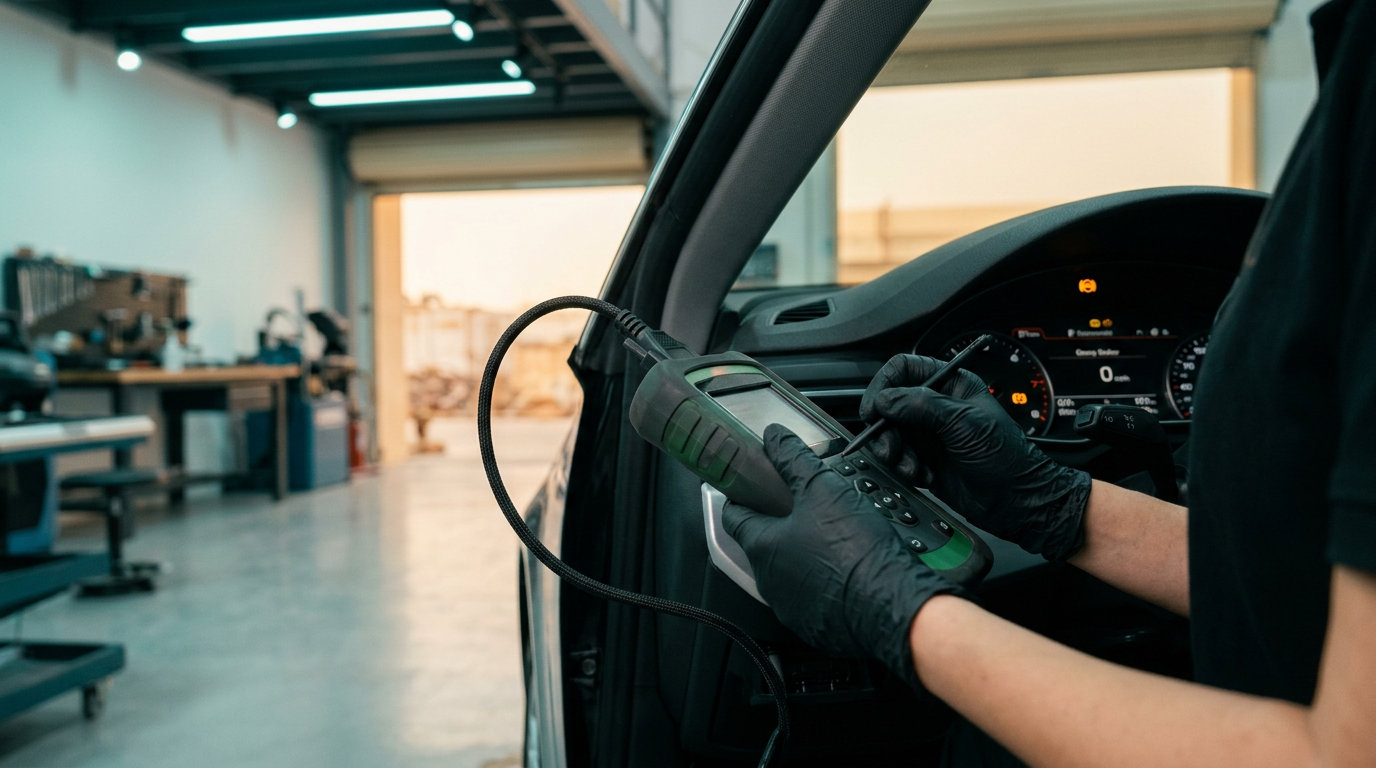
- High-voltage battery health check: A diagnostic scan retrieves state-of-health (SOH) percentage, cell voltage balance, and charge cycle count. Degradation below 90% SOH within the first three years may indicate cooling faults or aggressive fast charging habits. Learn more in our article on EV battery health in UAE heat.
- Software and firmware updates: Manufacturers release over-the-air (OTA) updates for battery management, charging algorithms, and safety systems. If your vehicle doesn't support OTA, an annual visit to a facility with ECU programming tools ensures you're running the latest software.
- 12-volt auxiliary battery: EVs use a small 12V battery to power computers, lights, and door locks. Heat kills these batteries in 18–24 months in the UAE. Test voltage and cranking amps annually; replace proactively. See our guide on battery care in the UAE.
- Suspension and steering components: Heavier curb weight increases stress on bushings, ball joints, and tie rods. Inspect for play or noise annually. Suspension and steering work is identical to conventional vehicles.
- AC system: The air conditioning in an electric car also cools the cabin and sometimes assists battery thermal management. Check refrigerant charge, compressor function, and evaporator cleanliness. AC services prevent efficiency losses that cut driving range.
Maintenance Works: EV vs Gas Powered Car
The table below compares typical annual maintenance tasks. Note that hybrid vehicles fall somewhere between, retaining engine oil and filters but adding battery cooling and regenerative brake systems.
| Task | Gas Powered Car | Electric Vehicle |
|---|---|---|
| Engine oil & filter | Every 5,000–10,000 km | Not applicable |
| Spark plugs | Every 30,000–60,000 km | Not applicable |
| Transmission fluid | Every 40,000–80,000 km | Not applicable (single-speed) |
| Exhaust & emissions | Annual inspection | Not applicable |
| Battery coolant | Not applicable | Check annually, replace every 2–4 years |
| Brake fluid | Every 2 years | Every 2 years (test annually) |
| Cabin air filter | Every 15,000 km | Every 15,000 km |
| Tire rotation | Every 10,000 km | Every 10,000 km |
| 12V auxiliary battery | Every 3–5 years | Every 18–24 months (UAE heat) |
| Software updates | Rare | Annually or OTA |
Battery Pack Care: Charging Practices That Extend Life
The lithium-ion battery pack is the single most expensive component in an electric vehicle, typically costing AED 40,000–80,000 to replace out of pocket (manufacturer warranties in the United States and UAE commonly cover eight years or 160,000 km). Proper charging habits slow degradation:
- Avoid frequent fast charging: DC fast chargers push high current into cells, generating heat. Reserve them for road trips; use AC Level 2 charging at home or work whenever possible.
- Keep state of charge between 20% and 80%: Lithium cells degrade faster at very high or very low charge levels. Most EVs let you set a daily charge limit; use 80% for routine driving and 100% only before long trips.
- Precondition the battery: If your vehicle supports it, precondition the battery pack while plugged in before summer drives. This cools the pack using grid power instead of draining range.
- Park in shade: A battery pack sitting at 50°C ambient will degrade faster than one at 25°C. Covered parking is worth the cost in Dubai.
Where to Service Your Electric Vehicle in Dubai
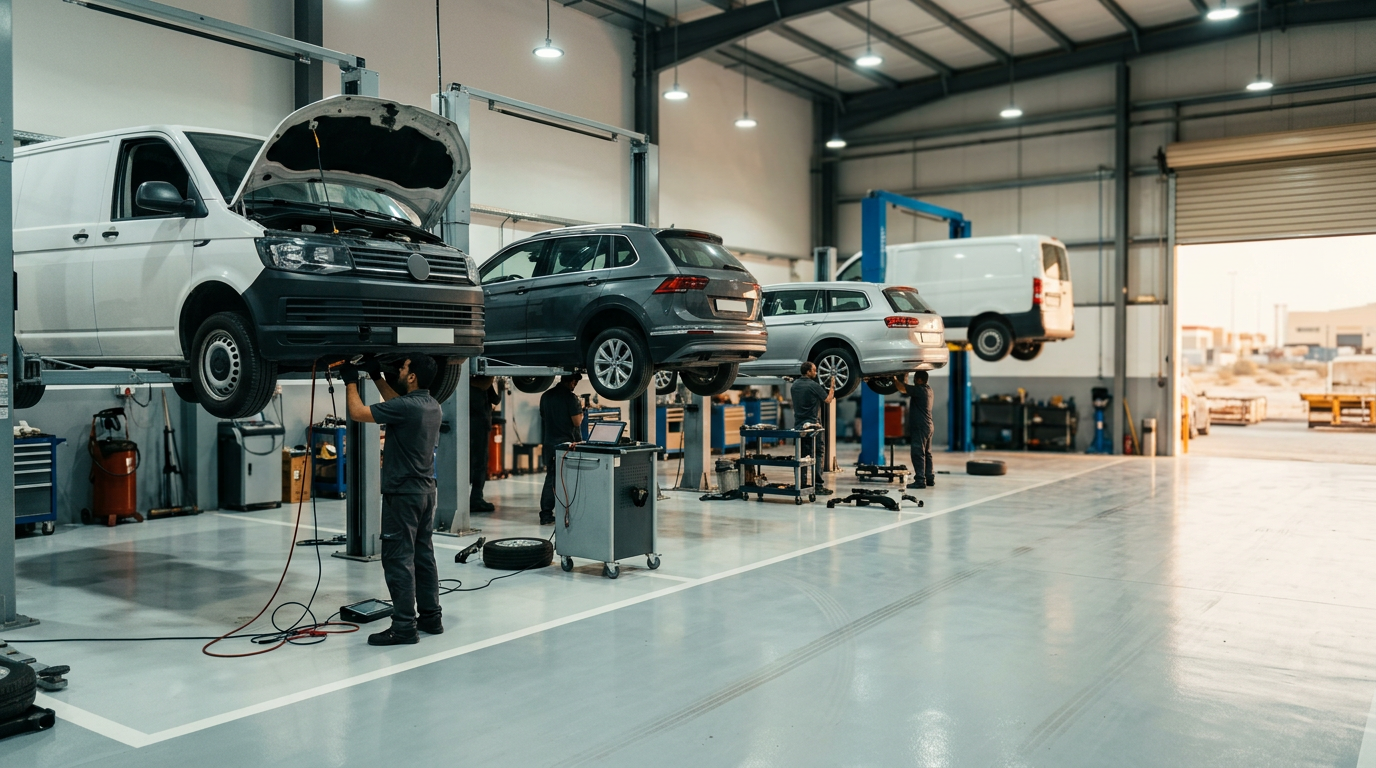
Independent workshops with manufacturer-grade diagnostic equipment can perform every item on this checklist except warranty-covered battery pack replacements. Look for facilities that invest in high-voltage safety training, insulated tools, and EV-specific scan tools. Brands such as Tesla, BMW, Audi, Mercedes-Benz, Porsche, Polestar, Volvo, and Jaguar all have hybrid or fully electric models circulating in the UAE.
For fleet operators managing multiple electric vehicles, predictable service intervals and lower fluid costs make EVs attractive—but only if you track battery health and cooling system condition rigorously. Our fleet services include centralized reporting and scheduled inspections to minimize downtime. Read more on downtime cost per vehicle.
Common Repairs and Troubleshooting for EVs
While electric vehicles require less routine maintenance, certain repairs do occur:
- 12V battery failure: Symptoms include failure to wake the vehicle, door locks not responding, or dashboard blank. Replacement is straightforward and costs AED 400–800 in the Dubai market depending on brand and capacity.
- Coolant leaks: Battery cooling systems use hoses, pumps, and heat exchangers that can crack or leak. A puddle under the vehicle or a high-temperature warning on the dash warrants immediate diagnostic attention.
- Charging port or cable faults: Worn contacts, foreign objects, or software glitches can prevent charging. Electrical and electronics diagnostics pinpoint the fault.
- Tire wear: Instant torque and heavy weight accelerate tread wear. Rotate on schedule and check alignment if the vehicle pulls to one side.
- Software glitches: Occasionally, an EV will throw spurious warnings or fail to charge due to corrupted firmware. A reflash via ECU programming tools resolves most issues.
Are EV Servicing Costs Lower Than Gas Cars?
Over the first three years and 60,000 km, electric vehicles typically cost 30–40% less to maintain than equivalent gas powered cars, primarily because you eliminate engine oil changes, spark plug replacement, and exhaust work. However, when the battery pack or high-voltage components require repair outside warranty, costs can exceed conventional vehicle repairs significantly. Preventive annual checks—especially cooling system and software updates—protect that investment.
Typical annual service costs in the Dubai market range from AED 800 to AED 1,500 for a comprehensive EV inspection covering all the checklist items above, excluding tire replacement or major component repairs. By contrast, a gas car's annual service including oil, filters, and spark plugs might run AED 1,200 to AED 2,500 depending on the model.
Safety Protocols for EV Maintenance
High-voltage systems (typically 400V or 800V) demand strict safety procedures. Technicians must isolate the battery pack before working on cooling, braking, or electrical systems. Insulated gloves, voltage testers, and clear lockout/tagout protocols are non-negotiable. Owners should never attempt to open high-voltage covers or orange-jacketed cables themselves. For any car repair involving the propulsion system, choose a workshop with documented EV training and equipment.
If you're considering a used electric vehicle, a pre-purchase inspection should include a battery health report and cooling system pressure test. Our article on cars to avoid buying used in the UAE discusses red flags that apply to EVs as well.
Expert Electric Vehicle Servicing in Al Quoz
Keep your EV running efficiently in Dubai's demanding climate. Our Al Quoz workshop uses manufacturer-grade diagnostics for battery health, cooling systems, and software updates. Call +971 56 355 6113 or visit Warehouse No.1, Street 8, Al Quoz 4 to book your annual EV service.
Frequently asked questions