
MINI Cooper Common Faults and Service Costs in Dubai

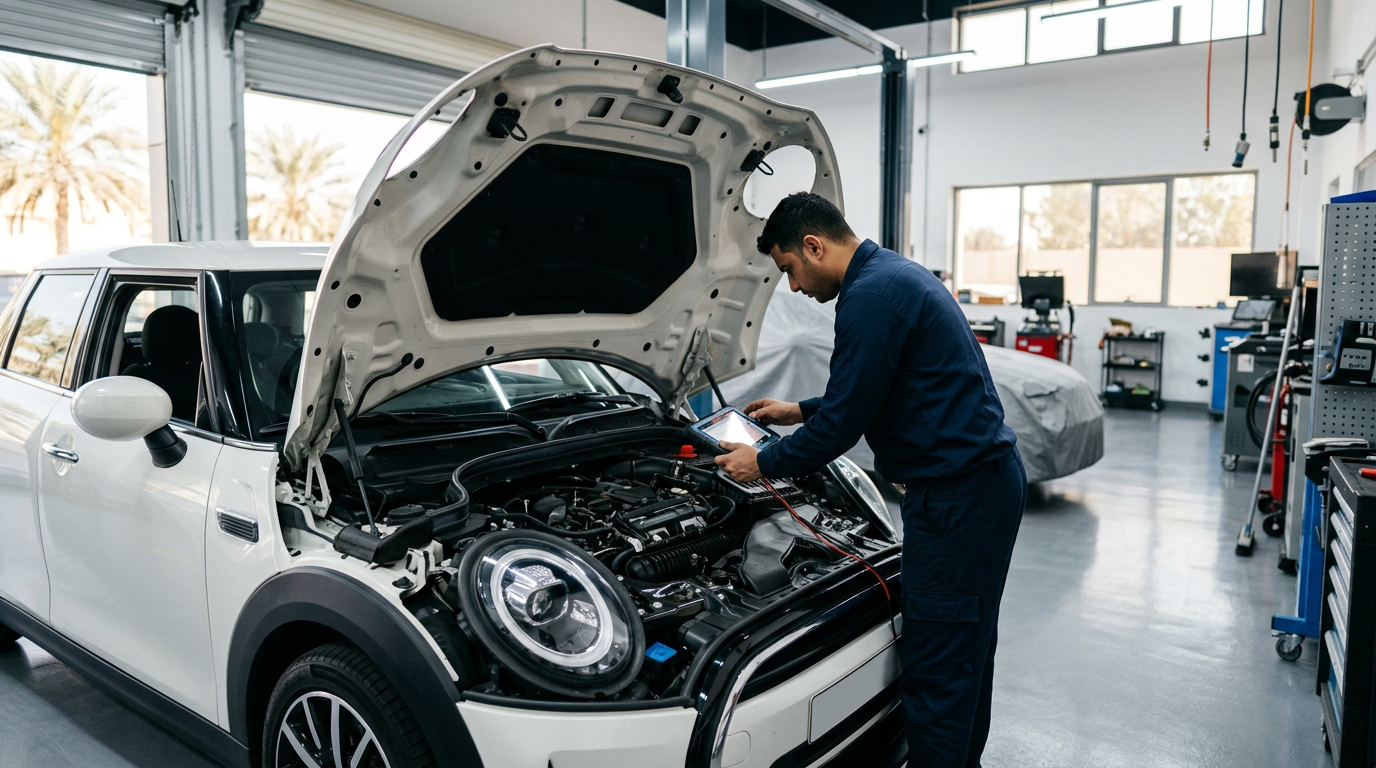
MINI Cooper problems typically centre around timing chain tensioners, carbon buildup on intake valves, valve cover gasket oil leaks, and wastegate rattle in turbocharged models. While these cars offer character and driving fun, owners report higher-than-average maintenance needs, especially after 60,000 km. Regular oil changes and early intervention prevent most catastrophic failures.
Why Mini Cooper Problems Are Common
Since BMW acquired the MINI brand in 2000, modern Mini Coopers share many components with BMW's 1 and 3 Series. That means they inherit both the engineering sophistication and some of the reliability challenges of their Bavarian cousins. The compact engine bay, turbocharged engines, and performance-oriented tuning create stress points that Dubai's climate amplifies.
Heat, short city trips, and stop-start traffic accelerate wear on turbochargers, gaskets, and timing components. Many Mini Coopers in the UAE clock low annual mileage but endure harsh operating conditions—exactly the scenario that reveals common mini cooper weaknesses early.
Timing Chain Tensioner Failure
The timing chain tensioner is the single most serious issue across second-generation (R56) and early third-generation (F56) models built between 2007 and 2015. Unlike a timing belt, which requires scheduled replacement, a timing chain is designed to last the engine's lifetime. But the plastic tensioner and guides wear prematurely, especially in engines that see irregular oil changes or extended service intervals.
Symptoms include a loud rattling noise on cold start that fades after a few seconds, or a persistent metallic rattle from the front of the engine. If ignored, the chain can skip teeth or snap, causing catastrophic valve and piston damage. Replacement typically costs between AED 3,500 and AED 6,000 in Dubai, depending on the model and whether cylinder head work is needed.
The Prince engine family (used in Cooper S, JCW, and some standard Coopers) is most affected. Later F-series models from 2016 onward use revised tensioners with improved materials, reducing but not eliminating the risk. Engine services should include a visual and audible check of timing components, especially on cars approaching 80,000 km.
Carbon Buildup on Intake Valves
Direct-injection turbocharged engines—common across Cooper S and JCW variants—suffer from carbon buildup intake valves because fuel no longer washes over the valve stems. Instead, oil vapour from the crankcase ventilation system bakes onto the hot valve surfaces, gradually restricting airflow.
Owners report symptoms around 60,000 to 100,000 km:
- Rough idle and hesitation during acceleration
- Check engine light with misfiring codes (P0300-P0304)
- Reduced fuel economy and loss of power
- Hard starting, especially when the engine is warm
The only effective solution is walnut blasting—a process that uses crushed walnut shells to physically scrub carbon from the valves without damaging metal surfaces. This service typically ranges from AED 1,200 to AED 2,500 for a four-cylinder engine in Dubai. Preventive measures include frequent oil changes with high-quality synthetic oil and occasional high-RPM driving to increase exhaust gas temperatures.
Valve Cover and Oil Leaks
Valve cover gasket leaks are almost inevitable on Mini Coopers beyond five years or 80,000 km. The gasket hardens in Dubai's heat, allowing oil to seep down the side of the engine block. Left unchecked, oil drips onto the exhaust manifold, creating a burning smell and visible smoke from the engine bay.
Replacement is straightforward but labour-intensive due to the cramped engine bay. Expect to pay AED 800 to AED 1,800 depending on whether you choose OEM or premium alternative parts. Many independent workshops in Al Quoz recommend replacing the valve cover gasket, spark plug tube seals, and crankcase breather valve simultaneously to avoid repeat labour charges.
Other common oil leak points include the oil filter housing gasket (a known weak spot on N14 and N18 engines) and the vacuum pump seal. Regular inspections during general maintenance catch these leaks before they become expensive.
Wastegate Rattle in Turbocharged Models
Wastegate rattle is a characteristic metallic buzzing or rattling noise from turbocharged Coopers, most noticeable between 2,000 and 3,000 RPM under light throttle. It's caused by play in the wastegate actuator arm inside the turbocharger. While it sounds alarming, wastegate rattle rarely leads to turbo failure—it's more of an annoyance than a mechanical threat.
Some owners live with the noise; others opt for turbocharger replacement or aftermarket actuator upgrades. A new or remanufactured turbo can cost AED 4,000 to AED 8,000 installed. If boost pressure remains normal and there's no oil consumption or blue smoke, the rattle alone doesn't justify immediate replacement. Diagnostic services can confirm whether boost control and wastegate function are within specification.
Cooling System and Thermostat Issues
Plastic cooling system components—thermostat housings, expansion tanks, and radiator end tanks—degrade faster in UAE heat. Thermostats can stick open (causing slow warm-up and poor heater performance) or closed (leading to overheating). Expansion tanks develop stress cracks, especially around mounting points.
A failing thermostat often triggers a check engine light with codes related to coolant temperature. Replacement costs AED 600 to AED 1,200. It's wise to replace the thermostat housing, coolant hoses, and expansion tank cap as preventive measures during any cooling system repair, since labour is the largest cost component.
Overheating in Dubai traffic is serious. If the temperature gauge climbs above normal or the check engine light illuminates with a coolant warning, pull over immediately to avoid warping the cylinder head.
Electric Power Steering Pump Failure
Second-generation Mini Coopers (R56, R57, R58, R59) use an electric power steering pump that sits low in the engine bay, vulnerable to water ingress and heat. Pump failure causes heavy, unassisted steering and often triggers a warning light on the dashboard.
Replacement pumps cost AED 2,500 to AED 4,500 depending on whether you source OEM or remanufactured units. Symptoms include whining noises during steering input, intermittent loss of assist, or a sudden failure with no prior warning. Suspension and steering specialists can test pump output pressure and verify electrical supply before condemning the unit.
Transmission and Clutch Wear
Manual transmissions in Mini Coopers are generally robust, but clutches wear faster in stop-start Dubai traffic. Expect clutch replacement around 80,000 to 120,000 km depending on driving style. A full clutch kit with flywheel resurfacing typically costs AED 2,800 to AED 4,500.
Automatic transmissions—especially the six-speed Aisin unit in later models—are more reliable but require regular fluid changes. BMW's official "lifetime fill" recommendation doesn't account for UAE heat and traffic. Independent specialists recommend transmission services every 60,000 km to prevent valve body issues and torque converter shudder.
Electrical Gremlins and Window Regulators
Mini Coopers suffer from minor electrical issues: window regulators that fail (especially the driver's side), door lock actuators that stick, and occasional module faults. Window regulator replacement costs AED 600 to AED 1,200 per door. These aren't safety-critical, but they're frustrating and common enough to budget for.
Battery drain issues sometimes trace back to faulty comfort access modules or aftermarket accessories. A proper electrical and electronics diagnosis with manufacturer-grade equipment isolates parasitic draw and module faults without guesswork.
How Long Do Mini Coopers Last?
With diligent maintenance, a Mini Cooper can reach 200,000 km or more. But "diligent" means oil changes every 8,000 km (not the 15,000 km interval some manuals suggest for European driving), cooling system refreshes every three years, and early attention to timing chain noise or oil leaks.
Dubai's conditions shorten component life. Turbos, gaskets, and plastic parts age faster here than in temperate climates. Owners who treat their Mini like a low-maintenance appliance face expensive failures; those who stay ahead of common mini cooper problems enjoy relatively affordable ownership.
Service Cost Expectations in Dubai
Routine servicing for a Mini Cooper at an independent European specialist typically ranges from AED 600 to AED 1,200 depending on the service interval and required consumables. Major services including brake services, coolant flush, and gearbox oil can reach AED 1,800 to AED 2,500.
Repair costs vary widely based on the fault:
- Timing chain tensioner replacement: AED 3,500–6,000
- Carbon cleaning (walnut blasting): AED 1,200–2,500
- Turbocharger replacement: AED 4,000–8,000
- Clutch and flywheel: AED 2,800–4,500
- Valve cover gasket: AED 800–1,800
- Power steering pump: AED 2,500–4,500
These are typical market ranges across Dubai's independent workshops. Using OEM parts raises costs by 20–40% compared to premium alternative brands that meet or exceed original specifications.
Which Mini Cooper Models to Avoid
The second-generation R56 Cooper S (2007–2010) with the N14 engine has the worst reputation for timing chain and high-pressure fuel pump failures. The 2011–2013 facelift models with the N18 engine are more reliable but still prone to carbon buildup and oil leaks.
Third-generation F56 models from 2014 onward are significantly improved, especially 2016+ cars with the revised B-series engines co-developed with BMW. These still require careful maintenance but avoid the catastrophic timing chain failures of earlier generations. Before purchasing any used Mini, a pre-purchase inspection with compression testing and timing chain assessment is essential.
Maintenance Tips for Dubai Owners
Preventing common mini cooper problems in the UAE comes down to a few key habits:
- Change oil every 8,000 km with fully synthetic 5W-30 or 0W-40
- Listen for timing chain rattle on cold starts and investigate immediately
- Check coolant level monthly and watch for leaks under the car
- Have carbon buildup assessed around 80,000 km if you notice hesitation
- Replace valve cover gaskets and seals at the first sign of oil seepage
- Use high-quality fuel from reputable stations to reduce carbon formation
- Allow the engine to warm up before aggressive driving, especially in summer
Dubai's heat accelerates every wear mechanism. Components that might last 150,000 km in Europe often fail at 100,000 km here. Shorter service intervals and proactive replacement of known weak points make Mini ownership far less painful.
Independent specialists with experience in BMW and MINI platforms offer the best value. They understand the common failure modes, stock the right parts, and charge transparent labour rates without the markup of a showroom environment.
Mini Cooper Specialist in Al Quoz
JAD Garage in Al Quoz 4 uses manufacturer-grade diagnostics and OEM-quality parts for all Mini Cooper repairs. From timing chain inspection to carbon cleaning, our technicians understand these cars inside out. Call +971 56 355 6113 or visit us Monday to Saturday, 09:00–19:00.
Frequently asked questions