
Porsche IMS, Coolant and PDK: What 911 and Cayenne Owners Should Watch

Three critical areas demand attention in water-cooled Porsche models driven in Dubai: the intermediate shaft (IMS) bearing in 1997–2008 911s, coolant pipes prone to cracking under heat cycles, and PDK transmission fluid that degrades faster in stop-start traffic. Regular inspection, proactive replacement before failure, and adherence to mileage-based service intervals protect both performance and resale value in the UAE's demanding climate.
The IMS Bearing Issue: Which Models and When to Act
The intermediate shaft bearing supports the camshaft drive system in M96 and early M97 engines fitted to 911 Carrera models from 1997 (996 generation) through 2008 (early 997). Porsche revised the bearing design multiple times, but all variants share a sealed cartridge that cannot be lubricated during routine oil change service.
Failure typically occurs between 40,000 and 100,000 miles, though some bearings last the engine's life and others fail earlier. The bearing's sealed design means contamination or insufficient grease from the factory cannot be corrected without removal. When it fails, metal debris circulates through the oiling system, often destroying the engine within minutes.
Models most affected:
- 996 Carrera (1999–2005) – all non-Turbo, non-GT variants
- Boxster 986 (1997–2004) – all variants
- 997.1 Carrera (2005–2008) – early production units
- Cayman 987.1 (2006–2008) – early production units
Turbo, GT2, and GT3 models use a different shaft arrangement and are not affected. The 997.2 generation (2009 onward) and all subsequent engines moved to the MA1 block with a larger, more robust bearing that has proven reliable.
Dubai's climate adds two risk factors: short trips in stop-start traffic prevent full engine warm-up, and extended periods of inactivity (common for second cars or summer storage) allow oil to drain from the bearing. If you own an affected model with unknown bearing history and mileage above 50,000, proactive replacement during clutch or rear main seal work makes financial sense. The bearing itself is inexpensive; labour involves removing the transmission and splitting the engine case.
Coolant Pipe Failures and Plastic Component Degradation
Water-cooled Porsche engines—both flat-six and V8—use plastic coolant pipes, thermostat housings, and expansion tanks that become brittle after years of heat cycling. In Dubai, where under-bonnet temperatures regularly exceed 90°C and ambient summer heat reaches 50°C, these components age faster than in temperate climates.
The 996 and 997 Carrera models are notorious for coolant pipe cracks at the rear of the engine, often near the cylinder head connection. The Cayenne V8 (both naturally aspirated and Turbo) suffers from expansion tank and pipe failures, typically between 80,000 and 120,000 km. A sudden coolant loss on Sheikh Zayed Road can lead to severe overheating within minutes.
Inspection during every major service should include:
- Pressure testing the cooling system to reveal micro-cracks before they rupture
- Visual check of all plastic components for discolouration, surface crazing, or weeping
- Expansion tank cap function and pressure rating
- Coolant condition and pH level—acidic coolant accelerates corrosion
Porsche specifies coolant replacement every three years or 60,000 km, whichever comes first. In the UAE, the time interval matters more than mileage for cars driven infrequently. Fresh coolant with the correct additive package protects aluminium engine blocks and maintains correct boiling point under pressure.
When replacing failed pipes, many owners opt to upgrade all related plastic components simultaneously. The labour to access rear coolant pipes on a 911 is substantial, so replacing adjacent parts during the same job prevents a second expensive strip-down within 12 months.
PDK Transmission Service Intervals and Fluid Condition
The Porsche Doppelkupplung (PDK) dual-clutch transmission debuted in the 997.2 generation (2009) and now appears across the 911, Cayenne, Panamera, and Macan ranges. Unlike a traditional torque-converter automatic, PDK uses two clutch packs submerged in transmission fluid. Clutch wear generates fine particles that contaminate the fluid, and heat from stop-start driving accelerates oxidation.
Porsche's official service schedule lists PDK fluid as "lifetime fill" in some markets, yet independent analysis and Porsche's own technical bulletins recommend replacement every 60,000 km or six years. In Dubai, where traffic congestion and high ambient temperatures stress the transmission, a 50,000 km interval is prudent.
Signs of degraded PDK fluid include:
- Hesitation or shudder during low-speed shifts (1st to 2nd gear)
- Delayed engagement when selecting Drive or Reverse
- Harsh downshifts under moderate braking
- Clutch slip or flare during acceleration
A full PDK service involves draining approximately seven litres of fluid, replacing the internal filter, and refilling with Porsche-approved PDK fluid (or a premium alternative meeting the same specification). The mechatronic unit—essentially the transmission's brain—also requires software adaptation after fluid replacement to recalibrate shift points and clutch engagement.
Neglecting PDK service can lead to clutch pack failure, which requires transmission removal and rebuild. Typical costs for clutch replacement in Dubai range from AED 15,000 to AED 25,000 depending on model and parts choice, compared to AED 2,500 to AED 4,000 for preventive fluid service.
Porsche Maintenance Schedule: Minor and Major Service Intervals
Porsche recommends service every 20,000 km or two years for most models, alternating between minor maintenance and major service. Dubai's severe operating conditions—heat, dust, short trips—mean time intervals often arrive before mileage thresholds.
| Service Type | Interval | Key Tasks |
|---|---|---|
| Minor Maintenance | 20,000 km / 2 years | Engine oil and filter, brake fluid check, visual inspection |
| Major Service | 40,000 km / 4 years | All minor tasks plus air filter, cabin filter, spark plugs (where applicable), brake system inspection |
| Brake Fluid Flush | Every 2 years | Complete system flush to remove moisture |
| Coolant Replacement | 60,000 km / 3 years | Drain, flush, and refill with approved coolant |
| PDK Fluid Service | 60,000 km / 6 years | Fluid and filter replacement, mechatronic adaptation |
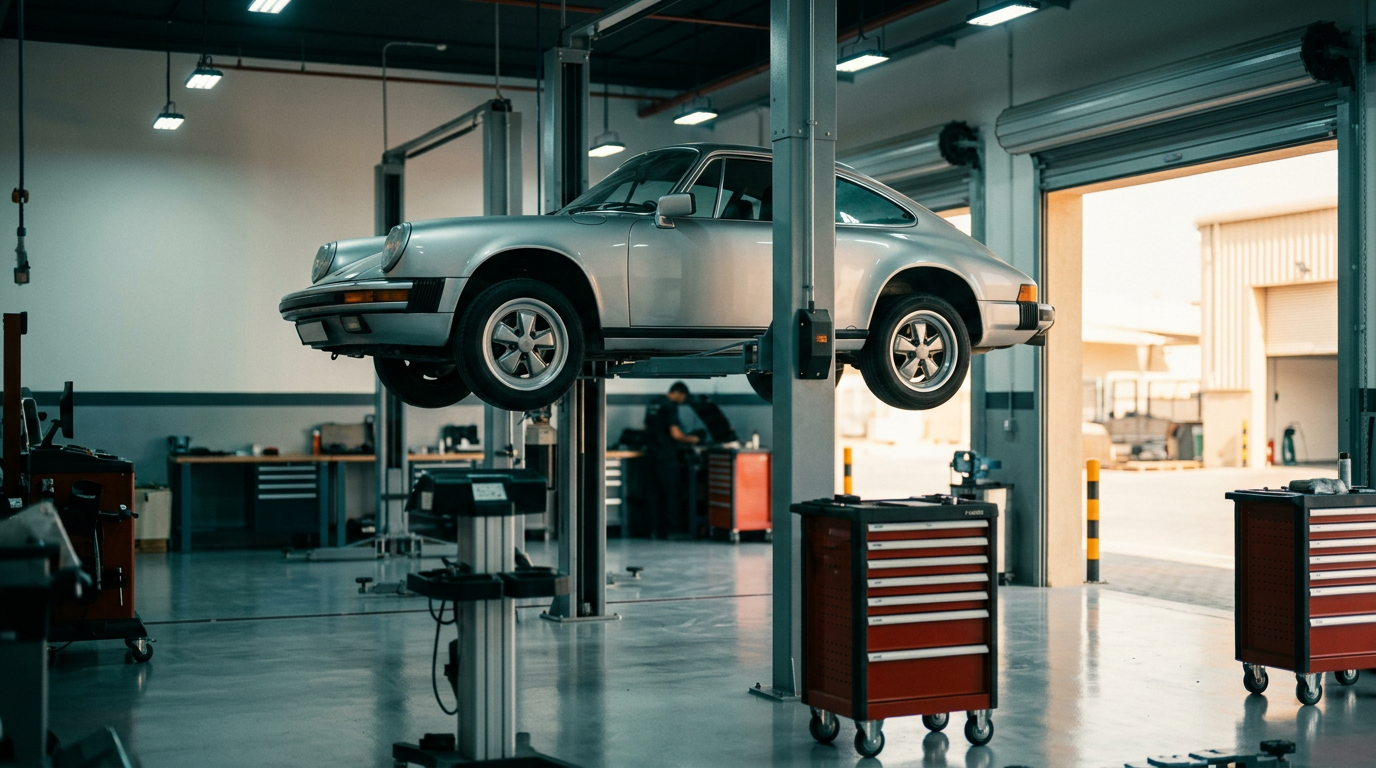
Air-cooled Porsche models (pre-1998 911s) follow different schedules. Without a water cooling system, they avoid coolant pipe issues but require more frequent valve adjustment—every 6,000 km for most models—and meticulous oil change intervals. High-quality oil is critical for air-cooled engines; the oil both lubricates and helps dissipate heat that would otherwise be managed by coolant.
For classic car service on air-cooled models, specialists familiar with mechanical fuel injection, distributor ignition, and manual valve adjustment are essential. Modern scan tools cannot communicate with these systems; diagnosis relies on mechanical gauges, compression testing, and experienced observation.
Brake System Maintenance in High-Temperature Conditions
Porsche brake systems are engineered for performance, with large ventilated discs and high-temperature pads. Dubai's heat accelerates brake fluid moisture absorption, lowering the boiling point and risking vapour lock under hard braking. Porsche specifies DOT 4 fluid replacement every two years regardless of mileage.
Brake pad and disc wear varies dramatically by driving style. Spirited driving or track use can consume pads within 20,000 km, while gentle urban driving may see 50,000 km. Minimum disc thickness specifications are stamped on the disc hub; once worn to minimum, replacement is mandatory for RTA testing.
Ceramic composite brakes (PCCB) fitted to many Turbo and GT models require specialized service. The discs themselves last 100,000 km or more, but pad replacement demands careful bedding-in procedures and specific pad compounds. Not all independent workshops have experience with PCCB; improper installation or incorrect pad material can damage the expensive ceramic rotors.
Choosing Between OEM and Premium Alternative Parts
Porsche parts carry a premium, but not every component demands the Porsche Crest. OEM vs aftermarket parts decisions should weigh risk, function, and cost.
Use genuine Porsche or OEM-equivalent for:
- Engine internals (IMS bearing, main seals, gaskets)
- Transmission components and fluids
- Safety-critical parts (brake calipers, ABS sensors, airbag components)
- Electronic modules and sensors
Premium alternatives work well for:
- Filters (oil, air, cabin) from brands like Mann or Mahle
- Brake pads and discs from Brembo, Pagid, or Textar
- Suspension bushings and mounts
- Coolant and brake fluid meeting Porsche specifications
Independent specialists with manufacturer-grade diagnostic equipment can service Porsche models to the same standard as main agents, often with more flexible parts sourcing and transparent pricing. For pre-purchase inspection of a used Porsche, an independent workshop can provide unbiased assessment of service history, deferred maintenance, and potential issues like IMS bearing risk or coolant system condition.
Building a Porsche Maintenance Checklist for Dubai Conditions
A practical maintenance checklist for Porsche ownership in the UAE should account for both manufacturer intervals and local stress factors:
- Every 10,000 km or 12 months: Engine oil and filter (more frequent than factory spec due to heat and short trips)
- Every 20,000 km or 2 years: Full vehicle inspection, brake fluid flush, tyre rotation
- Every 40,000 km or 4 years: Air filter, cabin filter, spark plugs, suspension and steering component check
- Every 60,000 km or 3 years: Coolant system pressure test and replacement, PDK fluid service, comprehensive electrical system scan
- Annually: AC system service (refrigerant pressure, condenser cleaning, cabin filter)
- Before summer: Coolant strength test, battery load test, tyre pressure and condition check
For certified pre-owned or recent used purchases, obtain the complete service history and cross-reference against Porsche's maintenance schedule. Missing services—especially brake fluid, coolant, or PDK fluid—should be completed immediately. A Porsche specialist can interrogate the vehicle's electronic service records to confirm what work has been logged by previous service centres.
When to Seek Specialist Porsche Service in Al Quoz
Porsche ownership in Dubai rewards proactive maintenance and specialist knowledge. Whether you drive a 996 Carrera with IMS bearing concerns, a Cayenne with aging coolant pipes, or a 991 with PDK transmission, understanding these common issues helps you schedule preventive work before roadside failures occur.
Independent European car specialists with Porsche experience offer an alternative to main agent service, particularly for older models or high-mileage vehicles where parts flexibility and transparent pricing matter. Look for workshops with genuine diagnostic tools, a track record with water-cooled and air-cooled models, and familiarity with Dubai's specific operating environment.
Expert Porsche Service in Al Quoz
JAD Garage in Al Quoz 4 provides specialist Porsche maintenance with manufacturer-grade diagnostics and transparent service. From IMS bearing assessment to PDK fluid service, our team understands water-cooled and air-cooled models. Call +971 56 355 6113 to schedule your inspection.
Frequently asked questions