Relocating to Dubai With Your Car: Servicing and Compliance Reset


When you relocate to Dubai with your car, you must complete UAE vehicle registration, reset service intervals to local conditions, and adapt maintenance schedules for extreme heat, fine dust, and different fuel specifications. The process typically takes 7–14 days and requires an RTA test, Emirates ID, and proof of ownership from your origin country.
Understanding UAE Vehicle Registration Requirements
The RTA (Roads and Transport Authority) requires all imported vehicles to pass a technical inspection before vehicle registration can be completed. You'll need your original title or manufacturer statement of origin (MSO), a customs clearance certificate, proof of insurance valid in the UAE, and your Emirates ID. Temporary registration is not available for private imports—you must complete the full process before driving legally.
The vehicle identification number (VIN) on your import documents must match the chassis plate exactly. Any discrepancy will delay registration by weeks. If your car was previously registered in another state or county, obtain a letter from that motor vehicle department confirming no outstanding liens or traffic violations.
Timeline and Documentation Checklist
- Original vehicle title or MSO with your name matching your passport
- Customs clearance certificate (issued at port of entry, valid 30 days)
- Export certificate from origin country (some jurisdictions require this)
- Valid UAE insurance policy (must be arranged before RTA test)
- Emirates ID and passport copy
- RTA technical inspection appointment (book within 7 days of customs clearance)
- Payment for registration fees (varies by engine size and vehicle age)
The RTA test checks emissions, brake balance, headlight aim, and underbody condition. European cars typically pass, but suspension components worn during overseas shipping often fail. Sand and salt ingress during transport can also trigger brake system failures.
Resetting Service Intervals for UAE Climate
Service schedules designed for temperate climates do not account for sustained ambient temperatures above 45°C, fine desert sand infiltration, or the short-trip stop-start driving common in Dubai. Even if your car was serviced recently in your origin state, a post-relocation inspection is essential.
| Service Item | Temperate Climate Interval | UAE Recommended Interval | Reason for Change |
|---|---|---|---|
| Engine oil | 15,000 km / 12 months | 10,000 km / 6 months | Heat accelerates oxidation; short trips prevent full warm-up |
| Cabin air filter | 20,000 km / 24 months | 10,000 km / 6 months | Fine sand clogs media; AC runs continuously |
| Coolant concentration | 50% glycol mix | 60% glycol mix | Raises boiling point to ~130°C for sustained load |
| Battery health check | 36 months | 24 months | Heat degrades electrolyte; typical lifespan 2–3 years |
| Brake fluid | 24 months | 18 months | Humidity absorption accelerates in coastal areas |
Many European manufacturers specify variable service intervals based on oil-quality sensors, but these algorithms assume moderate climates. For BMW, Audi, Mercedes-Benz, and Porsche models, independent workshops in Dubai typically recommend fixed 10,000 km intervals regardless of what the on-board computer displays.
Adapting to Fuel and Fluid Specifications
UAE petrol stations supply 95 RON (Special) and 98 RON (Super) unleaded fuel. If your car was tuned for 91 or 93 RON fuel common in some US states, the ECU will adapt within a few drive cycles, but performance and fuel economy may differ slightly. European turbocharged engines designed for 95 RON or higher will perform as intended.
Check your coolant specification. Many cars imported from northern climates use a weaker glycol mix (40–50%) suitable for freezing protection but inadequate for sustained heat. A 60% mix raises the boiling point to approximately 130°C, essential when ambient air temperature reaches 50°C and under-bonnet temperatures exceed 90°C in traffic. Diagnostic checks can confirm coolant concentration using a refractometer.
Transmission and Differential Fluids
Automatic transmissions—especially dual-clutch units in Volkswagen, Audi, and Porsche models—generate significant heat in stop-start traffic. If your car has covered more than 60,000 km, arrange a transmission fluid change within the first three months of arrival. Heat accelerates fluid breakdown, and many gearboxes that were "lifetime fill" in Europe require service every 60,000–80,000 km in the UAE.
Electrical and Battery Considerations
Lead-acid batteries degrade faster in heat. A battery that performed well in a cooler climate may fail within six months in Dubai. Voltage drop under load is the key indicator: a healthy 12V battery should maintain at least 12.4V at rest and not drop below 10V during cranking at 40°C ambient temperature. Battery testing should be part of your post-arrival service.
If you've imported an electric vehicle, confirm your home charging setup meets UAE electrical codes (TÜV-certified EVSE, RCD protection, and a dedicated 40A circuit for 7 kW AC charging). Public charging infrastructure is expanding, but home charging remains essential. Read our guide on DEWA EV Green Charger registration for details.
Tyre Age and Condition After Shipping
Shipping containers can reach internal temperatures above 60°C during transit. Tyres older than four years may develop internal cracks that are invisible externally. Check the DOT date code (a four-digit number on the sidewall: the first two digits are the week, the last two are the year). If your tyres are older than four years from the manufacture date, replacement is advisable before vehicle registration. The UAE heat accelerates rubber degradation, and tyre age limits are critical for safety.
Inspect for flat spots caused by prolonged stationary periods during shipping. A test drive will reveal vibration or thumping at highway speeds. Tyre services include balancing, alignment, and pressure checks—all essential after international transport.
Air Conditioning System Reset
Your AC system will work harder in Dubai than anywhere else. Refrigerant charge should be verified using manifold gauges; even a 10% undercharge reduces cooling capacity by 20% and increases compressor load. Cabin air filters clog rapidly with fine sand, restricting airflow and forcing the blower motor to work harder, which can shorten its lifespan from 10 years to 3–4 years.
If your car has been in storage or transit for more than 30 days, the AC compressor seals may have dried out. Run the system for 10 minutes weekly, even in cooler months, to circulate refrigerant and lubricate seals. A full AC service includes refrigerant recovery, vacuum test, recharge to manufacturer specification, and evaporator cleaning to remove mould that can develop in humid coastal air.
Pre-Registration Inspection Checklist
Before booking your RTA test, complete these checks to avoid delays:
- All exterior lights functional (headlights, indicators, brake lights, reversing lights)
- Windscreen free of cracks or chips larger than a 10 AED coin
- Brake pedal firm with no sponginess (air in lines or worn pads will fail)
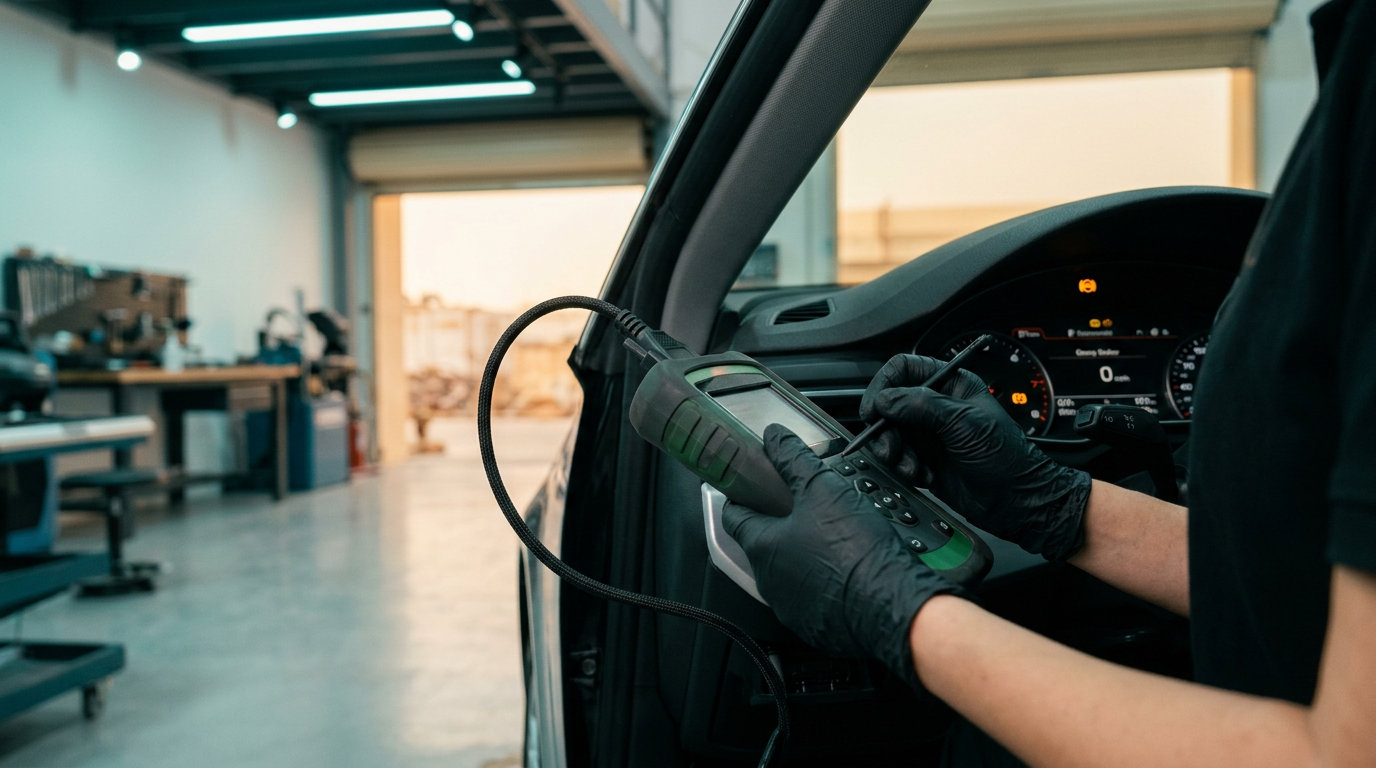
- No warning lights illuminated on the dashboard (check engine, ABS, airbag, TPMS)
- Exhaust emissions within limits (lambda sensor and catalyst function critical)
- Steering free of play (worn tie-rod ends common after shipping vibration)
- Underbody inspection for leaks (oil, coolant, brake fluid, fuel)
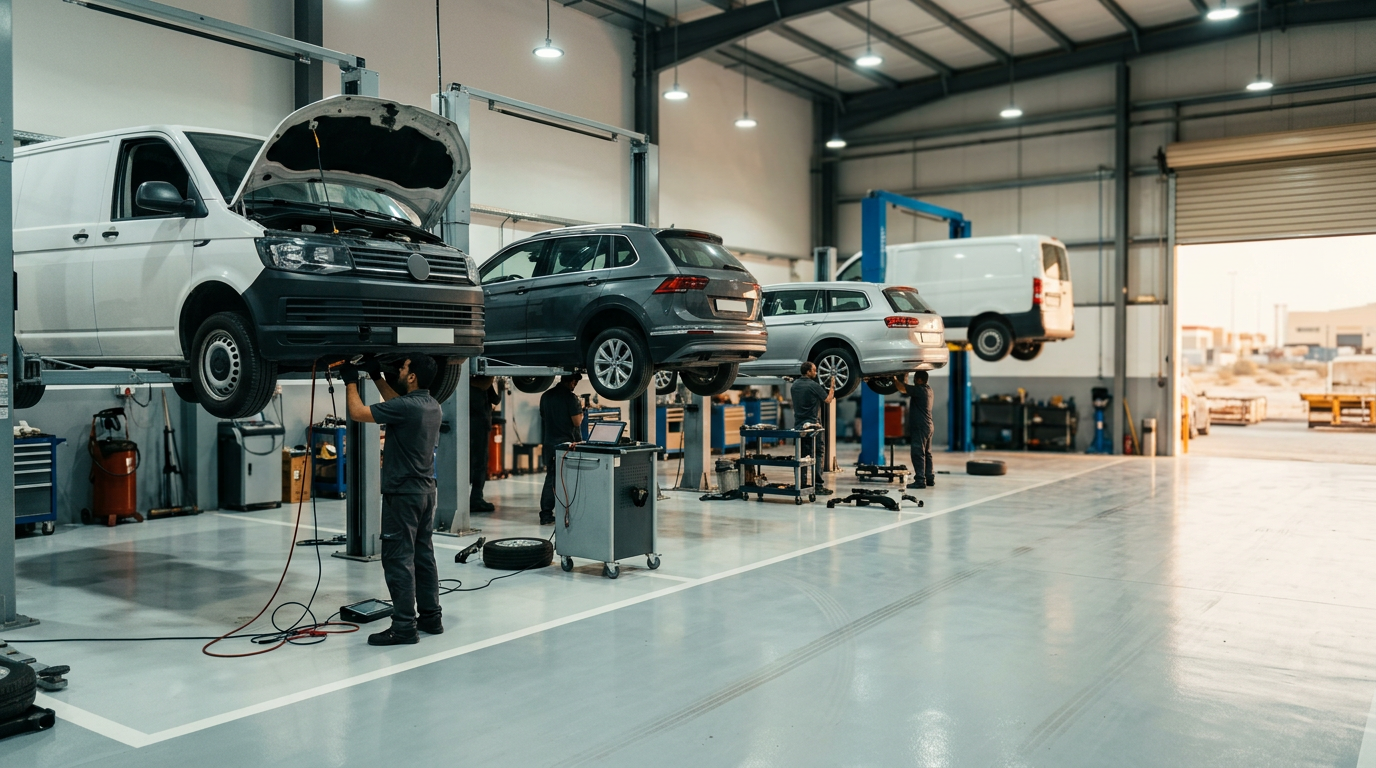
A pre-registration inspection at an independent workshop can identify issues before the RTA test, saving time and re-test fees. Many specialists in Al Quoz offer this service and can address faults immediately.
Ongoing Maintenance After Registration
Once your vehicle registration is complete and you receive your license plates, establish a service schedule that accounts for Dubai's unique conditions. Most European and EV specialists recommend an initial 1,000 km check (oil level, tyre pressures, fluid leaks, brake bed-in), then regular servicing every six months or 10,000 km, whichever comes first.
Keep digital copies of all service records. When you eventually sell or re-export the car, a complete service history significantly increases resale value. For advice on maintaining value, see our article on pre-sale repairs.
If you're relocating with a luxury, sports, or classic car, consider a specialist workshop familiar with European marques. Independent garages with manufacturer-grade diagnostic equipment can maintain your car to the same standard as the original dealer network, without the premium pricing structure.
Corporate and Fleet Considerations
Companies relocating staff with multiple vehicles can streamline the process through fleet services or corporate accounts. Bulk registration, coordinated inspections, and scheduled maintenance reduce administrative overhead and ensure all vehicles meet RTA standards on time.
Post-Relocation Service in Al Quoz
JAD Garage in Al Quoz 4 offers pre-registration inspections, climate adaptation services, and ongoing maintenance for European and EV models relocated to Dubai. Manufacturer-grade diagnostics and transparent advice. Call +971 56 355 6113 or visit Warehouse No.1, Street 8.
Frequently asked questions