Sports Car Garages in Dubai: What Specialist Equipment Matters


The right diagnostic hardware, manufacturer-grade lifts and parts inventory separate competent sports car garages from those that improvise on high-performance European vehicles. When you're entrusting a Porsche, Ferrari, McLaren or BMW M car to a workshop in Dubai, equipment capability directly determines whether the job is done correctly or whether you'll be back in three months with the same fault code.
Why Equipment Matters More for Sports Cars Than Daily Sedans
Sports cars layer complexity on top of every system. A turbocharged flat-six in a 911 runs different boost maps for ambient temperatures above 40°C. A McLaren's hydraulic suspension recalibrates ride height every few seconds. Ferrari V8s use variable-length intake runners controlled by stepper motors that throw codes if the car sits unused through a Dubai summer. Generic OBD-II scanners read only powertrain faults; they cannot access chassis, body or telemetry modules that log data critical to diagnosing intermittent faults on high-performance European vehicles.
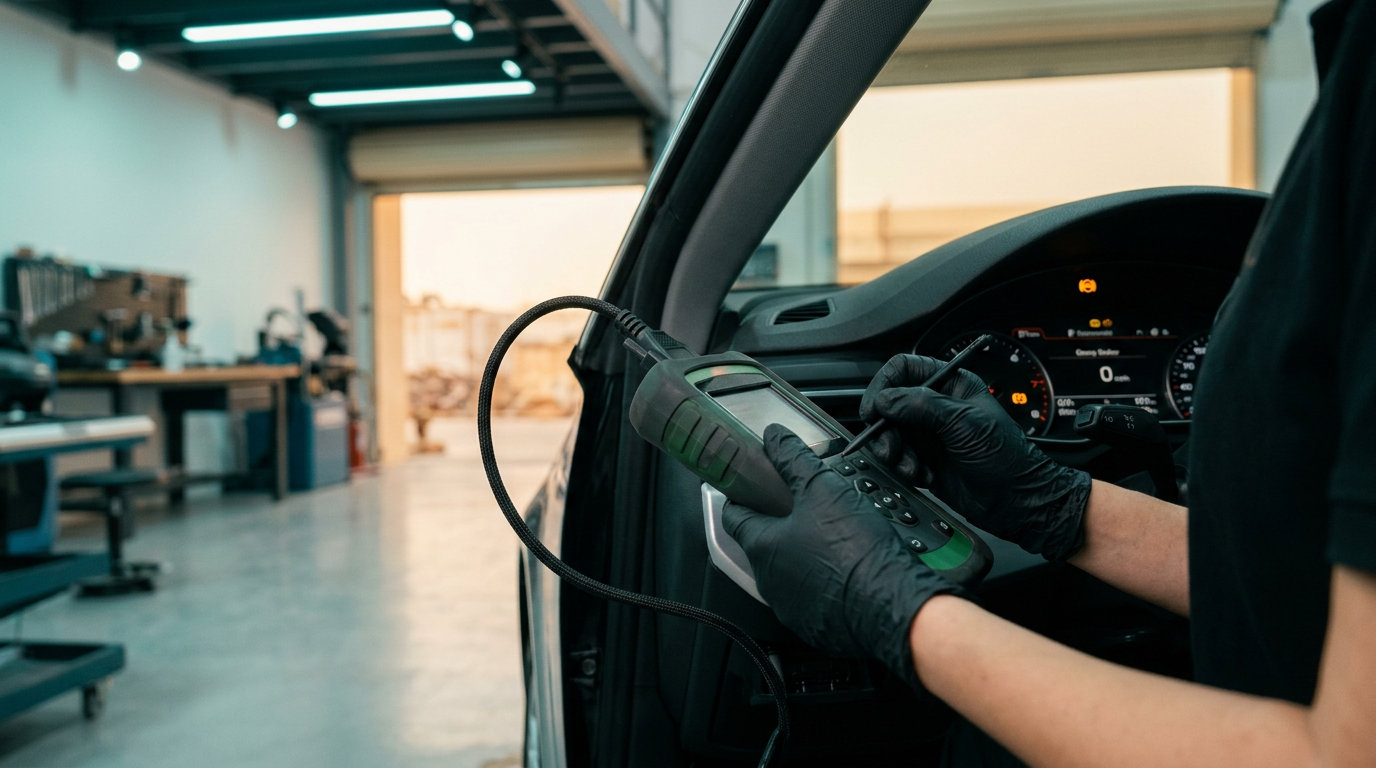
Manufacturer-grade diagnostic platforms—tools like PIWIS for Porsche, ISTA+ for BMW, ODIS for Audi, or dedicated systems for Maserati and Aston Martin—read live data streams, perform actuator tests and flash ECU updates. Without them, a garage is guessing. A diagnostic session that takes twenty minutes with the right tool can stretch into days of trial-and-error parts replacement without it.
Key Equipment Categories and What They Enable
Factory-Level Diagnostic Hardware and Software
Each marque uses proprietary communication protocols. Porsche PIWIS III accesses all control units, runs guided fault-finding and updates firmware. BMW ISTA+ performs the same role for M cars and i8 hybrids. Lamborghini and Ferrari use encrypted CAN-bus systems that lock out third-party scanners entirely. A sport car garage without marque-specific tools cannot clear adaptive values after brake pad replacement, cannot code new injectors after engine work, and cannot perform the dozens of small calibrations that prevent nuisance faults.
Four-Post and Two-Post Lifts with Jacking-Beam Capability
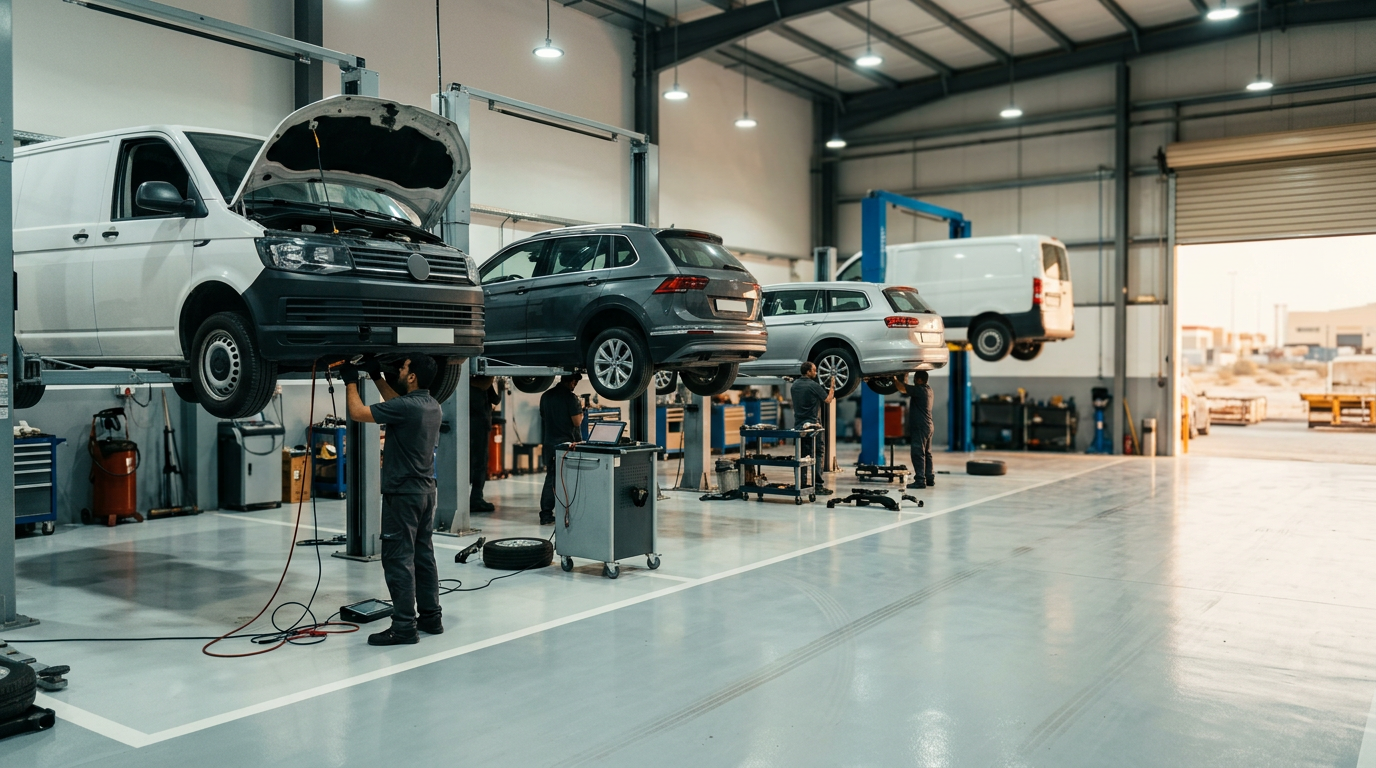
Low-slung sports cars demand lifts with adjustable arms and jacking beams that clear wide sills and underbody aero. A standard two-post lift can crack carbon-fiber side skirts or puncture undertray panels. Four-post lifts with rolling jacks allow safe access to suspension, exhaust and underbody without stressing the chassis. Wheel-free lifts are essential for suspension geometry work and brake jobs on cars with centre-lock wheels.
Refrigerant Recovery and AC Diagnostics
Dubai heat pushes AC systems harder than any other market. Sports cars often use smaller, roof-mounted condensers or side-mounted radiators that clog with fine sand. Refrigerant recovery machines that handle R134a and R1234yf, plus leak-detection UV dye kits, are mandatory. A garage that tops up refrigerant without diagnosing the leak will have you back in a month when the system is empty again.
Wheel Alignment with Ride-Height Compensation
Multi-link rear suspension and adjustable camber plates mean sports cars need alignment rigs that measure toe, camber and caster to 0.01-degree precision. Systems must account for ride height; a Porsche 911 GT3 RS with manually adjustable coilovers will show different geometry at each height setting. Generic two-camera rigs cannot match the accuracy required for track-focused cars.
OEM and Performance Parts Inventory
Waiting three weeks for a fuel pump from Europe turns a two-hour job into a month-long ordeal. Competent garages stock common service parts—brake pads, rotors, filters, belts—for the marques they service, and maintain supplier relationships that deliver less-common parts within days. Access to OEM and premium aftermarket suppliers (Brembo, Bilstein, KW, Akrapovič) matters as much as the tools on the rack.
Comparing Dubai Workshop Options for Sports Car Service
| Workshop Type | Diagnostic Access | Parts Source | Typical Hourly Rate (AED) | Turnaround |
|---|---|---|---|---|
| Main-dealer service centre | Full factory tools | OEM only | 650–950 | 3–7 days |
| Independent marque specialist | Factory-grade aftermarket | OEM + premium alternatives | 400–650 | 1–3 days |
| Multi-brand chain | Generic OBD-II | Aftermarket catalogue | 300–500 | 1–2 days |
| Mobile mechanic | Handheld scanner | Customer-supplied or local | 250–400 | Same day |
Main-dealer service centres have every tool and every part number in the system, but labour rates reflect property costs in Motor City or Sheikh Zayed Road showrooms. Independent specialists invest in the same diagnostic platforms and often employ technicians with dealer training, offering comparable technical capability at lower overhead. Multi-brand chains handle routine maintenance well but lack the deep diagnostic access required for complex faults. Mobile mechanics are convenient for oil changes and battery swaps but cannot perform jobs that require lifts, alignment or ECU programming.
Red Flags: What Missing Equipment Reveals
Walk through any garage and look for these gaps:
- No marque-specific diagnostic laptop visible: If the workshop services Porsche, BMW or McLaren but you see only a generic Autel or Launch scanner, they cannot access deeper control modules or perform software updates.
- Single two-post lift with fixed arms: Low sports cars will be jacked on sills or undertray mounts, risking damage.
- No parts shelving or supplier invoices: A garage that orders every part ad hoc adds days to every job and often sources low-grade alternatives to speed turnaround.
- No AC recovery unit or alignment rig: These are not optional for Dubai; a workshop without them will subcontract the work, adding cost and delay.
- Technicians using impact guns on wheel bolts: Torque specs matter. Overtightened bolts crack hubs; undertightened bolts cause wheels to loosen. Sports cars with lightweight alloys are especially vulnerable.
Questions to Ask Before Booking Your Sports Car Service
When you contact a garage, ask specific questions:
- Which diagnostic platform do you use for my marque?
- Can you flash ECU updates and code new modules?
- Do you stock service parts for my model, or will you need to order them?
- What type of lift will you use, and how do you protect underbody aero?
- Can you provide a digital service record with fault codes and live data snapshots?
A competent sports car garage will answer all five without hesitation. Vague replies or deflection suggest the workshop is stretching beyond its capability.
Service Records and Documentation
High-performance European vehicles benefit from detailed service records. A good garage logs fault codes before and after repair, records live data (boost pressure, lambda readings, oil temperature), and photographs wear items. This documentation is invaluable when diagnosing intermittent faults or preparing a car for sale. It also provides a paper trail if you later need to demonstrate that maintenance was performed to manufacturer standards—relevant if you're considering whether servicing outside the dealer affects your warranty.
Specialist Services Beyond Routine Maintenance
Equipment depth also determines which advanced jobs a garage can handle:
- ECU programming and tuning: Reflashing maps for performance or emissions compliance requires factory tools and software licences.
- Transmission adaptation: Dual-clutch gearboxes in Porsche PDK, Ferrari F1 or Lamborghini ISR systems need recalibration after clutch or mechatronic replacement.
- Hydraulic suspension bleeding: McLaren ProActive Chassis and Ferrari SCM dampers require dedicated bleed procedures and pressure testing.
- Pre-purchase inspection: Thorough fault-code history review and live data logging reveal hidden issues before you buy a used sports car.
- Bodywork and paint: Carbon-fiber repair, paint-to-sample colour matching and PPF installation demand specialist skills and controlled environments.
Disclosure
This guide is published by JAD Garage, an independent European and EV specialist located in Al Quoz 4, Dubai. We service Porsche, BMW, Audi, McLaren, Ferrari, Lamborghini, Maserati, Aston Martin and other high-performance European marques using manufacturer-grade diagnostic equipment and OEM parts. Readers should verify current service capabilities, parts availability and pricing directly with any garage before booking work. This article reflects general market observations and is not an endorsement of any specific business.
Related reading: Bosch Car Service Network in Dubai: What the Badge Means.
Sports Car Service with Manufacturer-Grade Diagnostics
JAD Garage in Al Quoz 4 services Porsche, McLaren, Ferrari, BMW M, Audi RS and other high-performance European marques with factory-level diagnostic platforms, OEM parts and experienced technicians. Call +971 56 355 6113 or visit Warehouse No.1, Street 8 to discuss your car's needs.
Frequently asked questions