
Brake Fluid Change: Why 2 Years Matters More in Dubai

Most manufacturers recommend changing brake fluid every two years regardless of mileage, and this interval becomes even more critical in Dubai. Brake fluid is hygroscopic—it absorbs moisture from the air—and the UAE's combination of extreme heat (up to 50°C), coastal humidity, and aggressive stop-start traffic accelerates moisture contamination and boiling-point degradation, directly compromising your braking system's safety and pedal feel.
Why Brake Fluid Degrades Faster in Dubai
Brake fluid works under extreme pressure and temperature. Every time you press the brake pedal, hydraulic fluid transmits force to the callipers, and friction generates heat that can push brake fluid temperatures well above 150°C during hard braking or downhill driving.
Fresh DOT 4 fluid has a dry boiling point around 230°C and a wet boiling point (after absorbing 3.7% water) of approximately 155°C. In Dubai's climate, brake fluid can absorb that much moisture in under 18 months. Once the boiling point drops below operating temperature, the fluid vaporises, creating compressible gas bubbles in your brake lines. The result: a spongy brake pedal, longer stopping distances, and in severe cases, complete brake fade.
The city's coastal humidity means moisture enters the braking system through microscopic pores in rubber hoses and around the brake fluid reservoir cap. Summer temperatures then accelerate chemical breakdown of the fluid itself, while stop-start traffic on Sheikh Zayed Road and short trips to the mall mean your brakes never fully cool between uses, keeping the system heat-soaked.
The Standard Brake Fluid Change Interval
The two-year or 30,000-mile interval is the most common recommendation across European and Japanese manufacturers. BMW, Mercedes-Benz, Audi, Porsche, and Toyota all specify two years in their service schedules, regardless of how many kilometres you've driven.
Some performance and luxury marques are even more conservative. Ferrari and McLaren often call for annual brake fluid changes, especially for cars used on track days or spirited driving. Land Rover specifies three years for certain models, but independent workshops in Dubai typically recommend shortening that to two years given local conditions.
For pre-owned vehicles where service history is unclear, it's safest to replace brake fluid immediately and then every two years from that baseline. A pre-purchase inspection should always include a brake fluid moisture test, especially for cars imported from humid regions or those that have sat unused for extended periods.
What Happens If You Don't Change Brake Fluid on Time
Delaying a brake fluid change beyond the recommended interval invites several compounding problems:
- Reduced boiling point: Moisture contamination lowers the temperature at which fluid vaporises, leading to brake fade during emergency stops or mountain descents.
- Internal corrosion: Water in the system corrodes steel brake lines, callipers, and the master cylinder from the inside, causing expensive component failures that could have been prevented with a simple fluid change.
- Spongy pedal feel: Absorbed moisture and micro-bubbles make the brake pedal feel soft or require more travel before the brakes engage, reducing driver confidence and reaction time.
- ABS and stability control issues: Modern braking systems rely on precise hydraulic pressure; contaminated fluid can interfere with ABS modulation and electronic brake-force distribution.
- Seal degradation: Old, acidic fluid attacks rubber seals in the master cylinder and callipers, leading to leaks and low brake fluid levels that trigger dashboard warnings.
In Dubai's heat, these issues develop faster than in temperate climates. A three-year-old fluid might still be marginal in London but dangerously degraded here.
Signs Your Brake Fluid Needs Changing
Between scheduled intervals, watch for these indicators that your brake fluid has deteriorated:
Brake pedal feel: If the pedal feels softer than usual, travels closer to the floor, or requires pumping to build pressure, moisture or air may be present in the system. This is the most common symptom drivers notice first.
Fluid colour: Open the brake fluid reservoir (usually a translucent plastic tank near the firewall on the driver's side) and check the colour. Fresh brake fluid is clear to pale amber; contaminated fluid turns dark brown or black. If you can't see through it, it's overdue for replacement.
Low brake fluid warning: A dashboard light indicating low brake fluid can mean a leak, but it can also result from fluid volume loss as brake pads wear or from boiling fluid creating vapour pockets. Either way, it requires immediate inspection at a brake service centre.
Burning smell or brake fade: If you notice a chemical smell during braking or find that repeated brake applications (such as descending Jebel Hafeet) cause the pedal to lose effectiveness, the fluid has likely reached its boiling point.
Can You Check Brake Fluid Condition Yourself?
Yes, partially. You can visually inspect the reservoir for colour and level, but you cannot accurately measure moisture content without a dedicated brake fluid tester. These handheld tools measure the boiling point or water percentage and cost around AED 150–400. Most workshops use them during routine service checks.
If you're checking the reservoir yourself, make sure the car is on level ground and the fluid sits between the MIN and MAX marks. Never top up with a different DOT specification than what's already in the system, and avoid leaving the cap off for extended periods—brake fluid absorbs moisture from the air within minutes.
Brake Fluid Types and Their Impact on Change Intervals
Brake fluids are classified by DOT (Department of Transportation) standards, each with different boiling points and chemical formulations:
| Type | Dry Boiling Point | Wet Boiling Point | Typical Use |
|---|---|---|---|
| DOT 3 | 205°C | 140°C | Older vehicles, basic braking systems |
| DOT 4 | 230°C | 155°C | Most modern European and Japanese cars |
| DOT 5.1 | 260°C | 180°C | Performance cars, high-temperature applications |
| DOT 5 | 260°C | 180°C | Silicone-based, not hygroscopic, incompatible with most cars |
DOT 3, 4, and 5.1 are glycol-based and hygroscopic—they all absorb moisture and require the same two-year change interval. DOT 5 is silicone-based and does not absorb water, but it's rarely used in road cars because it doesn't compress moisture out of the system; instead, water pools and causes localised corrosion. It's also incompatible with ABS systems in most vehicles.
Higher-spec fluids like DOT 5.1 offer better heat resistance and are often used in Porsche, Lamborghini, and other supercars, but they still absorb moisture at similar rates and need changing every two years. Always use the fluid type specified in your owner's manual; mixing DOT 3 and DOT 4 is generally safe in an emergency (they're compatible), but mixing in DOT 5 will damage seals and require a full system flush.
How Brake Fluid Change Fits Into Overall Maintenance
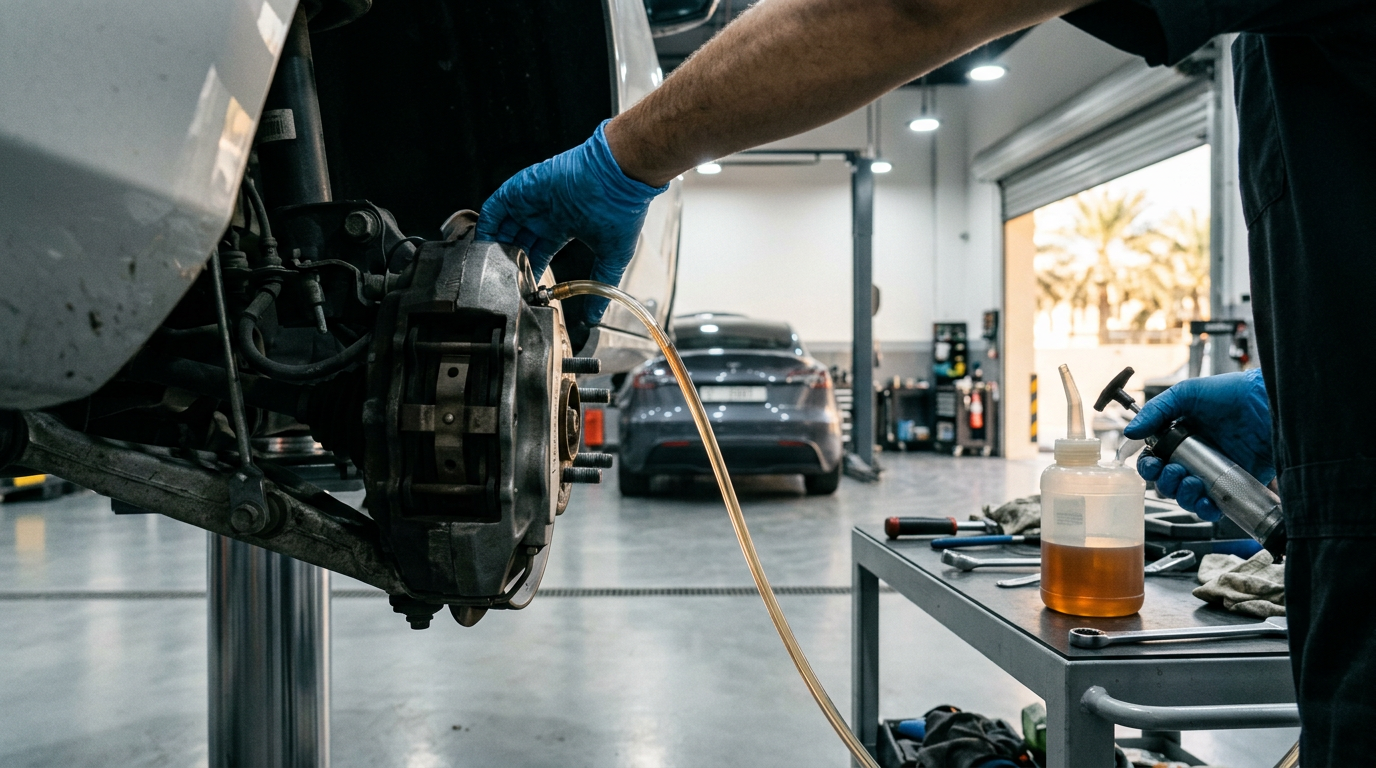
A brake fluid change is usually performed alongside other brake system inspections. During the service, a technician will flush old fluid from the master cylinder, brake lines, callipers, and sometimes the ABS modulator, replacing it with fresh fluid bled through each wheel in sequence.
This is an ideal time to inspect brake pads, discs, and hoses for wear. In Dubai, brake pads often last 30,000–50,000 km depending on driving style, and combining a brake pad replacement with a fluid change makes logistical and economic sense. Many workshops include a brake fluid moisture test as part of a general maintenance or annual service package.
Brake fluid changes also complement other fluid services. If you're already scheduling an oil change or transmission fluid service, adding a brake fluid flush every two years keeps all your vehicle's hydraulic systems in optimal condition. For fleet vehicles or corporate accounts, scheduling these services on a fixed calendar prevents missed intervals and ensures consistent safety across multiple cars.
Vehicle-Specific Recommendations
While two years is the baseline, some brands and models have unique considerations:
German premium brands (BMW, Audi, Mercedes-Benz) specify two years across almost all model lines. Vehicles with performance brakes or M/RS/AMG variants often benefit from annual changes if driven hard.
British sports and luxury cars (Aston Martin, Bentley, Rolls-Royce, Lotus) typically call for annual or two-year intervals, with shorter intervals recommended for track use.
Italian exotics (Ferrari, Lamborghini, Maserati) almost universally require annual brake fluid changes due to high-performance braking systems and track-focused use cases.
Japanese and Korean brands (Toyota, Honda, Hyundai) generally specify two years or 40,000 km, whichever comes first. MG follows similar schedules in the UAE market.
EVs and hybrids still need brake fluid changes every two years despite regenerative braking reducing mechanical brake use. The hydraulic system and moisture absorption remain unchanged. Owners of Polestar, MINI Electric, or other EVs sometimes mistakenly believe brake service is unnecessary, but fluid degradation occurs even if the brakes are used less frequently.
Typical Brake Fluid Change Cost in Dubai
Across Dubai's independent workshops and service centres, a standard brake fluid change typically ranges from AED 200 to AED 500, depending on the vehicle type, fluid specification, and whether the service includes a full system bleed or just a reservoir top-up.
Luxury and performance vehicles requiring DOT 5.1 fluid or more complex bleeding procedures (especially those with ABS modulator flushing) may see costs toward the higher end. The service usually takes 45–90 minutes and is straightforward on most cars, making it one of the more affordable preventive maintenance tasks relative to its safety impact.
Always ensure the workshop uses fresh, sealed fluid from reputable brands—brake fluid degrades in opened containers, so shops that decant from large drums may be introducing moisture before it even enters your car.
Dubai-Specific Considerations
Beyond the standard interval, Dubai driving conditions create a few unique scenarios:
Cars parked outdoors: Vehicles left in open parking under direct sun experience higher underbonnet temperatures, accelerating fluid degradation even when stationary. If your car sits outside all day, consider testing brake fluid moisture annually.
Short-trip city driving: Frequent short journeys mean brakes never fully cool, keeping the system heat-soaked and promoting moisture absorption. This is common for cars used only for school runs or supermarket trips within Al Quoz, Jumeirah, or Downtown.
Mountain drives: If you regularly drive to Hatta, Jebel Hafeet, or Jebel Jais, your brakes work much harder on descents. Annual fluid changes are worth considering for these use cases, and you should inspect the system after any trip where you noticed fade or a burning smell.
Imported pre-owned cars: Many used European cars imported into the UAE have unknown service histories. If you've recently purchased a used luxury car, have the brake fluid tested and replaced as part of your initial sorting. Moisture content above 3% warrants immediate replacement.
Why Two Years Is the Safety Baseline
The two-year interval isn't arbitrary—it's based on extensive testing of how quickly glycol-based fluids absorb moisture under normal conditions. In temperate climates, brake fluid reaches approximately 2–3% water content after two years. In Dubai, that timeline compresses to 18–24 months.
Once water content exceeds 3%, the wet boiling point drops into the range where normal driving can cause vapour lock. At 4–5% moisture, internal corrosion accelerates and you risk caliper piston seizure, master cylinder failure, or pinhole leaks in steel brake lines—all of which are far more expensive than a preventive fluid change.
Brake fluid is one of the lowest-cost, highest-impact services you can perform. It's not visible like tire tread or as obvious as pulling to one side, but it directly determines whether your car stops predictably in an emergency. In a city with high-speed highways, heavy traffic, and extreme temperatures, that two-year interval is your safety baseline.
Brake Fluid Change in Al Quoz
JAD Garage in Al Quoz 4 provides brake fluid testing and replacement for all European and EV models, using OEM-spec fluids and proper bleeding procedures. Call +971 56 355 6113 to book your service or discuss your car's brake system maintenance schedule.
Frequently asked questions