Car Coolant in the UAE: Which Type and How Often

In the UAE, car coolant should be replaced every 3–5 years or 60,000–100,000 km, depending on the type. Use OAT (Organic Acid Technology) or hybrid coolants rated for high temperatures, never plain water or incompatible mixtures. Dubai's sustained 50°C ambient heat and stop-start traffic place extreme thermal stress on the cooling system, making coolant quality and concentration critical.
What Is Car Coolant and Why It Matters in the UAE
Engine coolant—often called antifreeze—is a liquid that circulates through the engine block, cylinder head, radiator, and heater core to absorb and dissipate heat. It works in conjunction with the water pump, thermostat, and radiator to maintain optimal engine temperature, typically between 85°C and 105°C.
Modern coolant is a blend of ethylene glycol or propylene glycol, water, and additives that prevent corrosion, scale buildup, and cavitation. In the UAE, the cooling system operates under extreme duty: the radiator must reject heat into air that can reach 50°C, and the liquid cooling system runs continuously in stop-start traffic with minimal airflow. This makes coolant condition far more critical than in temperate climates.
Coolant serves three roles:
- Heat transfer: absorbs combustion heat from the engine block and cylinder head, then releases it through the radiator.
- Boiling and freezing protection: raises the boiling point above 100°C (typically to 120°C under pressure) and lowers the freezing point, though freezing is irrelevant in Dubai.
- Corrosion inhibition: protects aluminium, cast iron, copper, and solder joints inside the cooling system from oxidation and electrolytic corrosion.
When coolant degrades, its boiling point drops, additives deplete, and pH shifts, leading to internal corrosion, water pump seal failure, and eventually overheating. Engine Services often reveal coolant-related damage that could have been avoided with timely replacement.
Types of Coolant and Which Suits UAE Conditions
Coolant chemistry has evolved significantly. Older formulas relied on inorganic additives (silicates and phosphates) that deplete quickly; modern coolants use organic acids that last much longer. The main categories are:
| Type | Chemistry | Colour | Service Life | Common Applications |
|---|---|---|---|---|
| IAT (Inorganic Additive Technology) | Silicates, phosphates | Green | 2 years / 40,000 km | Pre-2000 vehicles, classic cars |
| OAT (Organic Acid Technology) | Carboxylate acids | Orange, red, pink | 5 years / 240,000 km | Most European brands (VW, Audi, Porsche) |
| HOAT (Hybrid OAT) | Silicates + organic acids | Yellow, orange | 5 years / 240,000 km | Mercedes-Benz, BMW, some Asian brands |
| Si-OAT (Silicated OAT) | Silicates + carboxylates | Purple, blue | 5 years / 240,000 km | Newer VAG group, Volvo, some EVs |
For UAE conditions, OAT and HOAT coolants are strongly preferred. Their longer service life and superior high-temperature stability suit extended drain intervals and reduce the risk of boil-over. Many European manufacturers specify OAT-based formulas: Volkswagen uses G12++ and G13, BMW specifies a blue HOAT, and Mercedes-Benz uses MB 325.0 and 326.0 specifications.
Colour is not a reliable guide to chemistry—two orange coolants may be incompatible. Always match the manufacturer specification, not the hue. Mixing incompatible coolants can cause precipitation, clogged radiator tubes, and water pump seal damage. If uncertain, a Diagnostic Services check can identify the current coolant type using a refractometer and pH test.
Concentration and Mixing Ratio
Coolant is sold as concentrate (pure glycol + additives) or pre-mixed 50:50 with distilled water. In the UAE, a 50:50 ratio is standard, providing a boiling point around 120°C under a 1.1-bar radiator cap. Some workshops use 60:40 (coolant:water) for additional margin, though this slightly reduces heat transfer efficiency.
Never use tap water. Dubai municipal water contains dissolved salts and minerals that precipitate inside the radiator and engine block, reducing cooling efficiency and promoting corrosion. Always use distilled or deionised water when topping up or mixing concentrate.
How Often to Replace Car Coolant in Dubai
Manufacturer service schedules typically specify coolant replacement every 5 years or 100,000 km for OAT/HOAT formulas, and 2 years or 40,000 km for older IAT types. In the UAE, the upper end of these intervals should be treated as the maximum, not a target.
Heat accelerates additive depletion. A cooling system that operates at 95°C for hours daily in traffic will degrade coolant faster than one in a temperate climate with regular highway cruising. Many independent workshops recommend replacing OAT coolant at 4 years or 80,000 km in Dubai, and IAT coolant at 18 months or 30,000 km.
Signs that coolant needs replacement include:
- Colour change from bright to dull or brown (indicates rust and contamination)
- Visible sediment or floating particles in the expansion tank
- Sweet smell from the engine bay (glycol vapour from a small leak or boil-over)
- Frequent need to top up (suggests a leak or combustion gas intrusion)
- Temperature gauge creeping higher than normal, especially in traffic
A workshop can test coolant condition using a refractometer (measures freeze/boil protection), pH strips (detects acidity from corrosion), and visual inspection. If pH drops below 7.5 or the boiling point falls below 115°C, replacement is due regardless of mileage. This is typically part of a comprehensive General Maintenance inspection.
How the Cooling System Works and What Can Fail
The liquid cooling system is a closed loop. The water pump—driven by the serpentine belt or timing belt—circulates coolant from the engine block through passages in the cylinder head, then to the radiator. The thermostat remains closed during warm-up to speed heat buildup, then opens at around 85°C to allow coolant to flow through the radiator.
The radiator is a heat exchanger: hot coolant flows through thin aluminium tubes while air (forced by the cooling fan or vehicle speed) passes over fins. Heat transfers to the air, and cooled liquid returns to the engine. An expansion tank accommodates thermal expansion and provides a fill point.
Common cooling system failures in the UAE include:
- Water pump seal failure: glycol leaks from the weep hole or mixes with engine oil if the internal seal fails. High temperatures and contaminated coolant accelerate wear.
- Radiator clogging: internal scale or sediment blocks tubes, reducing flow and causing localised hot spots.
- Thermostat stuck closed: prevents coolant circulation, leading to rapid overheating.
- Hose deterioration: rubber hoses become brittle in heat and burst, dumping coolant instantly.
- Head gasket failure: combustion gases enter the cooling system, pressurising it and forcing coolant out of the expansion tank.
Many of these failures are secondary to neglected coolant. Acidic, depleted coolant corrodes the water pump impeller, etches radiator tubes, and attacks gasket materials. Car Repair invoices for overheating damage often trace back to coolant that was never changed.
Checking and Topping Up Coolant Safely
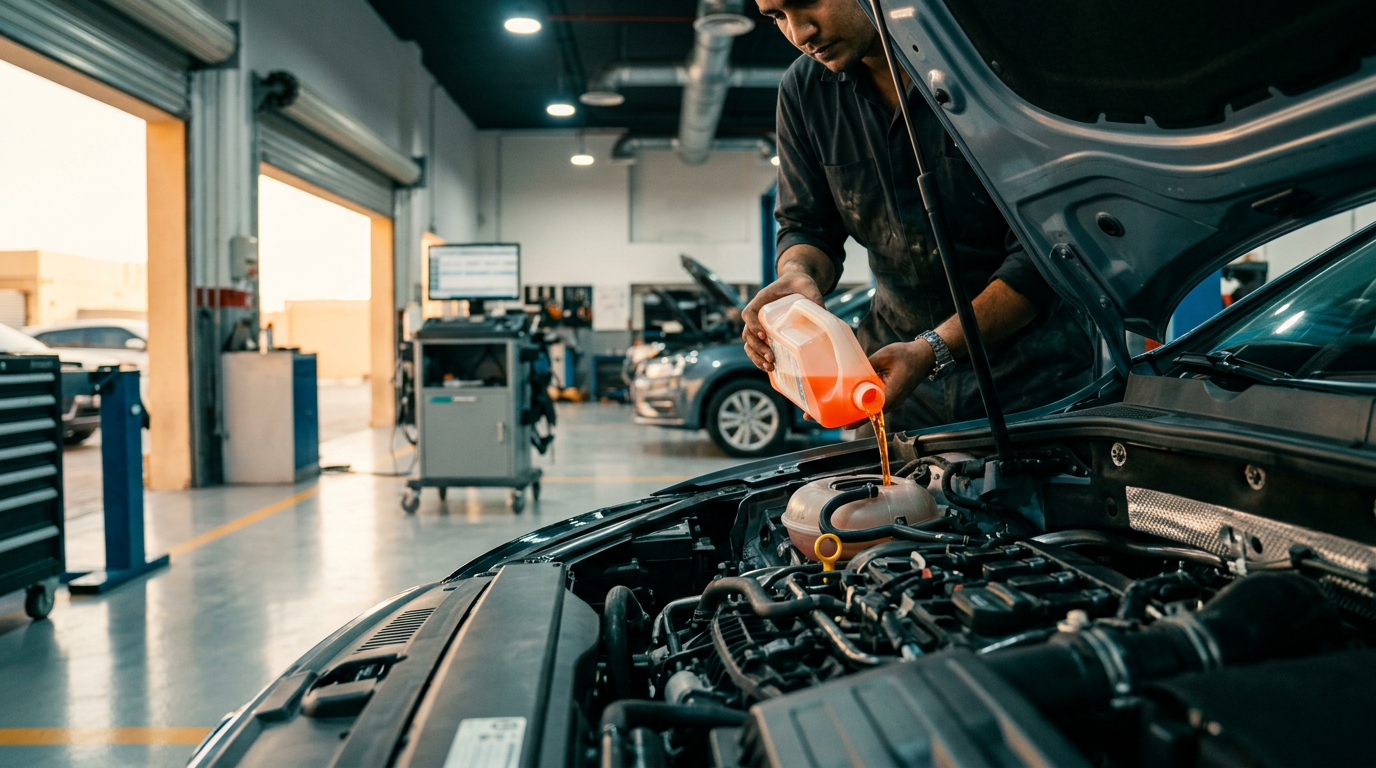
Check coolant level weekly if the vehicle is driven daily in Dubai traffic. The expansion tank has MIN and MAX marks; the level should sit between them when the engine is cold. If it drops below MIN, top up with the correct coolant type mixed 50:50 with distilled water.
Never open the radiator cap or expansion tank cap when the engine is hot. The system operates at 1.1 bar (16 psi) above atmospheric pressure, raising the boiling point. Releasing this pressure when coolant is near boiling causes explosive vaporisation and severe burns. Wait at least 30 minutes after shutdown, and open the cap slowly with a thick cloth.
If coolant level drops repeatedly, do not simply keep topping up. A leak or internal consumption (head gasket breach) requires diagnosis. Continued driving with low coolant will warp the cylinder head or crack the engine block. Diagnostic Services can pressure-test the system, check for combustion gases in the coolant, and identify leak sources using UV dye.
Coolant Replacement Procedure
A complete coolant flush involves draining the old fluid, flushing the system with distilled water to remove sediment, refilling with fresh coolant, and bleeding air pockets. Air trapped in the system creates hot spots and prevents proper circulation, especially on engines with complex plumbing (V6, V8, or turbocharged configurations).
The process typically includes:
- Removing the radiator drain plug or lower hose with the engine cold
- Flushing the block and radiator with distilled water until discharge runs clear
- Refilling with pre-mixed coolant or concentrate mixed to specification
- Running the engine with the heater on full to purge air
- Topping up after the thermostat opens and coolant circulates fully
- Pressure-testing the system to confirm no leaks
Some European vehicles require a specific bleeding procedure or a vacuum-fill tool to avoid air locks. BMW, Audi, and Mercedes-Benz models often have bleed screws at high points in the cooling system. Incorrect bleeding can leave air pockets that cause localised overheating and trigger false temperature warnings.
Special Considerations for EVs and Hybrids
Electric vehicles and plug-in hybrids use coolant to manage battery pack temperature, inverter heat, and (in some designs) electric motor temperature. These systems operate at lower temperatures than combustion engines—typically 25°C to 45°C—and use different coolant formulations, often with higher electrical resistivity to prevent current leakage.
EV coolant (sometimes called "EV fluid" or "battery coolant") must meet specific dielectric standards. Using standard engine coolant in an EV cooling circuit can cause short circuits and damage high-voltage components. Polestar, Audi e-tron, and other EVs specify low-conductivity coolants such as VW G13 or equivalent. Replacement intervals are similar—typically 4–5 years—but the procedure requires isolation of high-voltage systems and specific bleeding protocols. For details, see Electric Vehicle Servicing: The Real Annual Checklist.
Cost and Parts Availability in Dubai
Coolant replacement in Dubai typically costs between AED 250 and AED 600, depending on system capacity and coolant type. A standard 1.6-litre four-cylinder hatchback holds around 5 litres; a V8 luxury sedan or SUV may require 12–15 litres. OEM coolant from dealer parts counters ranges from AED 40 to AED 80 per litre; premium aftermarket alternatives (Liqui Moly, Motul, Comma) cost AED 30–60 per litre.
Labour for a drain-and-fill is modest, but a full flush with system cleaning and pressure testing adds time. Workshops using manufacturer-grade diagnostic equipment can verify correct fill, absence of air locks, and proper thermostat operation, reducing the risk of post-service issues. For a discussion of parts sourcing, see OEM vs Aftermarket Parts: When Each Makes Sense.
Common Mistakes to Avoid
Mixing coolant types is the most frequent error. A green IAT coolant mixed with an orange OAT can form a gel that clogs the radiator and water pump. If you cannot confirm the existing coolant type, drain and flush the system completely before refilling.
Using tap water instead of distilled water introduces minerals that precipitate at high temperatures, forming scale on internal surfaces. This insulates metal from coolant, reducing heat transfer and causing hot spots.
Ignoring small leaks is another mistake. A drip under the car or a faint sweet smell suggests coolant loss. In Dubai heat, even a 10% reduction in coolant volume can push operating temperature into the danger zone. Address leaks immediately to avoid catastrophic overheating.
Finally, neglecting the cooling system during routine service is risky. Many workshops focus on oil and filters but skip coolant inspection. A visual check, refractometer test, and pH measurement take minutes and can prevent expensive repairs. For related fluid maintenance, see Automatic Transmission Fluid Change: Interval and Warning Signs and Oil Change services.
Coolant and UAE Climate: Real-World Impact
Dubai's combination of high ambient temperature, humidity near the coast, and fine dust creates a harsh environment for cooling systems. Dust clogs radiator fins, reducing airflow and forcing the cooling fan to run continuously. Humidity accelerates corrosion inside the system if coolant pH drifts. Stop-start traffic means the engine runs at high load with minimal ram air, placing maximum demand on the radiator and fan.
Vehicles used for short city trips—common in Dubai—never fully heat-cycle the cooling system, allowing moisture and combustion byproducts to accumulate. This accelerates coolant degradation and promotes sludge formation. For more on how local driving patterns affect maintenance, see How Dubai Heat Shortens Car Battery, Tyre and Oil Life.
Owners of high-performance or supercar models should be especially vigilant. Turbocharged engines and high-output naturally aspirated engines generate more heat, and coolant condition directly affects knock resistance and power delivery. Porsche, Ferrari, and Lamborghini models often specify low-tolerance coolant formulations and shorter service intervals.
Coolant Service in Al Quoz with Manufacturer-Grade Tools
JAD Garage in Al Quoz 4 offers complete cooling system inspection, flush, and refill using OEM-specification coolants and diagnostic equipment to verify correct fill and system integrity. Call +971 56 355 6113 or visit Warehouse No.1, Street 8 Monday to Saturday, 09:00–19:00.
Frequently asked questions