Engine Mounting Failure: Vibration at Idle Explained

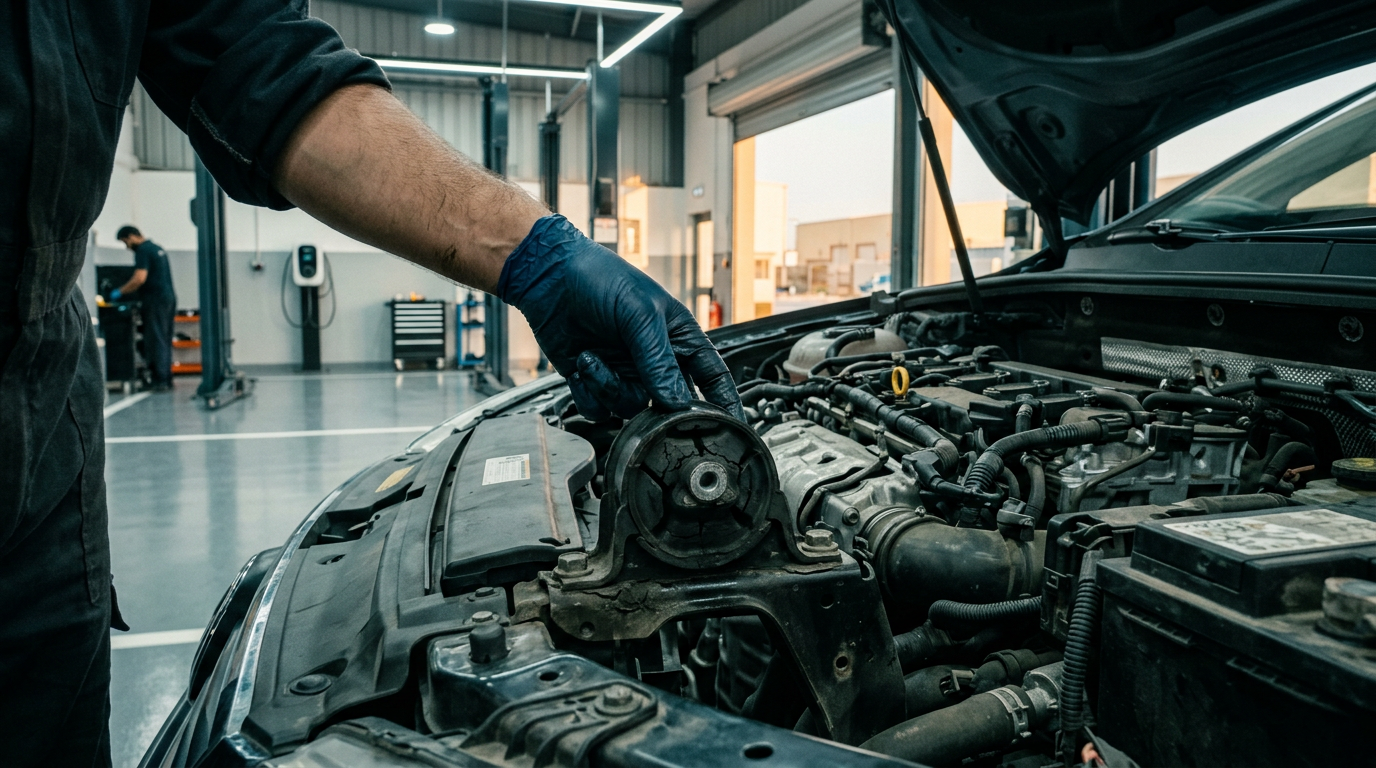
Engine mounting failure typically manifests as noticeable vibration through the cabin at idle, a clunking sound during gear engagement, and visible engine movement when accelerating or braking. Rubber engine mounts deteriorate from heat, oil contamination, and age, losing their ability to isolate vibration and support the motor securely within the chassis.
What Engine Mounts Do and Why They Fail
An engine mount is a structural component designed to secure the motor to the vehicle frame while absorbing vibration and preventing it from reaching the cabin. Most mounts use a rubber or hydraulic element sandwiched between metal brackets—one bolted to the engine block or transmission, the other to the subframe or chassis rail. This rubber engine mount design allows controlled movement while providing vibration isolation and support under acceleration, braking, and cornering loads.
In Dubai's climate, engine mounts face accelerated wear. Ambient temperatures reaching 50°C in summer bake the rubber compound, causing it to harden and crack. Oil leaks from valve covers, oil pan gaskets, or power steering systems drip onto mounts and chemically break down the rubber. Stop-start traffic generates constant load cycling, and short city trips mean the engine bay never fully cools between drives. European vehicles with transverse-mounted engines often use three or four mounts: a front engine mount, rear engine mount (sometimes called a torque mount), and side mounts. Rear-wheel-drive configurations add a transmission mount. Each serves a specific role in controlling engine movement along different axes.
Symptoms of Worn Engine Mounts
Recognizing mount failure early prevents damage to exhaust systems, drive shafts, and wiring harnesses that can contact the chassis when the motor shifts excessively. The following symptoms indicate one or more mounts have deteriorated:
- Vibration at idle: The most common sign. With the engine idling in Park or Neutral, you feel a rhythmic shaking through the steering wheel, seats, or centre console that wasn't present before.
- Clunking when shifting: Engaging Drive or Reverse produces a noticeable thud as the engine rocks on its remaining good mounts.
- Excessive engine movement: Opening the bonnet and asking someone to shift between Drive and Reverse while you observe reveals the motor tilting several centimetres—far more than the designed one or two centimetres of travel.
- Vibration under acceleration: As torque loads the mounts, a failed unit allows the engine to twist, transmitting vibration through the body and sometimes creating a buzzing noise from exhaust or intake components contacting the firewall.
- Steering wheel shake at idle in Drive: Particularly noticeable in automatic transmissions when stopped at traffic lights with the gear engaged and brake applied.
These symptoms often worsen gradually over weeks or months. A mount that has completely separated—where the rubber tears away from the metal bracket—will cause dramatic movement and loud impacts that are impossible to ignore.
How Workshops Diagnose Engine Mount Condition
Accurate diagnosis requires both visual inspection and functional testing. A technician will use manufacturer-grade diagnostic equipment and specific procedures to confirm which mounts have failed and whether related components have been damaged by excessive engine movement.
Visual Inspection on the Lift
With the vehicle raised, the technician inspects each mount for visible cracks, tears, or separation in the rubber. Oil saturation is easy to spot—the rubber appears swollen and shiny. A torch and mirror are often needed to view the rear engine mount, which sits between the engine and firewall in many transverse layouts. Original equipment mounts typically show part numbers and production dates; comparing the condition of all mounts helps identify whether one has failed prematurely or all are nearing end of life.
Engine Movement Test
The most definitive test requires two people. One person starts the engine and cycles between Park, Reverse, and Drive while applying the brake. The second observes engine movement from the side with the bonnet open. Healthy mounts allow 10–20 mm of controlled movement. A failed mount permits 40–60 mm or more, and the engine may contact the chassis or strut tower. The direction of excessive movement often indicates which mount has failed: forward-back movement points to the rear torque mount, side-to-side to a side mount, vertical bounce to a lower front mount.
Vibration Analysis at Idle
With the engine at normal operating temperature and idling in Park, the technician places a hand on the engine cover and then on the chassis. A significant difference in vibration amplitude confirms the mounts are no longer isolating effectively. Some workshops use a vibration analyzer—a handheld device that measures frequency and amplitude—to quantify the issue, particularly useful for intermittent symptoms or when comparing before-and-after readings.
Underbonnet Inspection Under Load
For hydraulic mounts (common on BMW, Audi, and Mercedes-Benz models), the technician may rev the engine gently while observing the mount. A hydraulic mount contains fluid chambers that dampen vibration; if the outer casing has cracked, fluid leaks out and the mount behaves like a solid rubber block, transmitting rather than absorbing vibration. Visible fluid residue or a collapsed appearance confirms hydraulic failure.
What Engine Mount Repair Involves
Replacing engine mounts is labour-intensive because the motor must be supported while each mount is unbolted and the new unit fitted. The process and cost vary depending on how many mounts require replacement and whether the engine must be lifted or tilted to access them.
Supporting the Engine
Before removing any mount, the engine must be supported from above using a support bar that spans the inner wings, or from below with a transmission jack. This prevents the motor from dropping onto remaining mounts or surrounding components. The technician carefully raises or lowers the engine by millimetres to relieve load on the mount being replaced, allowing the bolts to be removed without binding.
Removing the Failed Mount
Each mount typically uses two or three bolts: one set securing the bracket to the engine or transmission, another to the subframe or chassis. Corrosion from humidity and road salt (used on some Dubai highways during rare rain events) can seize these fasteners. Penetrating fluid and heat are often required. The rear engine mount on many transverse engines sits in a confined space between the engine and bulkhead, requiring removal of air intake components, battery trays, or even the windscreen wiper assembly for access. This explains why labour time for a rear mount often exceeds that for a front mount, even though the parts cost is similar.
Fitting the New Mount and Alignment
New mounts should be installed with the engine in its natural resting position—not under load in any direction. The technician loosely fits all bolts, then carefully lowers the support so the engine settles onto the new mounts before torquing fasteners to specification. This ensures the rubber element is not pre-stressed, which would shorten its service life. OEM parts and premium alternative items both offer longer service life than economy brands, particularly in high-temperature conditions. The rubber compound and bonding process differ significantly; a quality mount will remain pliable and maintain its bond for 80,000–120,000 km, while a budget part may harden and crack within 40,000 km.
Post-Replacement Inspection
After installation, the technician starts the engine and repeats the movement test to confirm the motor now stays within normal travel limits. A short road test verifies that vibration at idle has disappeared and gear engagement is smooth. If multiple mounts were replaced, the improvement is immediately noticeable—the cabin feels quieter and more refined, particularly at idle in Drive.
Common Causes and Their Confirmation Methods
| Symptom | Most Likely Cause | How It's Confirmed |
|---|---|---|
| Vibration at idle in Drive | Collapsed front or side engine mount | Visual inspection shows torn rubber; engine movement test reveals 40+ mm vertical or lateral shift |
| Clunk when engaging Drive/Reverse | Failed rear engine mount (torque mount) | Movement test shows excessive forward-back engine rotation; mount shows visible separation or fluid leak |
| Vibration under hard acceleration | Worn transmission mount | Engine tilts sharply under throttle; transmission mount shows cracks or oil saturation |
| Buzzing noise from engine bay | Engine contacting chassis due to multiple failed mounts | Inspection reveals witness marks (paint transfer) on strut tower or firewall; exhaust or intake touching body |
| Steering wheel shake at idle | Hydraulic mount fluid loss | Mount casing shows fluid residue; mount feels solid rather than yielding when pressed by hand |
How Often Should Engine Mounts Be Inspected?
Most European manufacturers do not specify a replacement interval for engine mounts because service life depends heavily on operating conditions. In Dubai, a realistic expectation is 80,000–100,000 km for original equipment mounts, potentially less if the vehicle has experienced oil leaks or is used exclusively for short trips in heavy traffic. Including a visual mount inspection during every major service—typically aligned with a 30-60-90 maintenance schedule—allows early detection of cracks or oil contamination before complete failure occurs.
Vehicles with high-performance engines or heavy powertrains experience greater mount stress. Sports car and supercar owners should request mount inspection annually, regardless of mileage. Classic car mounts often use older rubber compounds that degrade faster in heat; these require inspection every two years even if the vehicle covers minimal distance. For Porsche, Ferrari, Lamborghini, and Maserati models, uprated mounts designed for track use may offer improved durability but transmit more vibration—a trade-off some owners accept.
Choosing Replacement Engine Mounts
Three categories of replacement parts are available in the Dubai market, each with different performance and longevity characteristics. Understanding these options helps you make an informed decision based on how you use the vehicle and how long you plan to keep it.
Original Equipment Manufacturer (OEM) Parts
OEM mounts are designed specifically for your vehicle's engine weight, torque output, and vibration frequency. They offer the best balance of vibration isolation and engine control, and their rubber compound is formulated to withstand the temperature range the manufacturer anticipates. For BMW, Audi, Mercedes-Benz, Volkswagen, and Volvo models, OEM hydraulic mounts provide noticeably better refinement than alternatives. Typical market pricing in Dubai ranges from AED 250 to AED 800 per mount depending on the model, with labour adding AED 400 to AED 1,200 depending on accessibility.
Premium Aftermarket Parts
Brands such as Lemförder, Corteco, and Meyle produce mounts to OEM specifications, often in the same factories. These offer comparable quality and service life at a modest saving—usually 15–25 per cent less than OEM pricing. For many European vehicles, these represent the best value, particularly when replacing multiple mounts simultaneously. The rubber compound and hydraulic damping (where applicable) closely match original items.
Performance and Polyurethane Mounts
Performance-oriented mounts use stiffer rubber or polyurethane to reduce engine movement during hard acceleration and cornering. They improve throttle response and gearshift precision but transmit more vibration and noise into the cabin at idle and low speeds. These suit track-focused or heavily modified vehicles but are rarely appropriate for daily-driven luxury cars. Polyurethane mounts resist oil and heat better than rubber, offering longer service life in harsh conditions, but the comfort trade-off is significant.
Related Systems Affected by Failed Mounts
Excessive engine movement damages surrounding components. The exhaust system, particularly the flex section and catalytic converter, can crack from repeated impact or stress. Drive shafts on front-wheel-drive vehicles may wear CV joint boots as the angles exceed design limits. Wiring harnesses and coolant hoses chafe against the chassis, leading to electrical faults or coolant leaks. In severe cases, the radiator or condenser can be punctured by contact with the fan shroud.
Addressing mount failure promptly prevents these secondary issues. If you've noticed vibration worsening over recent weeks, or a new clunk has appeared during gear changes, a diagnostic inspection will identify the failed mounts and any collateral damage. Many workshops offer a complementary visual check during routine general maintenance or oil change services.
Engine Mounts in Electric Vehicles
Electric vehicles still require motor mounts, though the component is often called a motor mount rather than an engine mount. EV powertrains are typically lighter than combustion engines but generate instant torque, placing different stress on mounts. The lack of combustion vibration means EV mounts focus more on controlling torque reaction than isolating vibration. Polestar, BMW iX, and Audi e-tron models use fewer mounts—often two or three—but these are still subject to heat degradation and should be inspected during regular service intervals. For more on EV-specific maintenance, see our guide on EV brakes and tyres and battery health in UAE heat.
Preventing Premature Engine Mount Failure
While heat and age are unavoidable, several practices extend mount service life. Fix oil leaks promptly—even a small valve cover gasket weep will saturate the upper mounts over months. Avoid aggressive driving when the engine is cold; hard acceleration before the motor reaches operating temperature loads mounts while the rubber is still stiff. If your vehicle sits unused for weeks at a time, start it and let it idle for ten minutes monthly to keep fluids circulating and prevent rubber from drying out. During a pre-purchase inspection, always request a mount check—this reveals whether the previous owner deferred maintenance and helps you budget for imminent repairs.
For fleet operators and corporate accounts managing multiple vehicles, scheduling mount inspections at 60,000 km intervals and replacing them proactively at 100,000 km reduces breakdowns and maintains driver comfort across the fleet.
Engine Vibration? Get a Mount Inspection in Al Quoz
If you're experiencing vibration at idle or clunking during gear changes, our Al Quoz 4 workshop offers thorough engine mount diagnostics using manufacturer-grade equipment. Call +971 56 355 6113 or visit Warehouse No.1, Street 8 to schedule an inspection.
Frequently asked questions