How to Choose the Right Car Battery Size and CCA


Choosing the right car battery requires matching three critical specifications: the BCI group size (physical dimensions and terminal layout), the cold cranking amps (CCA) rating that meets or exceeds your manufacturer's requirement, and the battery chemistry—flooded lead-acid, AGM, or lithium—suited to your vehicle's electrical system and Dubai's extreme heat. Get any one wrong and you'll face fitment issues, starting failures, or premature battery death in temperatures that regularly exceed 45°C.
Understanding BCI Group Size
The Battery Council International (BCI) group size is a standardised code that defines a battery's physical dimensions, terminal type, and terminal placement. Your car was designed around a specific group size, and installing the wrong one can leave terminals unreachable, the battery loose in its tray, or cables stretched dangerously tight.
Common BCI group sizes in the UAE market include:
- Group 48 (H6): Popular in many European cars including Audi, BMW, and Mercedes-Benz models; typically 315 × 175 × 190 mm
- Group 49 (H8): Larger capacity variant for higher-spec European vehicles; around 353 × 175 × 190 mm
- Group 41: Common in Japanese imports and some compact European models
- Group 94R: Frequently specified for BMW and MINI vehicles
- Group 47 (H5): Used in many Volkswagen, Audi, and Porsche models
The group size is usually printed on your existing battery's label or listed in your owner's manual. If you're buying a replacement without checking, you risk discovering at installation that the hold-down bracket won't fit or the positive terminal sits where your fuse box expects the negative.
What CCA Means and Why It Matters in Dubai
Cold cranking amps (CCA) measure a battery's ability to deliver current at 0°F (-18°C) for 30 seconds while maintaining at least 7.2 volts. It's a standardised test from the United States designed for winter starting, but the rating remains the reference specification globally.
In Dubai, you'll never see 0°F, but CCA still matters because it correlates directly with the battery's overall capacity and internal resistance. A higher-CCA battery can deliver more current at any temperature, which matters when your engine oil is heat-soaked to 90°C and your starter motor needs extra torque to turn over a hot engine in stop-start traffic.
Match or exceed your manufacturer's specified CCA. A Porsche 911 might specify 680 CCA; installing a 550 CCA battery will leave you with sluggish cranking and potential no-starts after short trips around Dubai Marina. Going 10-20% above spec provides headroom as the battery ages, but don't double the rating—your alternator and charging system weren't sized for it.
Battery Chemistry: Flooded, AGM, or Lithium
Modern automotive batteries come in three main chemistries, each with distinct characteristics for Dubai conditions:
Flooded Lead-Acid Batteries
Traditional wet-cell batteries remain the most affordable option. They use liquid electrolyte and require occasional topping-up with distilled water, especially in UAE heat where evaporation accelerates. Flooded batteries work adequately in older vehicles without start-stop systems or complex electronics, but they're increasingly rare as OEM fitments on European cars built after 2010.
AGM Automotive Battery Technology
Absorbent Glass Mat (AGM) batteries use fibreglass matting to hold electrolyte, making them spill-proof and vibration-resistant. AGM deep cycle performance is superior to flooded batteries, handling the repeated partial discharge cycles common in Dubai's short-trip city driving. Most BMW, Audi, and Mercedes-Benz vehicles built after 2010 specify AGM batteries, and retrofitting a flooded battery will trigger charging system errors. If your car came with AGM, you must replace with AGM—the battery management system expects the different charging profile. Our guide on battery registration and coding explains why this matters for European brands.
Lithium Motorcycle and Automotive Batteries
Lithium iron phosphate (LiFePO₄) batteries weigh 70% less than lead-acid equivalents and tolerate heat better, but they require compatible charging systems and cost three to four times as much. They're common in motorcycles and appearing in some performance cars, but direct replacement in a standard European car without verifying alternator compatibility can damage both battery and vehicle electronics.
Heat, Lifespan, and Dubai Reality
Battery chemistry textbooks say lead-acid batteries lose 50% of their lifespan for every 8°C above 25°C ambient temperature. Dubai's summer cabin temperatures routinely hit 50°C when parked outdoors, which explains why a battery rated for five years in Germany often fails in 24-30 months here. Regular battery testing catches declining capacity before you're stranded at Ibn Battuta Mall.
AGM batteries handle heat slightly better than flooded types thanks to lower internal resistance and better charge acceptance, but no chemistry defies physics. If your Range Rover lives outdoors and does school runs in Jumeirah, expect replacement every two to three years regardless of the label's optimistic claims.
Reserve Capacity and Amp-Hour Ratings
Beyond CCA, two other specifications matter:
Reserve Capacity (RC) measures how many minutes a fully charged battery can deliver 25 amps at 27°C before dropping below 10.5 volts. It tells you how long your car's electronics will run if the alternator fails—useful information when you're crawling through Sharjah traffic with the AC on full blast.
Amp-hours (Ah) indicate total energy storage. A 70 Ah battery can theoretically deliver 70 amps for one hour or 7 amps for ten hours. Higher Ah ratings support vehicles with extensive electronics, heated seats, premium audio systems, and the parasitic drain from alarm systems and telematics that never sleep.
European luxury and sports cars often specify 80-100 Ah batteries. Downgrading to save cost leaves insufficient reserve for the vehicle's electrical demands, especially when the battery ages and capacity drops.
Typical Battery Replacement Costs in Dubai
Market prices for automotive batteries in Dubai vary by size, chemistry, and brand. These are typical retail ranges across the UAE market, not specific to any single workshop:
| Battery Type | Typical Capacity | Dubai Market Range (AED) |
|---|---|---|
| Flooded lead-acid (standard car) | 60-70 Ah | 250-450 |
| AGM battery (European car) | 70-80 Ah | 650-1,200 |
| AGM deep cycle (luxury/start-stop) | 90-105 Ah | 950-1,600 |
| Lithium (performance/specialist) | 40-60 Ah equivalent | 1,800-3,500 |
These ranges reflect battery cost only. Professional installation, disposal of the old battery, and any required coding or registration add to the total. Premium brands command the upper end of each range; budget alternatives sit at the lower end but may lack the cycle life needed for UAE conditions.
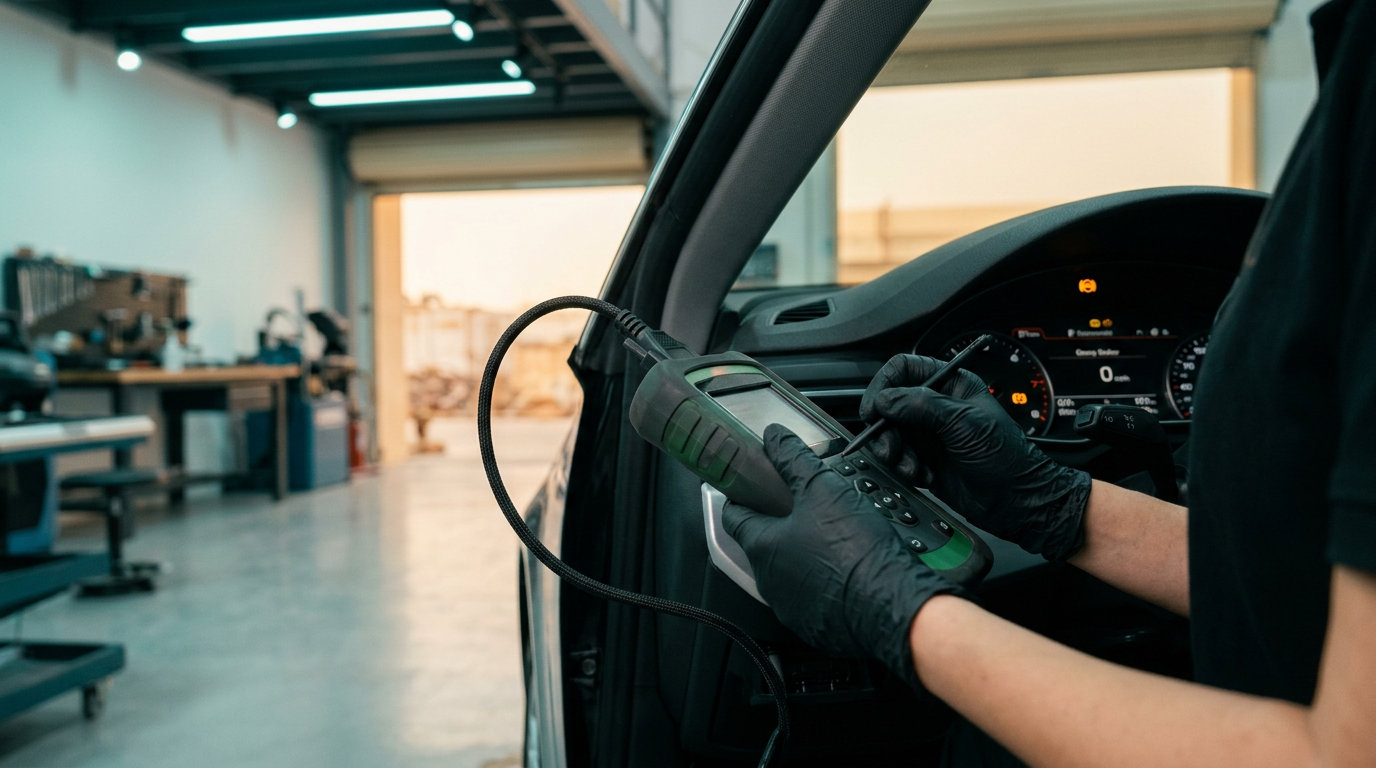
For vehicles requiring battery registration—most BMW, Audi, Mercedes-Benz, Porsche, and newer Volkswagen models—the coding process requires manufacturer-grade diagnostic equipment. Skipping this step leaves the charging system using the old battery's parameters, leading to chronic undercharging or overcharging.
Signs You Need a New Battery
Dubai heat accelerates battery failure, often with little warning. Watch for:
- Sluggish cranking, especially after the car has been parked in the sun
- Dimming interior lights when starting the engine
- Electrical glitches: flickering displays, hesitant power windows, erratic infotainment behaviour
- The battery warning light on your dashboard, though this often indicates alternator issues rather than battery failure
- Visible swelling or bulging of the battery case—a clear sign of internal damage from heat
- Age beyond 30 months in UAE conditions, even if the battery still works
Our article on diagnosing no-start conditions walks through testing procedures to isolate battery problems from starter or fuel system issues.
Deep Cycle Marine Batteries and Golf Cart Batteries
You'll see deep cycle marine batteries and golf cart batteries advertised alongside automotive batteries. These are designed for different discharge patterns: slow, sustained drain rather than short, high-current cranking bursts. A deep cycle battery has thicker plates optimised for repeated discharge to 50% capacity, which would destroy a standard car battery.
Don't use a deep cycle marine battery or golf cart batteries as a car battery replacement unless your vehicle is a dedicated off-road rig with a dual-battery system. The cranking performance will disappoint, and the charging profile won't match your alternator's output. Similarly, automotive batteries make poor choices for trolling motor or solar applications—wrong tool, wrong job.
Where to Buy and What to Check
Whether you shop online or in-store, verify:
- Manufacturing date: batteries degrade on the shelf in UAE heat; reject anything over six months old
- Warranty terms: reputable suppliers offer 12-24 month replacement warranties, but read the fine print on pro-rata versus full replacement
- Return policy: if the battery doesn't fit or your vehicle rejects it electronically, you need an exchange option
- Installation support: some online retailers deliver but don't install; factor in the cost and complexity of DIY installation on modern European cars
Our piece on DIY battery replacement covers the risks and requirements for vehicles with complex electronics.
Maintenance and Longevity
Even the best battery won't reach its rated lifespan without care. In Dubai:
- Park in shade whenever possible; every degree cooler extends battery life
- Drive regularly for at least 20 minutes to fully recharge after short trips
- Have electrical system health checks annually to catch parasitic drain before it kills your battery overnight
- Clean terminals every six months; corrosion builds faster in humidity and heat
- If storing a vehicle for extended periods, use a maintenance charger to prevent deep discharge
AGM automotive battery technology tolerates partial-state-of-charge better than flooded batteries, but it's not immune. A Ferrari or Lamborghini that sits for weeks between drives needs a smart charger to survive Dubai summers.
Choosing for EV and Hybrid Vehicles
Electric vehicles and plug-in hybrids still use a conventional 12-volt automotive battery to power accessories, computers, and the high-voltage system contactors. These auxiliary batteries are typically AGM or lithium and carry specific part numbers—generic replacements rarely work. Brands like Polestar, Volvo (plug-in hybrids), and Porsche Taycan require precise specifications and often coding after replacement. Our guide to EV maintenance covers the unique requirements of these systems.
Don't confuse the 12-volt auxiliary battery with the high-voltage traction battery. Replacing the traction battery is a major workshop procedure; replacing the 12-volt battery is routine maintenance, but it still demands attention to specifications and software.
Battery Replacement with Proper Coding in Al Quoz
JAD Garage in Al Quoz 4 stocks OEM-spec batteries for European and EV vehicles, with manufacturer-grade diagnostic tools for proper registration and coding. Call +971 56 355 6113 or visit Warehouse No.1, Street 8 Monday to Saturday, 09:00–19:00.
Frequently asked questions